Episode Details
Back to Episodes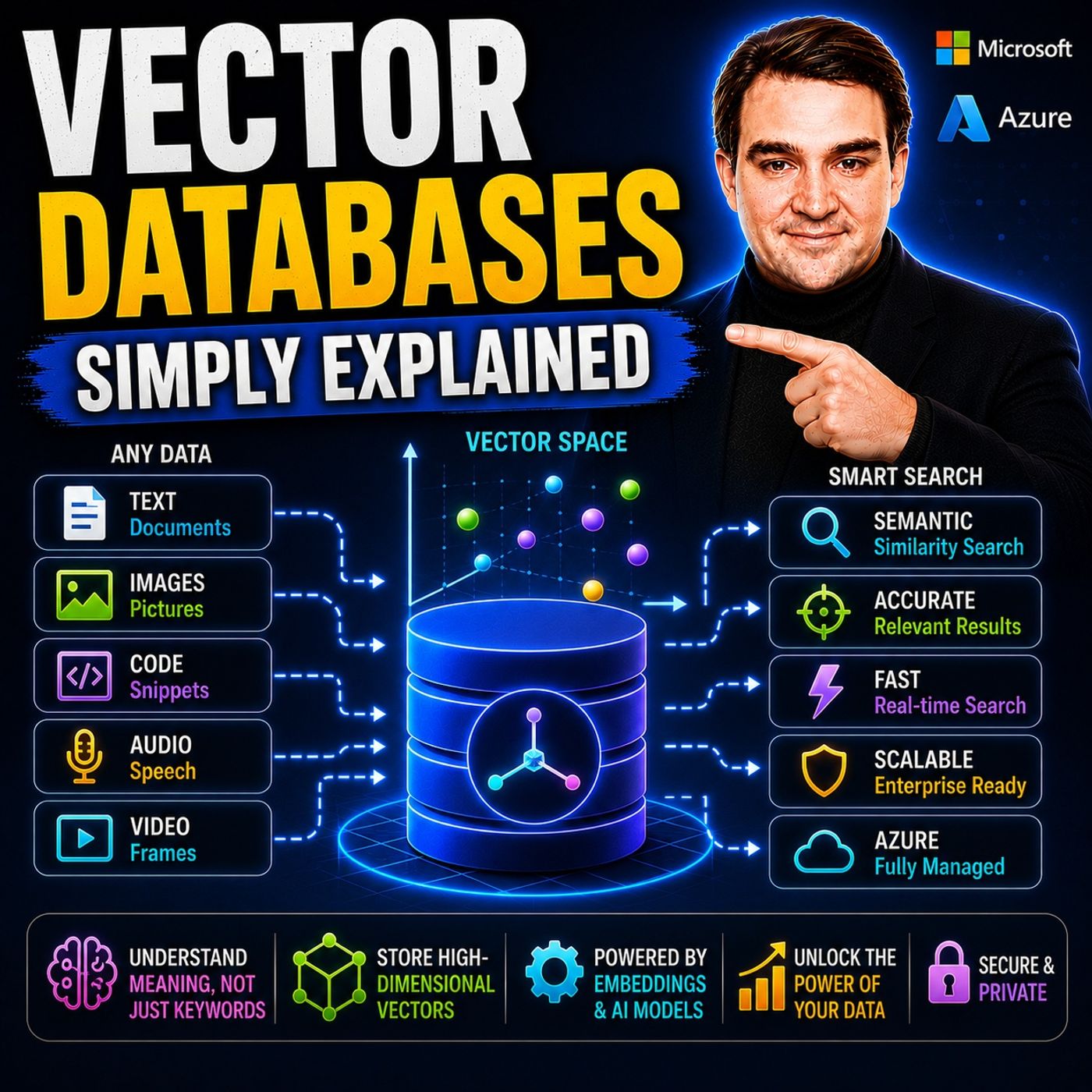
Vector Databases - Simply Explained
Season 3
Published 3 weeks, 2 days ago
Description
Large Language Models like GPT-4o, Microsoft Copilot, and ChatGPT are incredibly powerful, but they all depend on one critical technology that most people never hear about: vector databases. Traditional databases are excellent at storing structured information such as customer records, product prices, and inventory numbers, but they struggle to understand meaning. If you search for "red jacket," a traditional database won't necessarily find "crimson coat" because it only matches exact words. Vector databases solve this problem by storing mathematical representations of meaning instead of simple text. In this episode of Microsoft Knowledge Nuggets, we explain vector databases in simple terms and show why they have become the foundation of enterprise AI, semantic search, Retrieval-Augmented Generation (RAG), Microsoft Copilot, and modern Azure AI applications.
WHAT ARE VECTORS AND EMBEDDINGS?
Everything starts with a vector—a simple list of numbers that represents an object in a way computers can understand. While vectors may sound complicated, they're simply numerical descriptions of information. The real magic happens with embeddings, which are vectors generated by AI models that capture meaning instead of just words. Embedding models such as Azure OpenAI's text-embedding models analyze text, images, audio, or other content and place similar concepts close together in a high-dimensional vector space. That allows AI systems to understand that "car" and "automobile," or "red jacket" and "crimson coat," are closely related even though they use different words. Instead of performing keyword matching, AI performs similarity matching based on meaning, making search dramatically more intelligent.
WHY TRADITIONAL DATABASES AREN'T ENOUGH FOR AI
SQL databases excel at exact lookups, filtering, joins, and transactions, but they don't understand context or intent. They can tell you which products are exactly labeled "red," but they cannot determine whether another product is conceptually similar. Vector databases fill this gap by storing embeddings alongside metadata and organizing them for ultra-fast similarity search. Using advanced indexing algorithms such as HNSW and IVF, vector databases can search millions of vectors in milliseconds, allowing AI systems to retrieve the most relevant information almost instantly. Rather than replacing relational databases, vector databases complement them by adding semantic understanding to existing business data.
VECTOR DATABASES ACROSS THE MICROSOFT AZURE ECOSYSTEM
Microsoft has integrated vector search across its entire AI platform instead of requiring organizations to deploy separate specialist databases. Azure AI Search provides enterprise-grade vector search and hybrid search for Retrieval-Augmented Generation (RAG) applications. Azure Cosmos DB supports native vector indexing with DiskANN for low-latency operational workloads. SQL Server 2025 and Azure SQL Database now include native vector data types and similarity search functions, allowing organizations to combine relational data and AI-powered search in a single platform. Together with Azure OpenAI and Azure AI Foundry, these services enable developers to build intelligent copilots, AI assistants, recommendation engines, and enterprise search experiences using familiar Microsoft technologies.
REAL-WORLD USE CASES: RAG, COPILOT, RECOMMENDATIONS, AND SEMANTIC SEARCH
Vector databases power many of today's most impressive AI experiences. In Retrieval-Augmented Generation (RAG), enterprise documents are converted into embeddings so AI can retrieve relevant information before generating answers. Microsoft Copilot uses vector search to locate emails, Teams conversations, SharePoint files, and OneDrive documents that best match a user's question—even when the wording differs completely. Recommendation systems use vectors to match customers with products,
WHAT ARE VECTORS AND EMBEDDINGS?
Everything starts with a vector—a simple list of numbers that represents an object in a way computers can understand. While vectors may sound complicated, they're simply numerical descriptions of information. The real magic happens with embeddings, which are vectors generated by AI models that capture meaning instead of just words. Embedding models such as Azure OpenAI's text-embedding models analyze text, images, audio, or other content and place similar concepts close together in a high-dimensional vector space. That allows AI systems to understand that "car" and "automobile," or "red jacket" and "crimson coat," are closely related even though they use different words. Instead of performing keyword matching, AI performs similarity matching based on meaning, making search dramatically more intelligent.
WHY TRADITIONAL DATABASES AREN'T ENOUGH FOR AI
SQL databases excel at exact lookups, filtering, joins, and transactions, but they don't understand context or intent. They can tell you which products are exactly labeled "red," but they cannot determine whether another product is conceptually similar. Vector databases fill this gap by storing embeddings alongside metadata and organizing them for ultra-fast similarity search. Using advanced indexing algorithms such as HNSW and IVF, vector databases can search millions of vectors in milliseconds, allowing AI systems to retrieve the most relevant information almost instantly. Rather than replacing relational databases, vector databases complement them by adding semantic understanding to existing business data.
VECTOR DATABASES ACROSS THE MICROSOFT AZURE ECOSYSTEM
Microsoft has integrated vector search across its entire AI platform instead of requiring organizations to deploy separate specialist databases. Azure AI Search provides enterprise-grade vector search and hybrid search for Retrieval-Augmented Generation (RAG) applications. Azure Cosmos DB supports native vector indexing with DiskANN for low-latency operational workloads. SQL Server 2025 and Azure SQL Database now include native vector data types and similarity search functions, allowing organizations to combine relational data and AI-powered search in a single platform. Together with Azure OpenAI and Azure AI Foundry, these services enable developers to build intelligent copilots, AI assistants, recommendation engines, and enterprise search experiences using familiar Microsoft technologies.
REAL-WORLD USE CASES: RAG, COPILOT, RECOMMENDATIONS, AND SEMANTIC SEARCH
Vector databases power many of today's most impressive AI experiences. In Retrieval-Augmented Generation (RAG), enterprise documents are converted into embeddings so AI can retrieve relevant information before generating answers. Microsoft Copilot uses vector search to locate emails, Teams conversations, SharePoint files, and OneDrive documents that best match a user's question—even when the wording differs completely. Recommendation systems use vectors to match customers with products,