Episode Details
Back to Episodes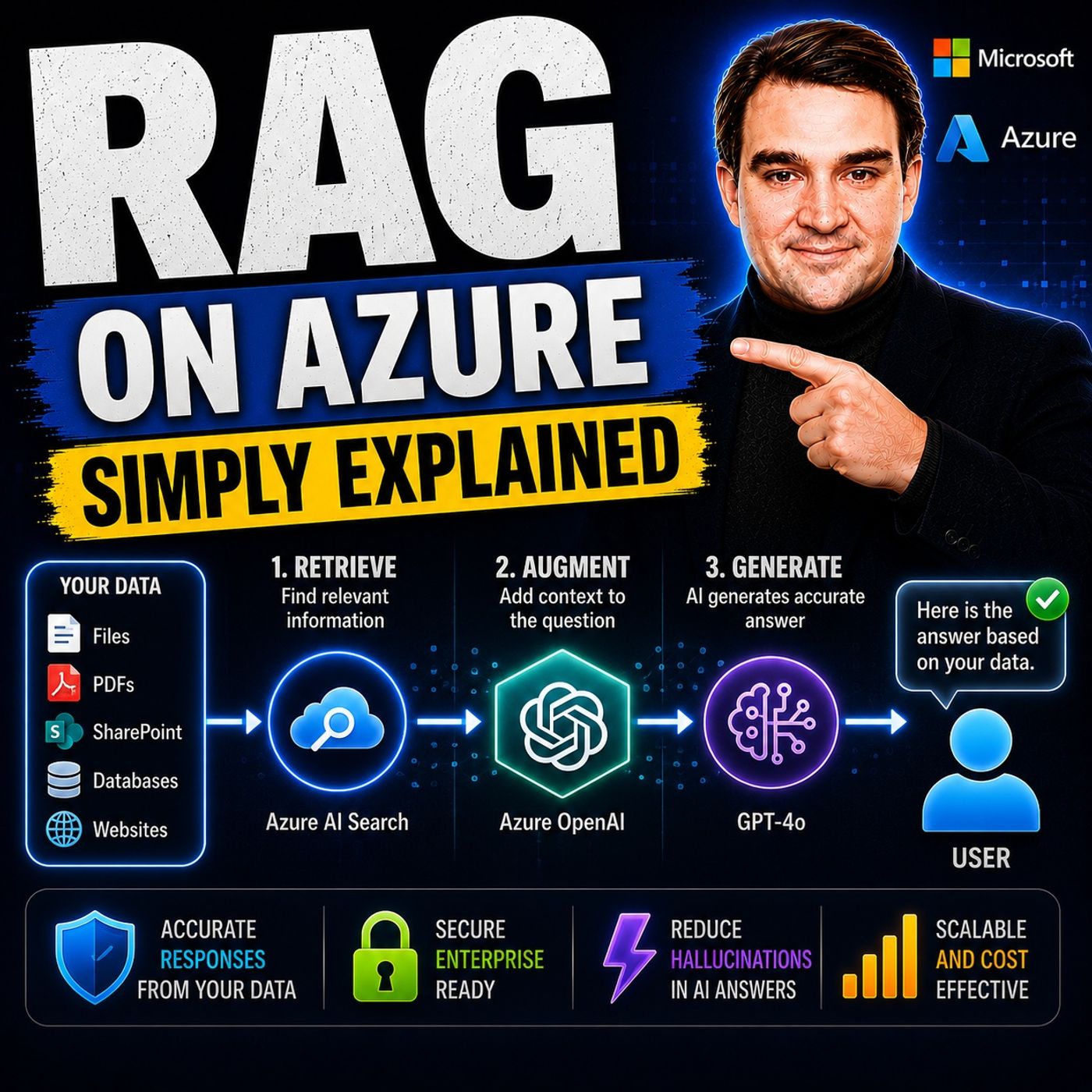
RAG on Azure — Simply Explained
Season 3
Published 3 weeks, 2 days ago
Description
Large Language Models like GPT-4o are incredibly powerful, but they have two major limitations. First, their knowledge is frozen in time, meaning they don't automatically know about recent events, changing regulations, or newly created documents. Second, they have no built-in knowledge of your organization's private data, including internal documentation, policies, product manuals, customer information, or business processes. Without additional context, AI models are forced to guess, increasing the risk of inaccurate or hallucinated answers. In this episode of Microsoft Knowledge Nuggets, we explain Retrieval-Augmented Generation (RAG) in simple terms and show how Azure combines Azure AI Search, Azure OpenAI, and Azure AI Foundry to build AI applications that answer questions using your own trusted data instead of relying solely on model memory.
WHY RETRIEVAL-AUGMENTED GENERATION SOLVES THE BIGGEST AI CHALLENGE
Rather than retraining or fine-tuning a language model every time your business information changes, RAG follows a much smarter approach. Before generating an answer, it first retrieves the most relevant information from your documents, databases, SharePoint sites, PDFs, websites, or other enterprise knowledge sources. That information is then added to the user's question before being sent to the language model. The AI generates its response based on the retrieved context instead of relying purely on its training data. This approach dramatically improves accuracy, reduces hallucinations, keeps information current, and ensures sensitive enterprise data never becomes part of the model itself.
VECTOR EMBEDDINGS, SEMANTIC SEARCH, AND AZURE AI SEARCH
One of the most important concepts behind RAG is semantic search. Instead of searching for exact keywords, Azure AI Search converts documents and user questions into vector embeddings—mathematical representations of meaning. This allows the search engine to understand concepts rather than simply matching words. For example, a search for "budget hotels" can successfully find documents discussing "affordable accommodation" because their meanings are closely related. We explain how Azure AI Search indexes enterprise data, creates vector embeddings using embedding models, performs hybrid search, applies semantic ranking, and retrieves the most relevant content within milliseconds before passing it to the language model.
HOW AZURE OPENAI AND AZURE AI FOUNDRY POWER RAG APPLICATIONS
Once Azure AI Search retrieves the relevant knowledge, Azure OpenAI uses models like GPT-4o or GPT-4.1 to generate a natural language response based entirely on the supplied context. Azure AI Foundry then acts as the orchestration layer that connects models, prompts, enterprise knowledge, tools, and deployment into one unified AI development platform. This episode explains how developers create Foundry projects, connect Azure AI Search indexes, configure system prompts, deploy AI agents, and build production-ready RAG solutions without manually wiring together multiple Azure services. Together, Azure AI Search, Azure OpenAI, and Azure AI Foundry provide a complete enterprise architecture for building secure, scalable, and trustworthy generative AI applications.
CLASSIC RAG VS AGENTIC RAG
Not every AI application retrieves information in the same way. We compare Classic RAG, where a single search retrieves relevant documents before generating an answer, with the newer Agentic RAG approach, where AI agents can perform multiple searches, combine information from different sources, reason across datasets, and dynamically decide which knowledge to retrieve. While Classic RAG delivers fast, predictable responses for straightforward question-and-answer scenarios, Agentic RAG offers significantly higher accuracy for complex, multi-step business questions by allowing AI agents to intelligently orchestrate retrieval before
WHY RETRIEVAL-AUGMENTED GENERATION SOLVES THE BIGGEST AI CHALLENGE
Rather than retraining or fine-tuning a language model every time your business information changes, RAG follows a much smarter approach. Before generating an answer, it first retrieves the most relevant information from your documents, databases, SharePoint sites, PDFs, websites, or other enterprise knowledge sources. That information is then added to the user's question before being sent to the language model. The AI generates its response based on the retrieved context instead of relying purely on its training data. This approach dramatically improves accuracy, reduces hallucinations, keeps information current, and ensures sensitive enterprise data never becomes part of the model itself.
VECTOR EMBEDDINGS, SEMANTIC SEARCH, AND AZURE AI SEARCH
One of the most important concepts behind RAG is semantic search. Instead of searching for exact keywords, Azure AI Search converts documents and user questions into vector embeddings—mathematical representations of meaning. This allows the search engine to understand concepts rather than simply matching words. For example, a search for "budget hotels" can successfully find documents discussing "affordable accommodation" because their meanings are closely related. We explain how Azure AI Search indexes enterprise data, creates vector embeddings using embedding models, performs hybrid search, applies semantic ranking, and retrieves the most relevant content within milliseconds before passing it to the language model.
HOW AZURE OPENAI AND AZURE AI FOUNDRY POWER RAG APPLICATIONS
Once Azure AI Search retrieves the relevant knowledge, Azure OpenAI uses models like GPT-4o or GPT-4.1 to generate a natural language response based entirely on the supplied context. Azure AI Foundry then acts as the orchestration layer that connects models, prompts, enterprise knowledge, tools, and deployment into one unified AI development platform. This episode explains how developers create Foundry projects, connect Azure AI Search indexes, configure system prompts, deploy AI agents, and build production-ready RAG solutions without manually wiring together multiple Azure services. Together, Azure AI Search, Azure OpenAI, and Azure AI Foundry provide a complete enterprise architecture for building secure, scalable, and trustworthy generative AI applications.
CLASSIC RAG VS AGENTIC RAG
Not every AI application retrieves information in the same way. We compare Classic RAG, where a single search retrieves relevant documents before generating an answer, with the newer Agentic RAG approach, where AI agents can perform multiple searches, combine information from different sources, reason across datasets, and dynamically decide which knowledge to retrieve. While Classic RAG delivers fast, predictable responses for straightforward question-and-answer scenarios, Agentic RAG offers significantly higher accuracy for complex, multi-step business questions by allowing AI agents to intelligently orchestrate retrieval before