Episode Details
Back to Episodes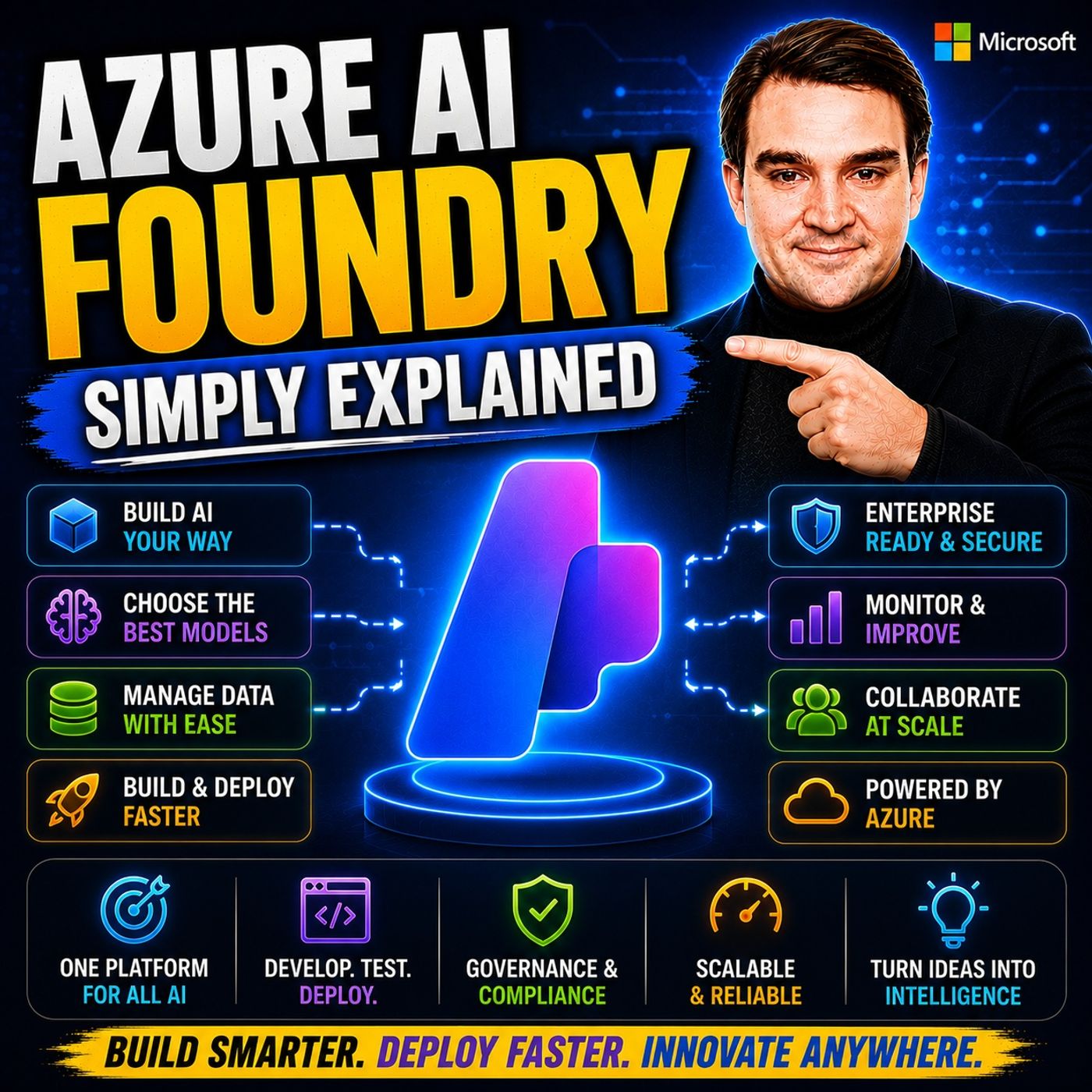
Azure AI Foundry - Simply Explained
Season 3
Published 3 weeks, 2 days ago
Description
Artificial Intelligence is evolving faster than almost any other technology, and with new models, frameworks, and AI services appearing almost every month, it's becoming increasingly difficult to know where to start. Microsoft has also renamed and expanded its AI platform several times—from Cognitive Services to Azure AI Services, Azure AI Studio, Azure AI Foundry, and now Microsoft Foundry—leaving many developers unsure what the platform actually does. In this episode of Microsoft Knowledge Nuggets, we explain Azure AI Foundry in simple terms and show how Microsoft's unified AI development platform brings together foundation models, AI agents, development tools, evaluation, security, and deployment into one enterprise-ready environment. Whether you're building AI copilots, autonomous agents, chatbots, or custom AI applications, Azure AI Foundry provides everything you need from development to production.
WHY AZURE AI FOUNDRY CHANGES HOW AI APPLICATIONS ARE BUILT
Before Azure AI Foundry, developers often had to provision Azure OpenAI, Azure AI Search, Azure Machine Learning, storage accounts, Key Vault, monitoring services, and networking individually before writing a single line of application code. Azure AI Foundry removes that complexity by providing a single, unified development platform where models, security, projects, evaluation tools, agent frameworks, and deployment services are already integrated. Instead of spending days configuring infrastructure, developers can immediately focus on building intelligent applications while Azure manages the underlying platform. We also explain the difference between the older hub-based architecture and the modern Foundry Project model, and why Microsoft recommends using the new project-based experience for all new AI solutions.
FOUNDRY PROJECTS, MODEL CATALOG, AND ENTERPRISE AI DEVELOPMENT
At the center of Azure AI Foundry are Foundry Projects—isolated workspaces that organize every AI solution independently while sharing centralized governance, billing, and security. Each project contains its own model deployments, AI agents, knowledge sources, evaluations, monitoring, and collaboration tools. We also explore the massive Model Catalog, which includes OpenAI models like GPT-4o and GPT-4.1, Microsoft's Phi family, Meta Llama, Mistral, DeepSeek, Claude, Cohere, and thousands of additional foundation models. You'll learn how developers can compare models based on quality, latency, cost, safety, and performance before deploying the best model for each specific business scenario.
BUILDING AI AGENTS WITH TOOLS, KNOWLEDGE, MEMORY, AND PLAYGROUNDS
One of Azure AI Foundry's most powerful capabilities is AI Agent development. This episode explains how developers create intelligent agents by combining five core building blocks: instructions that define behavior, foundation models that provide reasoning, tools such as web search and code interpreter, enterprise knowledge stored through Azure AI Search, and memory that allows conversations to continue across sessions. You'll also discover the Agent Playground, where developers can visually build, test, evaluate, and troubleshoot agents before deploying them through APIs or integrating them directly into Microsoft Teams and custom applications. Rather than simply creating chatbots, Azure AI Foundry enables developers to build AI systems that can reason, retrieve information, perform actions, and automate complex business workflows.
ENTERPRISE SECURITY, AZURE INTEGRATION, AND SCALABLE AI DEPLOYMENT
Azure AI Foundry is designed for enterprise production environments rather than experimental AI projects. We explain how it integrates with Microsoft Entra ID, Azure Key Vault, Azure Storage, Azure AI Search, managed identities, role-based access control (RBAC), private networking, monitoring, and built-in Content Safety services. The Foundry Agent Service aut
WHY AZURE AI FOUNDRY CHANGES HOW AI APPLICATIONS ARE BUILT
Before Azure AI Foundry, developers often had to provision Azure OpenAI, Azure AI Search, Azure Machine Learning, storage accounts, Key Vault, monitoring services, and networking individually before writing a single line of application code. Azure AI Foundry removes that complexity by providing a single, unified development platform where models, security, projects, evaluation tools, agent frameworks, and deployment services are already integrated. Instead of spending days configuring infrastructure, developers can immediately focus on building intelligent applications while Azure manages the underlying platform. We also explain the difference between the older hub-based architecture and the modern Foundry Project model, and why Microsoft recommends using the new project-based experience for all new AI solutions.
FOUNDRY PROJECTS, MODEL CATALOG, AND ENTERPRISE AI DEVELOPMENT
At the center of Azure AI Foundry are Foundry Projects—isolated workspaces that organize every AI solution independently while sharing centralized governance, billing, and security. Each project contains its own model deployments, AI agents, knowledge sources, evaluations, monitoring, and collaboration tools. We also explore the massive Model Catalog, which includes OpenAI models like GPT-4o and GPT-4.1, Microsoft's Phi family, Meta Llama, Mistral, DeepSeek, Claude, Cohere, and thousands of additional foundation models. You'll learn how developers can compare models based on quality, latency, cost, safety, and performance before deploying the best model for each specific business scenario.
BUILDING AI AGENTS WITH TOOLS, KNOWLEDGE, MEMORY, AND PLAYGROUNDS
One of Azure AI Foundry's most powerful capabilities is AI Agent development. This episode explains how developers create intelligent agents by combining five core building blocks: instructions that define behavior, foundation models that provide reasoning, tools such as web search and code interpreter, enterprise knowledge stored through Azure AI Search, and memory that allows conversations to continue across sessions. You'll also discover the Agent Playground, where developers can visually build, test, evaluate, and troubleshoot agents before deploying them through APIs or integrating them directly into Microsoft Teams and custom applications. Rather than simply creating chatbots, Azure AI Foundry enables developers to build AI systems that can reason, retrieve information, perform actions, and automate complex business workflows.
ENTERPRISE SECURITY, AZURE INTEGRATION, AND SCALABLE AI DEPLOYMENT
Azure AI Foundry is designed for enterprise production environments rather than experimental AI projects. We explain how it integrates with Microsoft Entra ID, Azure Key Vault, Azure Storage, Azure AI Search, managed identities, role-based access control (RBAC), private networking, monitoring, and built-in Content Safety services. The Foundry Agent Service aut