Episode Details
Back to Episodes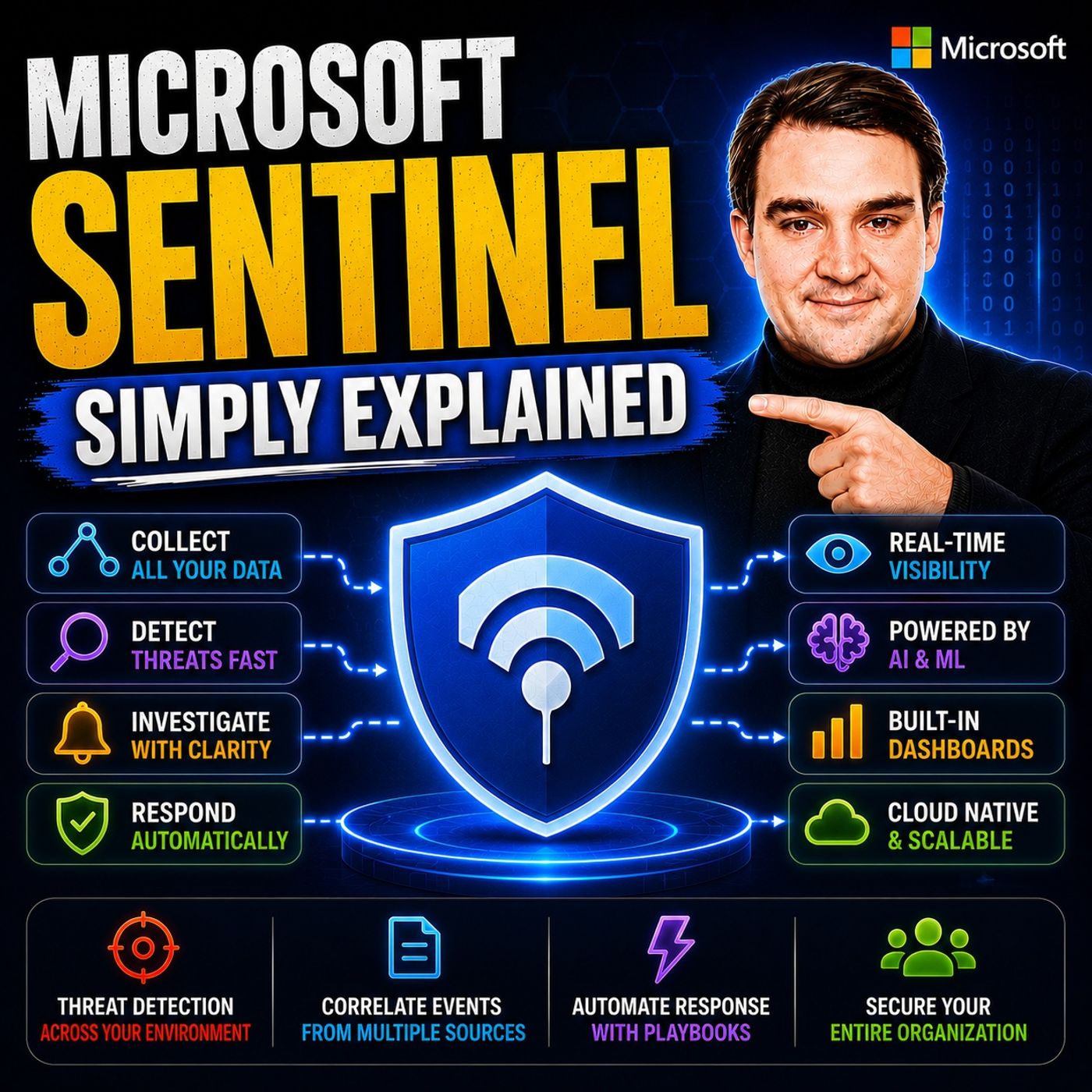
Microsoft Sentinel - Simply Explained
Season 3
Published 3 weeks, 3 days ago
Description
Modern cyberattacks rarely happen in a single moment. Attackers often move slowly, testing identities, exploring systems, downloading data, and establishing persistence over days, weeks, or even months. The challenge for Microsoft 365 administrators is that security information is often scattered across Microsoft Entra ID, Exchange Online, SharePoint, Microsoft Defender, Teams, Azure, and countless other systems. Investigating a single incident can require jumping between multiple portals while trying to piece together what actually happened. In this episode of Microsoft Knowledge Nuggets, we explain Microsoft Sentinel in simple terms and show how Microsoft's cloud-native SIEM and SOAR platform brings all your security signals together into one intelligent security operations center. Instead of searching through isolated logs, Sentinel helps you connect the dots, identify threats faster, and automate your response before attackers can cause serious damage.
WHAT A SIEM AND SOAR ACTUALLY DO
Microsoft Sentinel combines two essential security technologies: Security Information and Event Management (SIEM) and Security Orchestration, Automation, and Response (SOAR). A SIEM collects security logs from Microsoft Entra ID, Exchange Online, SharePoint, Defender, Azure, firewalls, servers, and third-party platforms before correlating millions of events to identify suspicious patterns that individual systems would never detect on their own. SOAR extends this capability by automatically responding to incidents using Playbooks that can disable compromised accounts, block malicious IP addresses, revoke active sessions, isolate devices, and notify security teams without waiting for manual intervention. Together, SIEM and SOAR transform Microsoft Sentinel from a monitoring solution into an intelligent security platform capable of detecting, investigating, and responding to attacks in real time.
HOW MICROSOFT SENTINEL FITS INTO THE MICROSOFT SECURITY ECOSYSTEM
Microsoft Sentinel doesn't replace Microsoft Defender, Microsoft Entra, Microsoft Purview, or Microsoft Intune—it connects them. Each Microsoft security solution specializes in protecting identities, endpoints, devices, applications, or data, while Sentinel acts as the central intelligence layer that correlates signals across every security product. We also discuss Microsoft's ongoing transition toward a unified security experience, where Microsoft Sentinel is becoming fully integrated into the Microsoft Defender portal. This consolidation reduces operational complexity by allowing security teams and Microsoft 365 administrators to investigate incidents, hunt threats, and manage security operations from one centralized interface instead of switching between multiple portals.
THE UNIFIED DATA LAKE AND LONG-TERM THREAT HUNTING
One of the biggest recent innovations in Microsoft Sentinel is the Unified Data Lake. Traditional SIEM platforms often forced organizations to choose between affordable storage and long-term visibility because storing years of security logs became prohibitively expensive. Sentinel's Data Lake separates storage from analytics, allowing organizations to retain security data for years at dramatically lower cost while only paying for compute resources when running investigations. Combined with Kusto Query Language (KQL), security teams can hunt for long-term attack patterns, identify slow-moving threats, investigate historical incidents, and correlate years of security telemetry that would otherwise have been deleted under traditional retention models.
AI, SECURITY COPILOT, AND THE FUTURE OF SECURITY OPERATIONS
Microsoft Sentinel continues to evolve with AI-powered capabilities including Microsoft Security Copilot, Sentinel Graph, and Model Context Protocol (MCP) integration. Security Copilot allows administrators to investigate incidents using natural language instead of wr
WHAT A SIEM AND SOAR ACTUALLY DO
Microsoft Sentinel combines two essential security technologies: Security Information and Event Management (SIEM) and Security Orchestration, Automation, and Response (SOAR). A SIEM collects security logs from Microsoft Entra ID, Exchange Online, SharePoint, Defender, Azure, firewalls, servers, and third-party platforms before correlating millions of events to identify suspicious patterns that individual systems would never detect on their own. SOAR extends this capability by automatically responding to incidents using Playbooks that can disable compromised accounts, block malicious IP addresses, revoke active sessions, isolate devices, and notify security teams without waiting for manual intervention. Together, SIEM and SOAR transform Microsoft Sentinel from a monitoring solution into an intelligent security platform capable of detecting, investigating, and responding to attacks in real time.
HOW MICROSOFT SENTINEL FITS INTO THE MICROSOFT SECURITY ECOSYSTEM
Microsoft Sentinel doesn't replace Microsoft Defender, Microsoft Entra, Microsoft Purview, or Microsoft Intune—it connects them. Each Microsoft security solution specializes in protecting identities, endpoints, devices, applications, or data, while Sentinel acts as the central intelligence layer that correlates signals across every security product. We also discuss Microsoft's ongoing transition toward a unified security experience, where Microsoft Sentinel is becoming fully integrated into the Microsoft Defender portal. This consolidation reduces operational complexity by allowing security teams and Microsoft 365 administrators to investigate incidents, hunt threats, and manage security operations from one centralized interface instead of switching between multiple portals.
THE UNIFIED DATA LAKE AND LONG-TERM THREAT HUNTING
One of the biggest recent innovations in Microsoft Sentinel is the Unified Data Lake. Traditional SIEM platforms often forced organizations to choose between affordable storage and long-term visibility because storing years of security logs became prohibitively expensive. Sentinel's Data Lake separates storage from analytics, allowing organizations to retain security data for years at dramatically lower cost while only paying for compute resources when running investigations. Combined with Kusto Query Language (KQL), security teams can hunt for long-term attack patterns, identify slow-moving threats, investigate historical incidents, and correlate years of security telemetry that would otherwise have been deleted under traditional retention models.
AI, SECURITY COPILOT, AND THE FUTURE OF SECURITY OPERATIONS
Microsoft Sentinel continues to evolve with AI-powered capabilities including Microsoft Security Copilot, Sentinel Graph, and Model Context Protocol (MCP) integration. Security Copilot allows administrators to investigate incidents using natural language instead of wr