Episode Details
Back to Episodes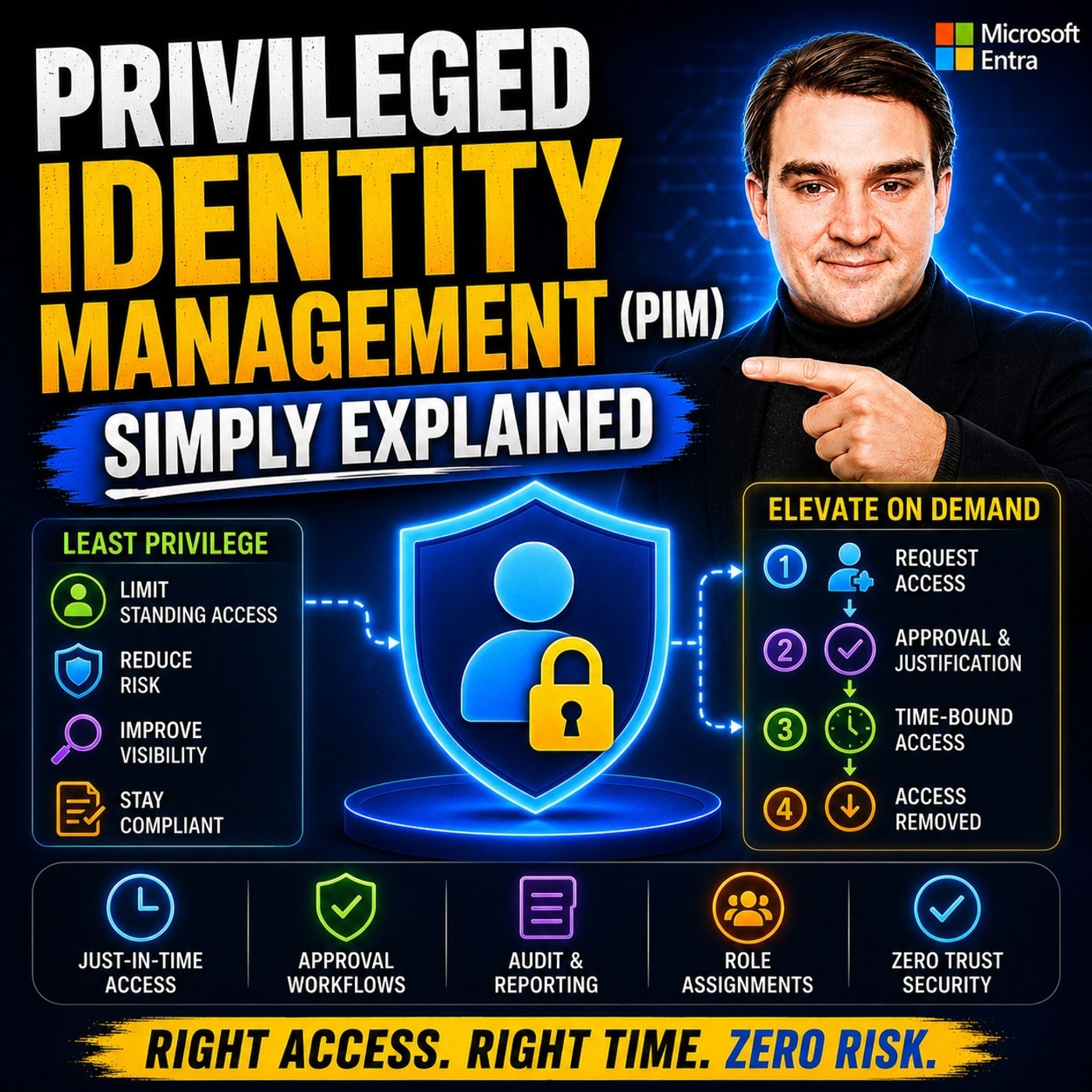
Privileged Identity Management (PIM) - Simply Explained
Published 3 weeks, 3 days ago
Description
Administrator accounts are among the most valuable targets for cybercriminals. If an attacker compromises a Global Administrator or another privileged account, they can potentially reset passwords, access sensitive data, modify security settings, or even take complete control of your Microsoft 365 tenant. The biggest problem isn't that administrators have elevated permissions—it's that many organizations grant those permissions permanently. In this episode of Microsoft Knowledge Nuggets, we explain Microsoft Entra Privileged Identity Management (PIM) in simple terms and show how Just-in-Time (JIT) administration dramatically reduces your attack surface by providing privileged access only when it's actually needed. Instead of leaving powerful accounts permanently active, PIM transforms administrator roles into temporary, time-limited privileges with full auditing and approval workflows.
WHY STANDING PRIVILEGES ARE ONE OF THE BIGGEST SECURITY RISKS
Most administrators only perform privileged tasks for a few minutes each week, yet many organizations leave administrator permissions active 24 hours a day, seven days a week. These standing privileges create a massive security risk because attackers only need to compromise one privileged account to gain unrestricted access to your environment. Through phishing attacks, credential theft, malware, or stolen devices, permanent administrator accounts become valuable targets that remain exposed even when they're not being used. Microsoft Entra PIM eliminates this unnecessary exposure by ensuring privileged permissions exist only during approved maintenance windows instead of remaining active indefinitely.
HOW MICROSOFT ENTRA PIM AND JUST-IN-TIME ACCESS WORK
At the heart of PIM is the concept of Eligible versus Active role assignments. Instead of permanently assigning administrator roles, users become eligible to activate them when required. During activation, administrators can be required to complete multi-factor authentication, provide business justification, obtain manager or security approval, and request access for a limited duration. Once approved, the privileged role becomes active only for the specified time before automatically expiring. This Just-in-Time access model significantly reduces standing privileges while maintaining administrator productivity and complete operational flexibility.
PIM FOR ENTRA ROLES, GROUPS, AND AZURE RESOURCES
This episode explores how Privileged Identity Management extends far beyond Microsoft Entra administrator roles. You'll learn how PIM secures Microsoft 365 Groups, Security Groups, Azure subscriptions, Resource Groups, and Azure RBAC roles using the same activation workflow. Whether administrators need temporary Global Administrator permissions, developers require Contributor access to production Azure subscriptions, or project teams need short-term access to sensitive SharePoint sites, PIM ensures privileged permissions are granted only when required and automatically removed afterward. We also explain activation workflows, approval processes, time-limited assignments, audit logging, and role expiration to help organizations build a secure Zero Trust identity strategy.
SECURITY BENEFITS, AUDITING, AND BEST PRACTICES
Microsoft Entra PIM delivers far more than temporary administrator access. Every activation is fully logged with timestamps, justifications, approval history, and activation duration, creating comprehensive audit trails for compliance and security investigations. Combined with Access Reviews, Conditional Access, phishing-resistant MFA, and Identity Secure Score recommendations, PIM becomes a critical building block for modern identity governance. We also discuss common implementation mistakes such as leaving too many permanent administrators, using excessive activation durations, failing to require MFA during activation, and neglecting
WHY STANDING PRIVILEGES ARE ONE OF THE BIGGEST SECURITY RISKS
Most administrators only perform privileged tasks for a few minutes each week, yet many organizations leave administrator permissions active 24 hours a day, seven days a week. These standing privileges create a massive security risk because attackers only need to compromise one privileged account to gain unrestricted access to your environment. Through phishing attacks, credential theft, malware, or stolen devices, permanent administrator accounts become valuable targets that remain exposed even when they're not being used. Microsoft Entra PIM eliminates this unnecessary exposure by ensuring privileged permissions exist only during approved maintenance windows instead of remaining active indefinitely.
HOW MICROSOFT ENTRA PIM AND JUST-IN-TIME ACCESS WORK
At the heart of PIM is the concept of Eligible versus Active role assignments. Instead of permanently assigning administrator roles, users become eligible to activate them when required. During activation, administrators can be required to complete multi-factor authentication, provide business justification, obtain manager or security approval, and request access for a limited duration. Once approved, the privileged role becomes active only for the specified time before automatically expiring. This Just-in-Time access model significantly reduces standing privileges while maintaining administrator productivity and complete operational flexibility.
PIM FOR ENTRA ROLES, GROUPS, AND AZURE RESOURCES
This episode explores how Privileged Identity Management extends far beyond Microsoft Entra administrator roles. You'll learn how PIM secures Microsoft 365 Groups, Security Groups, Azure subscriptions, Resource Groups, and Azure RBAC roles using the same activation workflow. Whether administrators need temporary Global Administrator permissions, developers require Contributor access to production Azure subscriptions, or project teams need short-term access to sensitive SharePoint sites, PIM ensures privileged permissions are granted only when required and automatically removed afterward. We also explain activation workflows, approval processes, time-limited assignments, audit logging, and role expiration to help organizations build a secure Zero Trust identity strategy.
SECURITY BENEFITS, AUDITING, AND BEST PRACTICES
Microsoft Entra PIM delivers far more than temporary administrator access. Every activation is fully logged with timestamps, justifications, approval history, and activation duration, creating comprehensive audit trails for compliance and security investigations. Combined with Access Reviews, Conditional Access, phishing-resistant MFA, and Identity Secure Score recommendations, PIM becomes a critical building block for modern identity governance. We also discuss common implementation mistakes such as leaving too many permanent administrators, using excessive activation durations, failing to require MFA during activation, and neglecting