Episode Details
Back to Episodes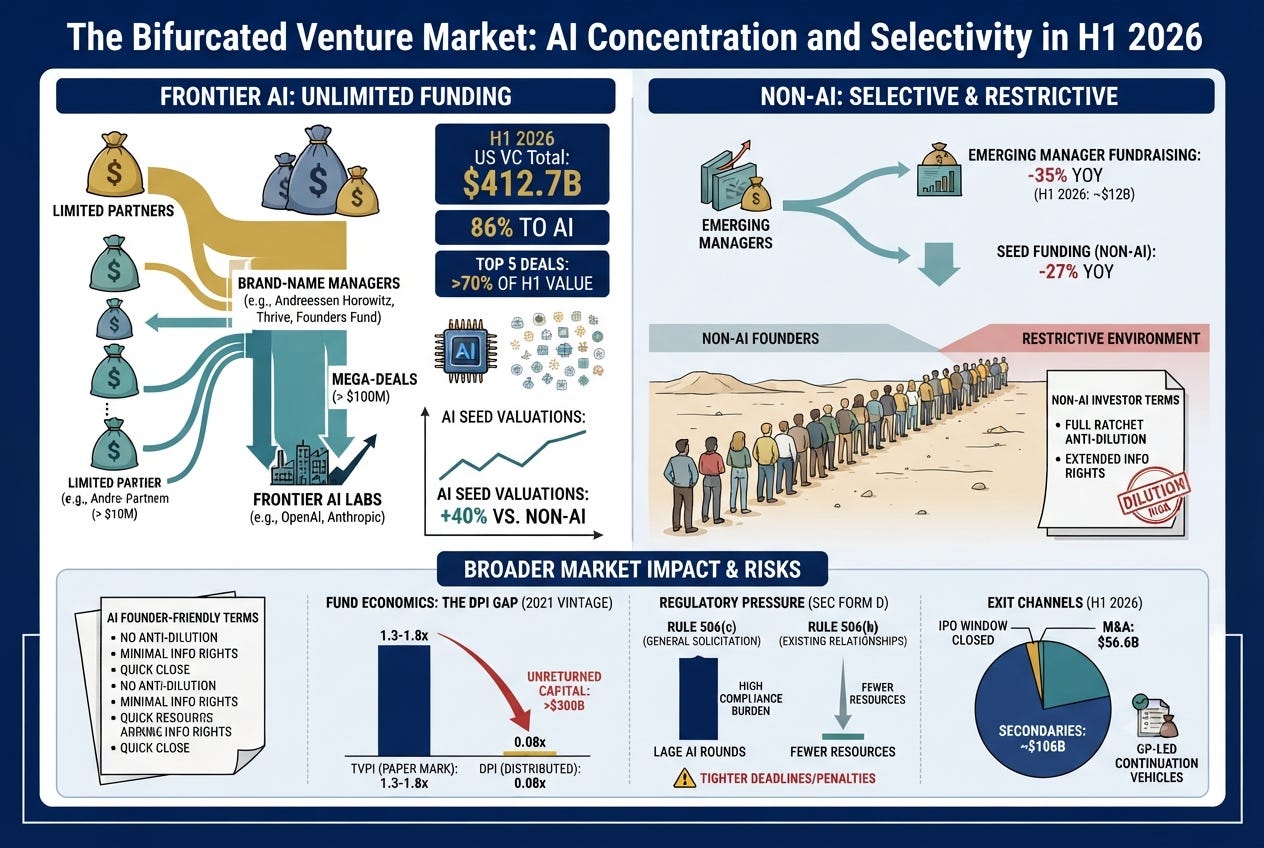
US Venture Funding Hit $412.7 Billion
Description
US venture capital funding hit $412.7 billion in the first half of 2026, surpassing all of 2025, and 86 percent of that capital went to artificial intelligence companies alone. Three venture firms captured just under half of all new fund commitments in the same period. Seed funding for companies outside artificial intelligence fell 27 percent year over year. The venture market did not simply grow in 2026. It split into two markets that share a name and almost nothing else.
This Substack is reader-supported. To receive new posts and support my work, consider becoming a free or paid subscriber.
The joint venture capital industry report covering the second quarter of 2026 is the closest thing this asset class has to an audited scoreboard, and this edition shows a market unrecognizable from three years earlier. Total dollars deployed are at a record. The number of distinct companies receiving meaningful capital, and the number of funds able to raise a next vintage, are both near multi year lows. Both facts are true in the same six months, in the same asset class, among many of the same investors.
Why AI Rounds Close Faster Than Everyone Else’s
Megadeals of $100 million or more captured 87.5 percent of total dollars deployed in the first half of the year, a threshold once reserved for late stage growth rounds and now common at seed and Series A for frontier AI labs. Two companies, OpenAI and Anthropic, accounted for 43 percent of global startup funding on their own, according to industry tracking published in the second quarter of 2026. The five largest US financings of the first half accounted for close to $200 billion, pushing the combined share of total venture deal value captured by the top five transactions past 70 percent. The mechanism behind this concentration reflects the underlying cost structure of frontier model development: training a frontier model requires computing capacity, specialized talent, and energy contracts priced in the billions of dollars, and the venture firms able to write financings of that size are the same firms whose brand names now draw the overwhelming share of new limited partner capital.
The redlines crossing my desk this past quarter illustrate the divide better than the aggregate figures do. AI seed and Series A term sheets for companies with a credible model or compute story routinely omit the full ratchet anti-dilution provisions and extended information rights that non-AI founders are now asked to accept as standard. Two founders raising identical dollar amounts at the same stage can end up ceding different percentages of their company depending on whether their product centers on a foundation model or an application built on top of one.
What Happened to Seed Funding Outside AI
Emerging manager fundraising, the source of most $500,000 to $5 million checks written into non-AI companies at seed stage, fell 35 percent year over year to approximately $12 billion in the first half of 2026, the lowest level since 2020. Seed valuations for AI companies now run roughly 40 percent above non-AI peers at the same stage, according to cap table data published in mid-2026. Non-AI founders are financing on a longer, more uncertain clock: rounds take longer to close, diligence runs deeper, and the investor base willing to lead a first check has narrowed.
With the initial public offering window largely closed through mid-2026 and merger and acquisition activity absorbing only $56.6 billion in the first quarter, secondary market transactions of approximately $106 billion have become a primary liquidity channel for venture-backed companies and their investors. General partner-led continuation vehicles, in which a fund manager transfers one or more portfolio companies into a newly formed vehicle backed by new secondary buyers, now give limited partners in older funds an exit option without waiting on a public listing or acquisition that may not a