Episode Details
Back to Episodes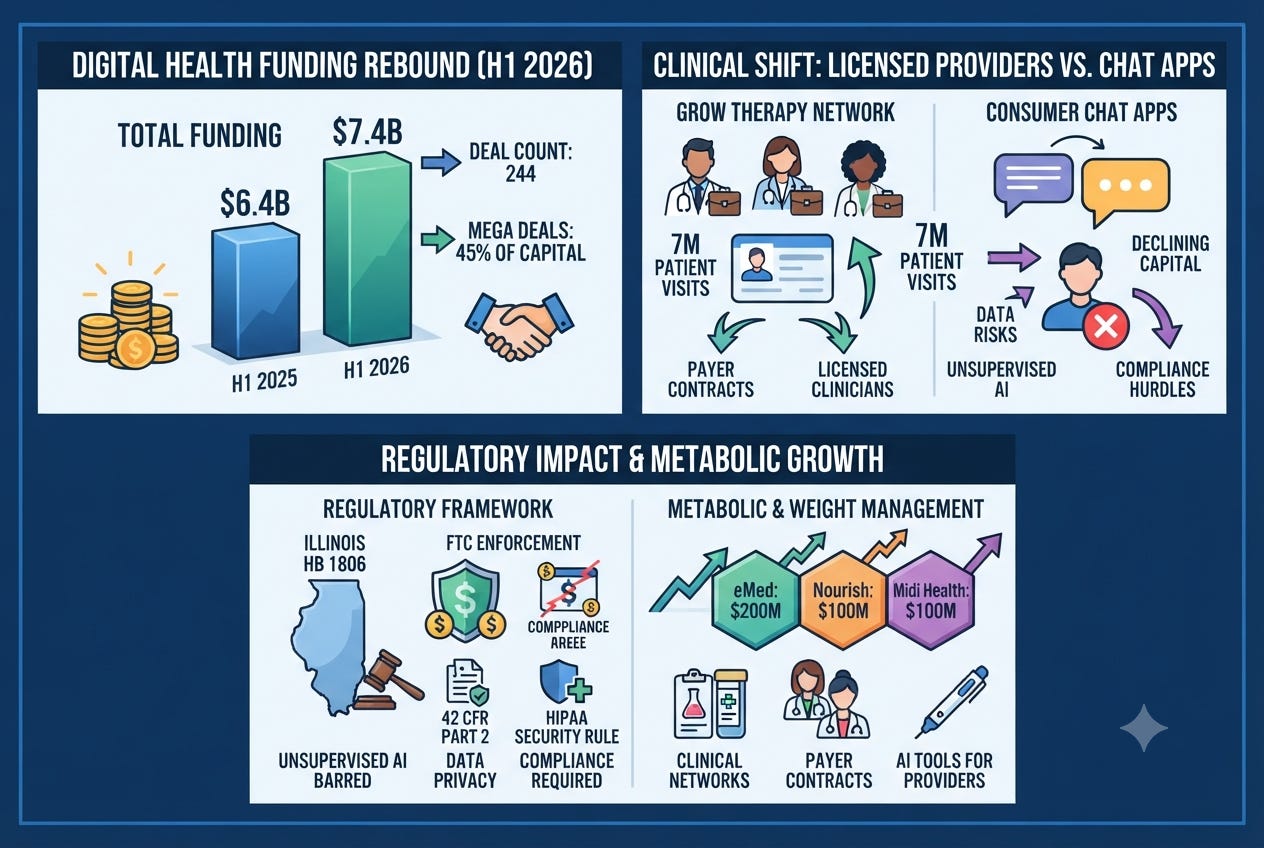
Digital Health Funding Reaches $7.4 Billion in H1 2026
Description
Digital Health Funding Rebound Reaches $7.4 Billion in H1 2026
why is digital health venture funding rebounding in 2026
Digital health funding rebounded to $7.4 billion across 244 deals in H1 2026, and investors funneled the largest checks toward companies that pair licensed clinicians with structured provider marketplaces rather than open ended AI chat products. Mental health kept its position as the most funded clinical indication for a seventh consecutive year, weight management and metabolic care moved into second place on continued GLP-1 demand, and mega deals of $100 million or more absorbed 45 percent of all capital while representing only 8 percent of completed transactions. That combination points to a specific pattern: the largest checks went to one particular model within the sector, a licensed clinical network paired with a platform.
The prior two years trained founders to expect the opposite. Consumer facing mental health chat products raised quickly on thin regulatory scrutiny and low clinical overhead, and weight loss apps rode GLP-1 prescribing growth without necessarily employing a single physician. H1 2026 broke that pattern. The largest mental health round of the period, a $150 million Series D for Grow Therapy at a $3 billion valuation, went to a company built on a network of licensed therapists who bill insurance directly for 220 million covered Americans through more than 125 health plan partnerships, not a subscription product billed to the individual consumer.
why are investors funding therapist marketplaces instead of chat apps
The answer sits in two numbers from the same funding cycle. Sixty four percent of the mental health and weight management companies that raised capital in H1 2026 still sell directly to the consumer, compared with 29 percent of digital health companies overall. Later stage investors read that gap as risk concentration, not diversification, because a consumer subscription model carries acquisition cost, churn, and regulatory exposure that an insurance reimbursed clinical network does not carry in the same way. Grow Therapy’s $150 million round closed on March 3, 2026, led by TCV and Goldman Sachs Alternatives, with BCI and Menlo Ventures joining existing backers Sequoia, SignalFire, and Transformation Capital. The company had already generated more than $1 billion in revenue in 2025 and facilitated 7 million patient visits, proof that a marketplace of licensed clinicians can scale faster than a chat product once payer contracts are in place.
what happened to weight management and metabolic care funding
Weight management and metabolic care took the second highest funding position in H1 2026, and the pattern matched mental health almost exactly. Three companies absorbed the bulk of the category’s capital: eMed raised $200 million, Nourish raised $100 million in a Series C led by Menlo Ventures that brought its total funding to $215 million, and Midi Health raised $100 million. Nourish operates the country’s largest dietitian led metabolic health clinic network, and its new capital is earmarked for expanding that clinical staff, adding AI tools for providers rather than patients, and deepening contracts with health plans and employers. None of the three companies launched a new consumer product. Each extended an existing clinical delivery network into a larger patient population, the same expansion pattern Grow Therapy used in mental health.
what regulatory risk changed for AI therapy chatbots
Illinois answered that question directly. House Bill 1806, the Wellness and Oversight for Psychological Resources Act, took effect on August 4, 2025, and it bars any entity from offering therapy or psychotherapy to the public unless a licensed professional delivers it. It further bars a licensed professional from letting an artificial intelligence system make an independent therapeutic decision, communicate directly with a client in a th