Episode Details
Back to Episodes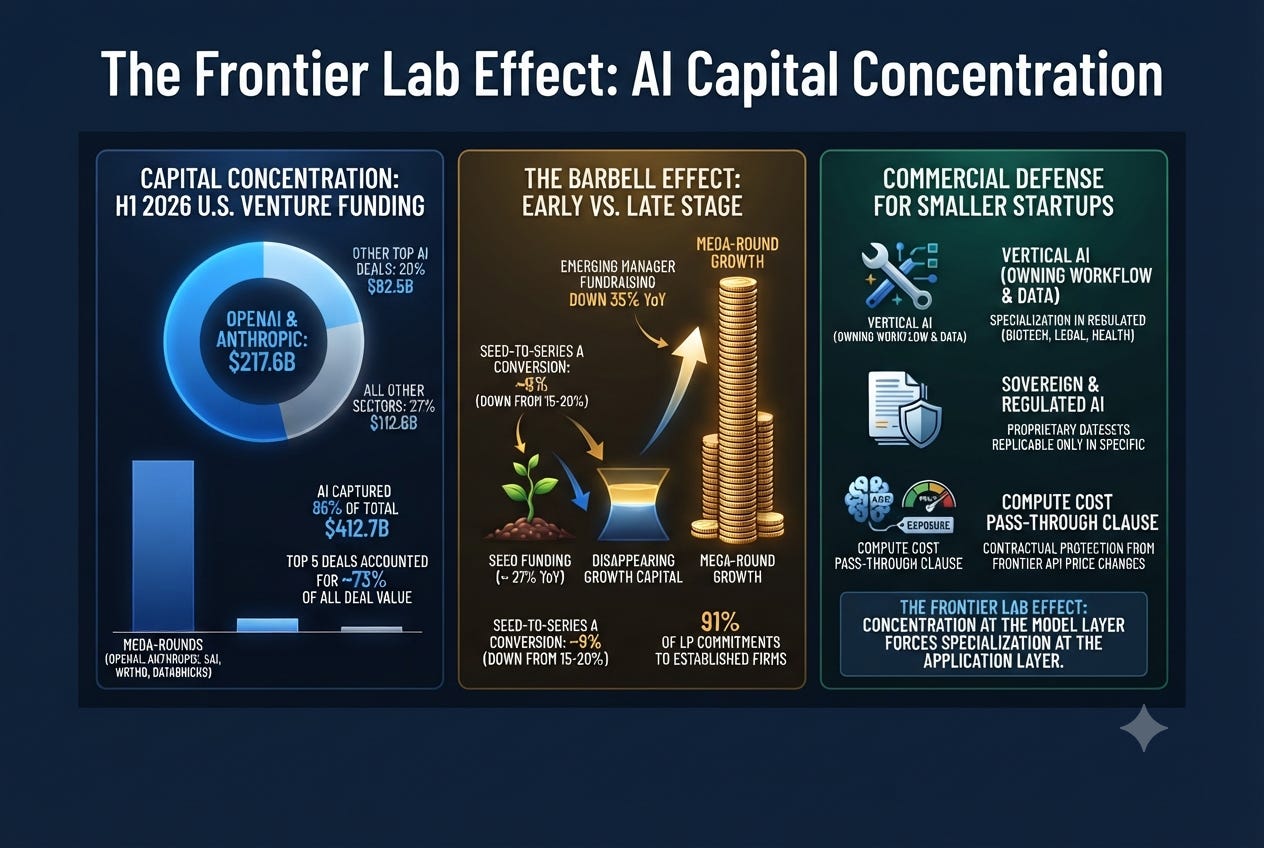
AI Capital Concentration in 2026
Description
AI companies captured 86 percent of the $412.7 billion in U.S. venture capital deployed in the first half of 2026, and OpenAI and Anthropic alone absorbed $217.6 billion of that total. Fewer than ten companies now determine the return profile of the entire venture capital market. Every founder building an AI company outside that top tier is competing for what is left, and most of them have not adjusted their pitch to reflect it.
This Substack is reader-supported. To receive new posts and support my work, consider becoming a free or paid subscriber.
The shift happened fast. AI took 61 percent of global venture capital dollars in 2025, itself a record, and then climbed to 86 percent of a much larger U.S. total within two quarters. The venture capital market has not been this concentrated around a single technology theme in its history, and the concentration is compounding rather than leveling off.
The mechanism is capital intensity, not hype. Training and serving a frontier model requires sustained access to graphics processing unit capacity, long-term power contracts, and data center commitments that run into the tens of billions of dollars before a product reaches a single customer. That cost structure limits credible frontier competition to a handful of companies, and it forces the venture firms backing them to raise fund sizes large enough to write single checks in the billions. Andreessen Horowitz closed $15 billion across five new funds in January 2026, lifting its assets under management to $90 billion. Thrive Capital raised $10 billion. Founders Fund raised $6 billion after deploying $4.6 billion in under a year into Anthropic, Anduril, and OpenAI. Three firms took in 48.1 percent of all capital raised by venture funds in the first half of 2026.
Mega-rounds close this quickly because they happen almost entirely outside the public markets. Rule 506(c) of Regulation D permits general solicitation, and a March 12, 2025 set of compliance and disclosure interpretations from the Securities and Exchange Commission’s Division of Corporation Finance expanded the safe harbor for verifying accredited investor status. That change let an issuer publicly discuss a raise while relying on investor self-certification rather than case-by-case documentation. A private company can now close a multibillion-dollar round in weeks, without the runway a registered public offering under the Securities Act of 1933 would require.
The capital that used to flow into that runway went somewhere else. Seed and angel funding fell 27 percent year over year in the second quarter of 2026. The rate at which seed-stage companies convert into Series A financings collapsed to approximately 9 percent in 2025, down from a historical range of 15 to 20 percent. Institutional limited partners directed 91 percent of new fund commitments in the first quarter of 2026 to established, brand-name venture firms, up from 74 percent a year earlier. The result is a barbell: enormous rounds at the frontier lab tier, disciplined but shrinking early-stage investing beneath it, and a hollowed-out middle where growth capital used to sit.
In seed and Series A term sheet negotiations closed since January 2026, this author has observed a new provision spreading across deals: a compute cost pass-through clause tying a portion of price protection to a company’s exposure to frontier model application programming interface pricing. That clause did not appear in comparable term sheets before 2025, and it reflects how directly a vertical AI company’s cost base now depends on pricing set by two or three providers it does not control.
The companies finding room to operate are not trying to out-train the frontier labs. They are building around a workflow, a regulated dataset, or a customer relationship a frontier lab cannot practically replicate. Legal, coding, and customer support specialists are winning by owning the workflow rather than t