Episode Details
Back to Episodes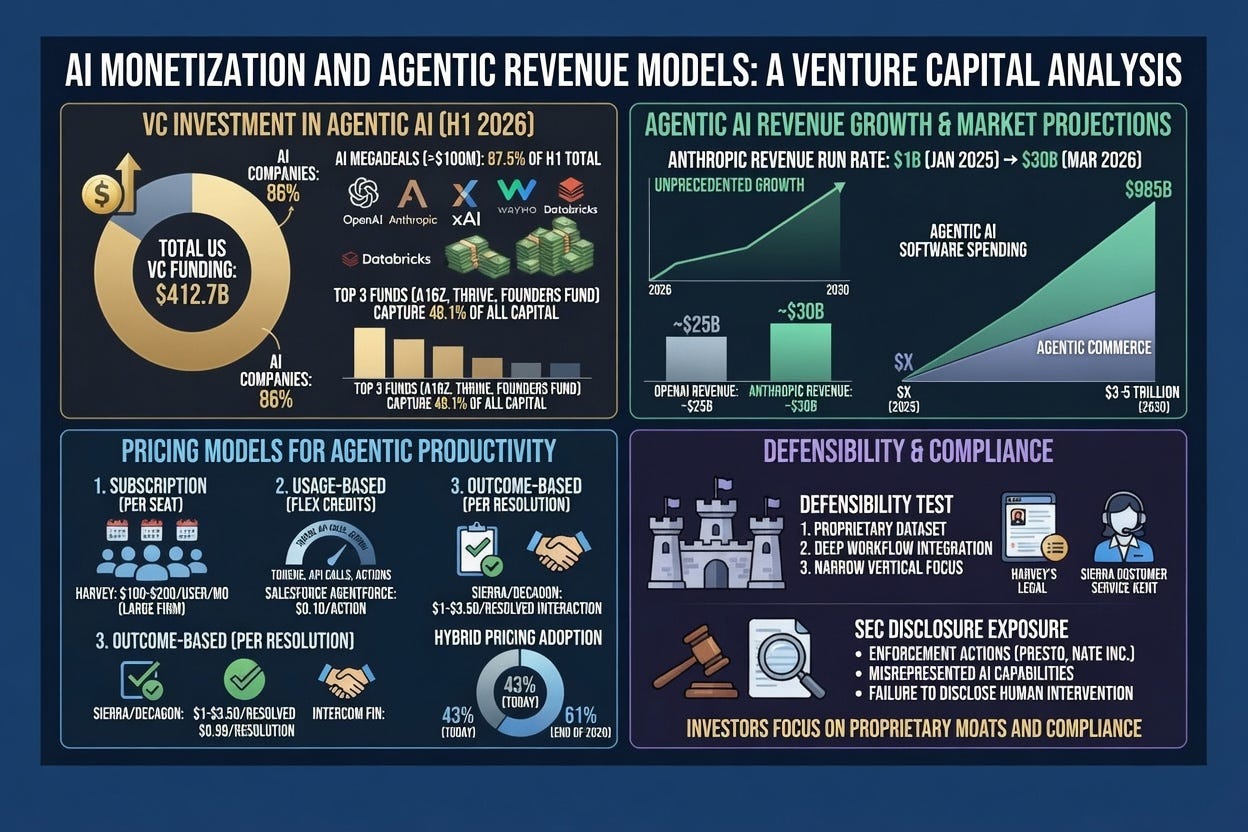
Agentic AI Pricing in 2026
Description
Salesforce has changed how it charges for its Agentforce product three times in eighteen months, moving from a flat 2 dollar per resolved conversation rate to a 0.10 dollar per action Flex Credit option, and that instability inside the company with the deepest enterprise pricing data in the industry says more about the state of agentic AI monetization than any product announcement. The venture capital pouring into this category, 86 percent of the 412.7 billion dollars deployed in United States funding during the first half of 2026, is chasing a business model nobody has fully settled yet.
This Substack is reader-supported. To receive new posts and support my work, consider becoming a free or paid subscriber.
For thirty years the software industry solved pricing with a familiar formula: charge per seat per month, and let the customer decide how much to use the product. Agentic products break that formula because the agent, not the human seat, does the work, and a company selling an agent that completes ten tasks for one customer and one thousand tasks for another has no principled reason to charge both customers the same monthly fee.
How much venture money is actually funding agentic AI in 2026
United States venture investors deployed 412.7 billion dollars in the first half of 2026, and AI companies captured 86 percent of it. Megadeals of 100 million dollars or more accounted for 87.5 percent of that total, and in the first quarter the five largest rounds, raised by OpenAI, Anthropic, xAI, Waymo, and Databricks, accounted for nearly three quarters of all venture investment recorded that quarter. Three funds, Andreessen Horowitz, Thrive Capital, and Founders Fund, took in 48.1 percent of all capital raised industry wide during the same period. A founder pitching an agentic product now competes for attention against companies already generating hundreds of millions of dollars in annual recurring revenue, and that gap should temper any fundraising narrative built on category enthusiasm alone.
What is the difference between subscription, usage based, and outcome based pricing
Subscription pricing charges a fixed amount per seat per month. Harvey, the legal AI company, runs 100 to 200 dollars per user per month for large firm deployments and 1,000 to 2,000 dollars per user per month for mid sized firms, with 12 month commitments and 20 seat minimums at entry. Usage based pricing charges for consumption instead of seats: Salesforce’s Flex Credits, introduced at 0.10 dollars per action, bill for what the agent actually does. Outcome based pricing goes further and charges only when the agent finishes the job. Sierra and Decagon price customer service agents at roughly 1 to 3.50 dollars per resolved interaction, and Intercom charges 0.99 dollars for each conversation its Fin agent fully resolves, with no charge for an escalation to a human agent.
Why outcome based pricing has not become the default
Fewer than 10 percent of AI companies have moved to pure outcome based pricing, and the holdout is not customer resistance. It is that a chief financial officer cannot forecast next quarter’s revenue against a metric the vendor, not the buyer, defines and measures. In reviewing vendor agreements for clients licensing agentic customer service platforms this year, the definition of a resolved interaction most often appears inside a usage exhibit written narrowly enough that the vendor controls when the billing meter starts. Hybrid pricing, a subscription floor paired with a usage or outcome component, has become the market’s compromise: it already covers 43 percent of SaaS companies, a figure projected to reach 61 percent by the end of 2026, and companies using it report 38 percent higher revenue growth and 38 percent higher net revenue retention than companies on pure subscription pricing.
How does a startup build a position a foundation model cannot absorb
A product