Episode Details
Back to Episodes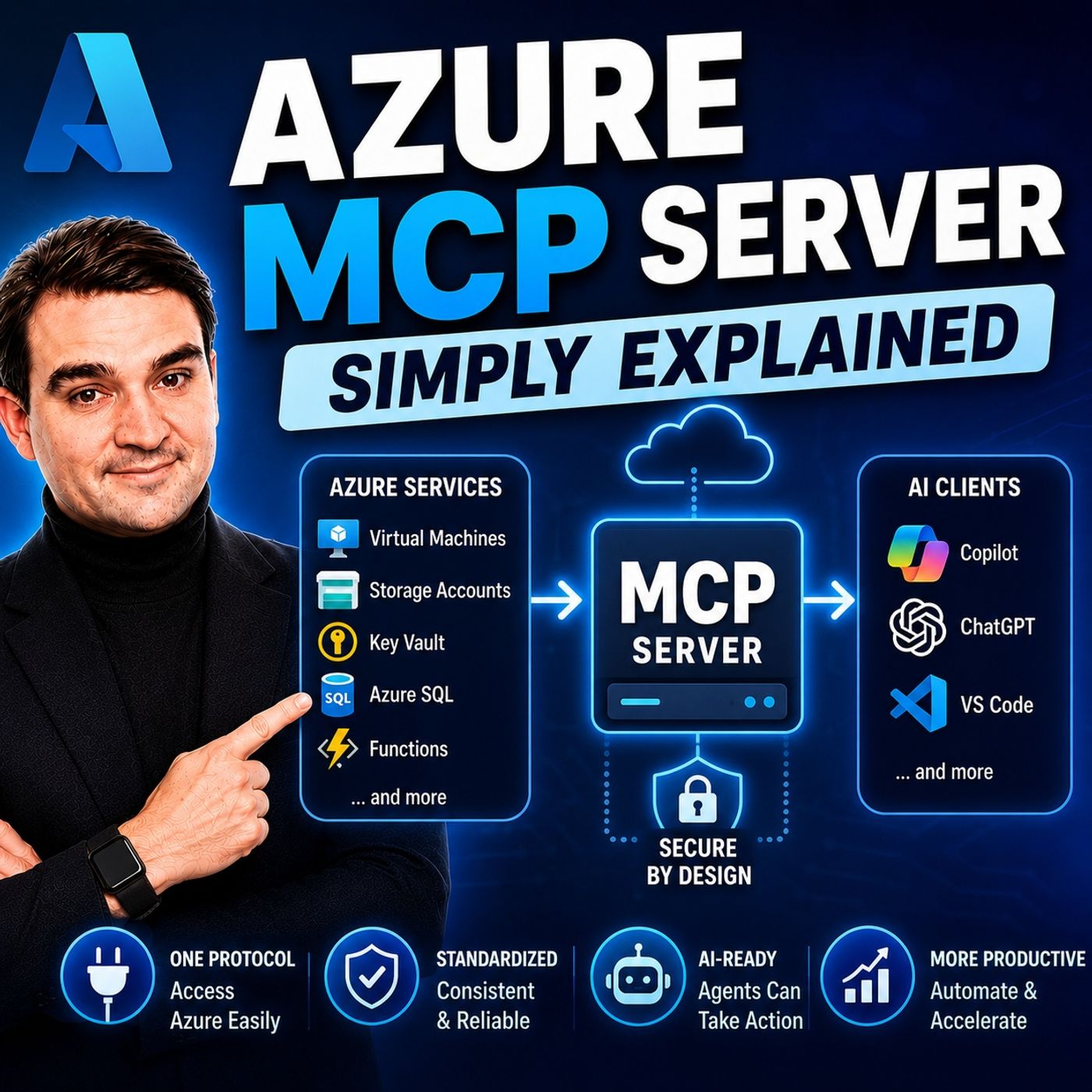
Azure MCP Server - Simply Explained
Season 3
Published 3 weeks, 4 days ago
Description
Artificial Intelligence is rapidly evolving from simply answering questions to actively performing real work. But for AI agents to become truly useful, they need secure access to cloud resources, databases, monitoring systems, and development tools. That's exactly where the Azure MCP Server comes in. In this episode, we explain Microsoft's Azure Model Context Protocol (MCP) Server in plain English, showing how it enables AI assistants to securely interact with Azure services using natural language instead of custom integrations. Whether you're an Azure administrator, cloud engineer, developer, or AI enthusiast, this episode will help you understand why MCP is becoming one of the most important technologies in Microsoft's AI ecosystem.
WHY AI NEEDS A STANDARD WAY TO CONNECT
Modern AI agents are expected to perform real business tasks instead of simply generating text. They need access to Azure Storage, Azure Monitor, databases, configuration services, deployment pipelines, and countless other systems. Traditionally, every AI application required custom APIs, authentication logic, error handling, and connectors for each individual service. This approach quickly becomes expensive, difficult to maintain, and nearly impossible to scale across multiple AI platforms. MCP solves this challenge by introducing a universal communication standard between AI agents and external tools.
WHAT IS THE MODEL CONTEXT PROTOCOL?
The Model Context Protocol (MCP) is an open standard that defines how AI applications discover available tools, access resources, and execute actions through a consistent interface. Instead of building separate integrations for every AI platform, organizations expose their capabilities through a single MCP server that any compatible AI assistant can understand. Created by Anthropic and now supported across the industry, MCP is rapidly becoming the common language for AI integrations, allowing agents such as GitHub Copilot, ChatGPT, Claude, and custom enterprise assistants to interact with business systems using the same protocol.
WHAT IS THE AZURE MCP SERVER?
The Azure MCP Server is Microsoft's open-source implementation of the Model Context Protocol for Microsoft Azure. Rather than introducing a new Azure service, it acts as a secure bridge between AI agents and Azure resources. AI assistants can query monitoring data, manage storage accounts, update configuration settings, deploy infrastructure, and interact with Azure services using natural language while the server translates those requests into the appropriate Azure SDK and API calls. This dramatically simplifies cloud automation while maintaining enterprise security and governance.
SUPPORTED AZURE SERVICES
The Azure MCP Server already provides access to a growing collection of Azure services. AI agents can manage Azure Storage, query Azure Cosmos DB, retrieve Azure Monitor logs, update Azure App Configuration, execute Azure CLI commands, and automate deployment workflows through a unified interface. Instead of learning multiple SDKs, authentication models, and APIs, developers and administrators gain a consistent experience across the Azure platform, making cloud operations significantly more efficient.
BUILT-IN SECURITY AND GOVERNANCE
One of Azure MCP Server's greatest strengths is that it fully respects Azure's existing security model. Authentication relies on Microsoft Entra ID, authorization follows Azure Role-Based Access Control (RBAC), and every action is executed using the authenticated user's existing permissions. AI agents cannot perform operations beyond what the user is already authorized to do. Organizations can further strengthen governance using Azure API Management, allowing administrators to apply policies, auditing, rate limiting, and monitoring without introducing entirely new security models.
REAL-WORLD TROUBLES
WHY AI NEEDS A STANDARD WAY TO CONNECT
Modern AI agents are expected to perform real business tasks instead of simply generating text. They need access to Azure Storage, Azure Monitor, databases, configuration services, deployment pipelines, and countless other systems. Traditionally, every AI application required custom APIs, authentication logic, error handling, and connectors for each individual service. This approach quickly becomes expensive, difficult to maintain, and nearly impossible to scale across multiple AI platforms. MCP solves this challenge by introducing a universal communication standard between AI agents and external tools.
WHAT IS THE MODEL CONTEXT PROTOCOL?
The Model Context Protocol (MCP) is an open standard that defines how AI applications discover available tools, access resources, and execute actions through a consistent interface. Instead of building separate integrations for every AI platform, organizations expose their capabilities through a single MCP server that any compatible AI assistant can understand. Created by Anthropic and now supported across the industry, MCP is rapidly becoming the common language for AI integrations, allowing agents such as GitHub Copilot, ChatGPT, Claude, and custom enterprise assistants to interact with business systems using the same protocol.
WHAT IS THE AZURE MCP SERVER?
The Azure MCP Server is Microsoft's open-source implementation of the Model Context Protocol for Microsoft Azure. Rather than introducing a new Azure service, it acts as a secure bridge between AI agents and Azure resources. AI assistants can query monitoring data, manage storage accounts, update configuration settings, deploy infrastructure, and interact with Azure services using natural language while the server translates those requests into the appropriate Azure SDK and API calls. This dramatically simplifies cloud automation while maintaining enterprise security and governance.
SUPPORTED AZURE SERVICES
The Azure MCP Server already provides access to a growing collection of Azure services. AI agents can manage Azure Storage, query Azure Cosmos DB, retrieve Azure Monitor logs, update Azure App Configuration, execute Azure CLI commands, and automate deployment workflows through a unified interface. Instead of learning multiple SDKs, authentication models, and APIs, developers and administrators gain a consistent experience across the Azure platform, making cloud operations significantly more efficient.
BUILT-IN SECURITY AND GOVERNANCE
One of Azure MCP Server's greatest strengths is that it fully respects Azure's existing security model. Authentication relies on Microsoft Entra ID, authorization follows Azure Role-Based Access Control (RBAC), and every action is executed using the authenticated user's existing permissions. AI agents cannot perform operations beyond what the user is already authorized to do. Organizations can further strengthen governance using Azure API Management, allowing administrators to apply policies, auditing, rate limiting, and monitoring without introducing entirely new security models.
REAL-WORLD TROUBLES