Episode Details
Back to Episodes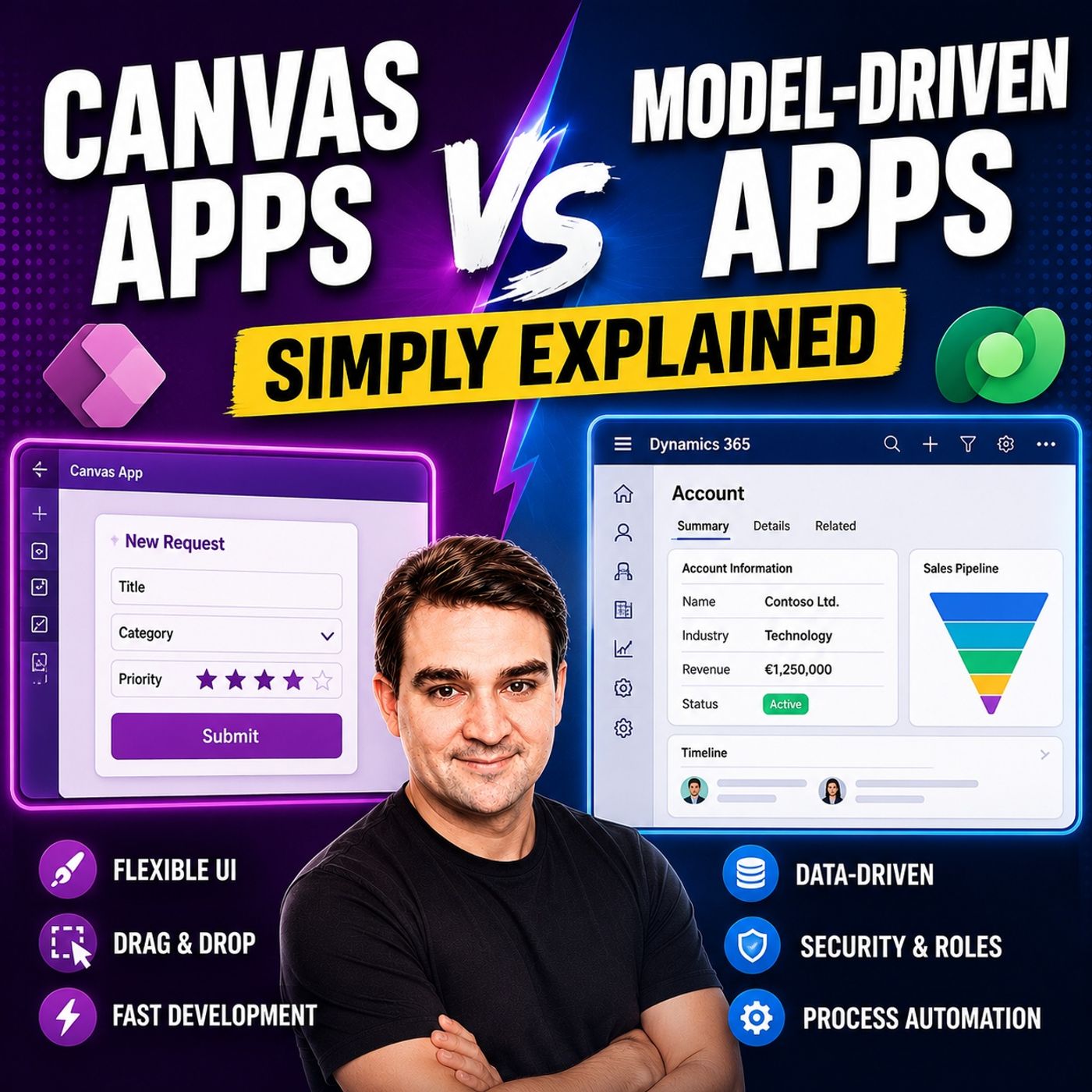
Canvas Apps vs Model-Driven Apps - Simply Explained
Season 3
Published 3 weeks, 4 days ago
Description
Microsoft Power Apps offers two primary ways to build business applications: Canvas Apps and Model-Driven Apps. At first glance they may appear similar, but they are designed for very different scenarios. Choosing the wrong app type can lead to unnecessary complexity, expensive redesigns, and weeks of additional work. In this episode, we explain the differences in plain English, helping you understand when to choose each approach and why the decision is based on your business requirements—not on how the app looks. Whether you're a Power Platform beginner, citizen developer, or enterprise architect, this episode gives you a practical framework for selecting the right tool for your next project.
UNDERSTANDING THE FUNDAMENTAL DIFFERENCE
The biggest difference between Canvas Apps and Model-Driven Apps isn't the user interface—it's where development begins. Canvas Apps start with the user experience. You begin with a blank screen and design every button, image, form, and navigation element yourself before connecting data. Model-Driven Apps take the opposite approach. They begin with your business data model in Microsoft Dataverse, automatically generating forms, views, dashboards, and navigation based on your data structure. One is design-first, while the other is data-first, and that single difference influences every design decision that follows.
CANVAS APPS – COMPLETE DESIGN FREEDOM
Canvas Apps provide maximum flexibility for creating custom user experiences. Developers can design every screen exactly as they want while connecting to hundreds of different data sources including SharePoint, Excel, SQL Server, Salesforce, Microsoft Dataverse, and many other systems. This makes Canvas Apps ideal for mobile-first applications, inspection forms, approval processes, dashboards, field service solutions, and task-focused business apps where branding, usability, and custom layouts are critical. The trade-off is that developers are responsible for building navigation, validation, business logic, and user interactions themselves.
MODEL-DRIVEN APPS – DATA COMES FIRST
Model-Driven Apps are built around Microsoft Dataverse and automatically generate a professional business application from your data model. Instead of designing screens manually, you define tables, relationships, security roles, and business rules. Power Apps then creates forms, views, navigation, dashboards, and responsive layouts automatically. This approach is ideal for enterprise applications such as CRM systems, case management, project tracking, compliance solutions, and business process automation where structured data, governance, and consistency are more important than visual customization.
REAL-WORLD USE CASES
Canvas Apps excel when users need highly customized interfaces, mobile experiences, offline capabilities, or applications that combine information from multiple external systems. Model-Driven Apps perform best when organizations require centralized business data, complex relationships, role-based security, auditing, and standardized business processes. Instead of asking which app type is better, organizations should focus on which business problem they are solving, because each platform has been optimized for a different category of application.
LICENSING CONSIDERATIONS
Licensing is another important factor when selecting an app type. Canvas Apps using only standard Microsoft 365 connectors such as SharePoint, Excel, Outlook, and OneDrive are often included within existing Microsoft 365 subscriptions. However, once an app uses Microsoft Dataverse or premium connectors, premium Power Apps licensing is required. Since Model-Driven Apps always rely on Dataverse, they require premium licensing by design. Understanding these licensing differences helps organizations avoid unexpected costs while planning new Power Platform solutions.
T
UNDERSTANDING THE FUNDAMENTAL DIFFERENCE
The biggest difference between Canvas Apps and Model-Driven Apps isn't the user interface—it's where development begins. Canvas Apps start with the user experience. You begin with a blank screen and design every button, image, form, and navigation element yourself before connecting data. Model-Driven Apps take the opposite approach. They begin with your business data model in Microsoft Dataverse, automatically generating forms, views, dashboards, and navigation based on your data structure. One is design-first, while the other is data-first, and that single difference influences every design decision that follows.
CANVAS APPS – COMPLETE DESIGN FREEDOM
Canvas Apps provide maximum flexibility for creating custom user experiences. Developers can design every screen exactly as they want while connecting to hundreds of different data sources including SharePoint, Excel, SQL Server, Salesforce, Microsoft Dataverse, and many other systems. This makes Canvas Apps ideal for mobile-first applications, inspection forms, approval processes, dashboards, field service solutions, and task-focused business apps where branding, usability, and custom layouts are critical. The trade-off is that developers are responsible for building navigation, validation, business logic, and user interactions themselves.
MODEL-DRIVEN APPS – DATA COMES FIRST
Model-Driven Apps are built around Microsoft Dataverse and automatically generate a professional business application from your data model. Instead of designing screens manually, you define tables, relationships, security roles, and business rules. Power Apps then creates forms, views, navigation, dashboards, and responsive layouts automatically. This approach is ideal for enterprise applications such as CRM systems, case management, project tracking, compliance solutions, and business process automation where structured data, governance, and consistency are more important than visual customization.
REAL-WORLD USE CASES
Canvas Apps excel when users need highly customized interfaces, mobile experiences, offline capabilities, or applications that combine information from multiple external systems. Model-Driven Apps perform best when organizations require centralized business data, complex relationships, role-based security, auditing, and standardized business processes. Instead of asking which app type is better, organizations should focus on which business problem they are solving, because each platform has been optimized for a different category of application.
LICENSING CONSIDERATIONS
Licensing is another important factor when selecting an app type. Canvas Apps using only standard Microsoft 365 connectors such as SharePoint, Excel, Outlook, and OneDrive are often included within existing Microsoft 365 subscriptions. However, once an app uses Microsoft Dataverse or premium connectors, premium Power Apps licensing is required. Since Model-Driven Apps always rely on Dataverse, they require premium licensing by design. Understanding these licensing differences helps organizations avoid unexpected costs while planning new Power Platform solutions.
T