Episode Details
Back to Episodes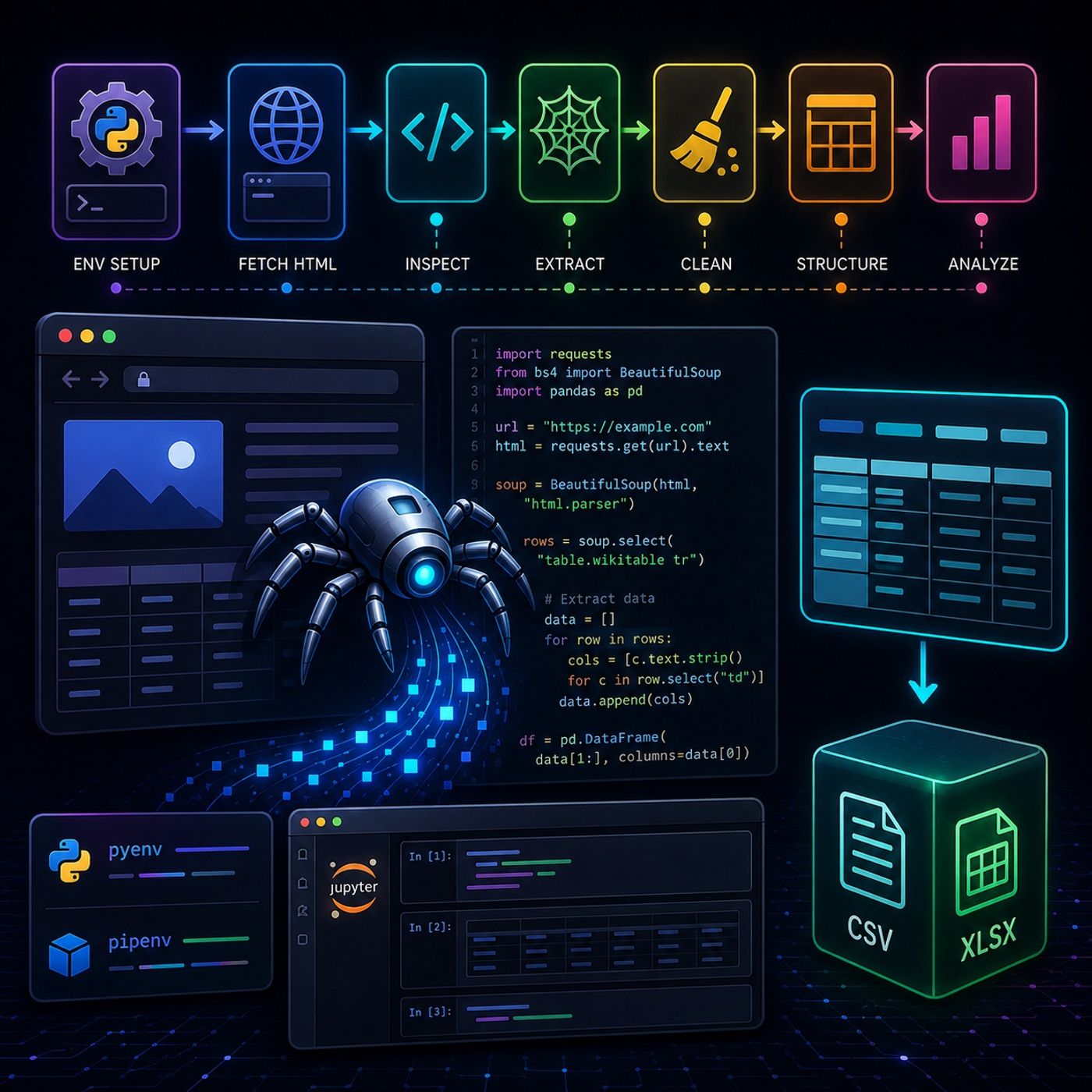
Course 40 - Web Scraping with Python | Episode 5: From Environment Setup to Pandas DataFrames
Published 1 month, 1 week ago
Description
In this lesson, you’ll learn about: setting up a professional Python scraping environment, extracting web data step-by-step, and transforming raw HTML into structured datasets1. Setting Up Your Development Environment🔹 Python Version ManagementUse pyenv
Clean environment = fewer bugs + reproducible projects🔹 Interactive DevelopmentUse JupyterLab
Locate the exact HTML structure of your target data (e.g., tables, divs)3. Extracting Data with BeautifulSoup🔹 Parsing HTMLUse BeautifulSoupfrom bs4 import BeautifulSoup soup = BeautifulSoup(html, "html.parser") 🔹 Using CSS Selectorstable = soup.select("table.wikitable")[0] rows = table.select("tr") 👉 This allows precise targeting of elements4. Cleaning the Data🔹 Fix Column Names
A successful scraping project is not just about extraction—
it’s about building a clean, repeatable pipeline that turns messy web content into usable data.
You can listen and download our episodes for free on more than 10 different platforms:
https://linktr.ee/cybercode_academy
- Install and switch between Python versions بسهولة
- Avoid compatibility issues across projects
- Create isolated environments
- Manage dependencies like:
- requests
- BeautifulSoup4
- pandas
Clean environment = fewer bugs + reproducible projects🔹 Interactive DevelopmentUse JupyterLab
- Run code in cells step-by-step
- Inspect outputs instantly
- Explore files and HTML visually
- Work offline
- Avoid repeated requests
- Debug faster
- JupyterLab HTML viewer
- Browser DevTools (Elements tab)
Locate the exact HTML structure of your target data (e.g., tables, divs)3. Extracting Data with BeautifulSoup🔹 Parsing HTMLUse BeautifulSoupfrom bs4 import BeautifulSoup soup = BeautifulSoup(html, "html.parser") 🔹 Using CSS Selectorstable = soup.select("table.wikitable")[0] rows = table.select("tr") 👉 This allows precise targeting of elements4. Cleaning the Data🔹 Fix Column Names
- Remove whitespace
- Replace spaces with _
- [1], [citation needed]
- Easy filtering
- Data analysis
- Export to CSV/Excel
- Setup environment (pyenv + pipenv)
- Fetch HTML (Requests)
- Inspect structure (DevTools / Jupyter)
- Extract data (BeautifulSoup)
- Clean data (Regex + string ops)
- Structure data (lists)
- Analyze (Pandas DataFrame)
A successful scraping project is not just about extraction—
it’s about building a clean, repeatable pipeline that turns messy web content into usable data.
You can listen and download our episodes for free on more than 10 different platforms:
https://linktr.ee/cybercode_academy