Episode Details
Back to Episodes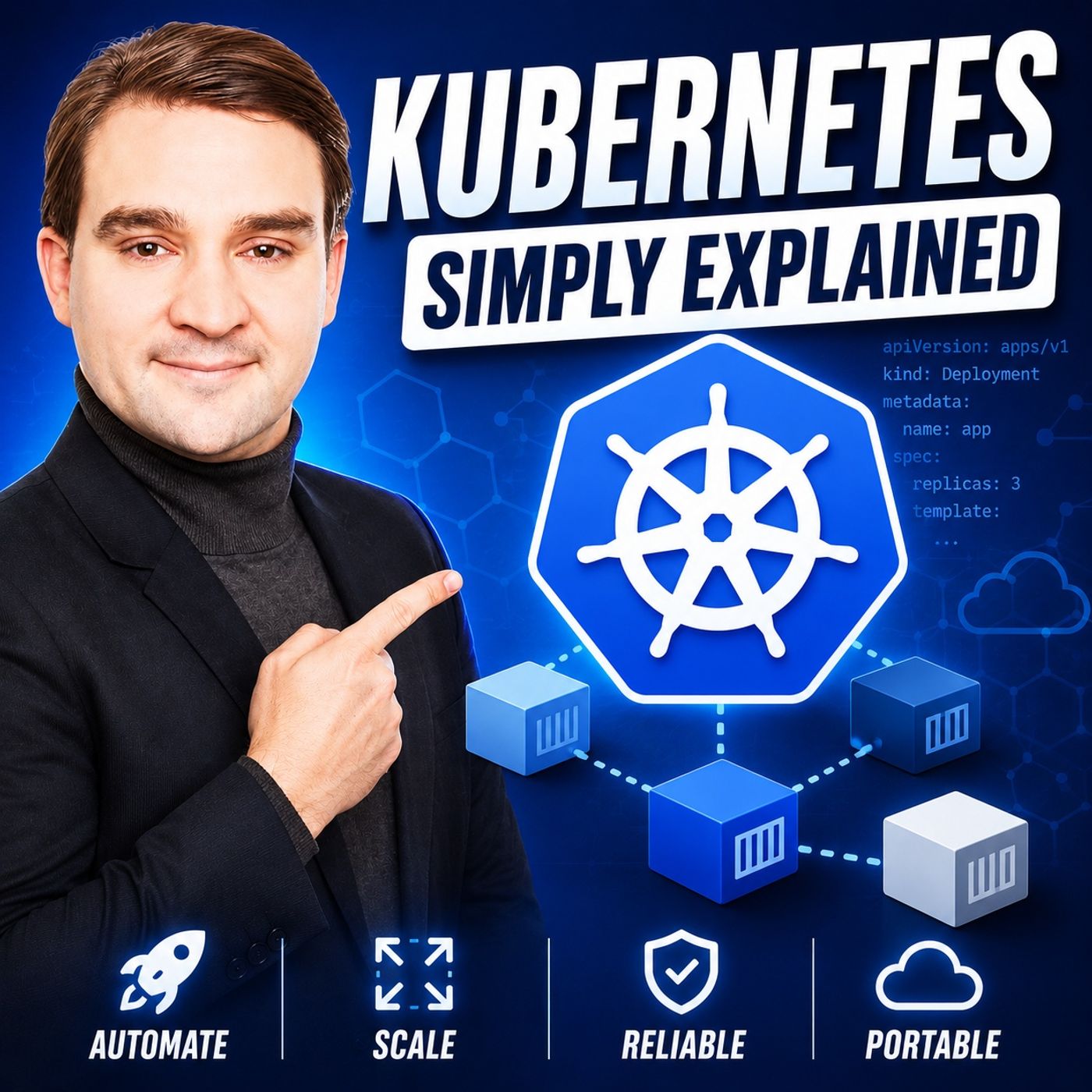
Kubernetes - Simply Explained
Season 3
Published 3 weeks, 4 days ago
Description
Kubernetes has become one of the most important technologies in modern cloud computing, yet it's also one of the most misunderstood. Many people know the name but struggle to explain what it actually does. In this episode, we break Kubernetes down into plain English, exploring why it was created, how it works with containers, and why platforms like Azure Kubernetes Service (AKS) have made enterprise container orchestration accessible to organizations of every size. Whether you're a developer, IT professional, cloud architect, or simply curious about modern infrastructure, this episode gives you a practical foundation without overwhelming technical complexity.
WHY CONTAINERS CHANGED EVERYTHING
Before containers, organizations relied on physical servers and virtual machines to host applications. While virtual machines improved hardware utilization, they remained resource-intensive and difficult to manage at scale. Containers revolutionized software deployment by packaging applications together with all of their dependencies, creating lightweight, portable environments that run consistently across development, testing, and production. Technologies like Docker solved the "it works on my machine" problem, but managing hundreds or thousands of containers introduced an entirely new operational challenge.
WHAT IS KUBERNETES?
Kubernetes is an open-source container orchestration platform that automates the deployment, scaling, networking, recovery, and lifecycle management of containerized applications. Rather than manually deciding where every container should run, Kubernetes treats your infrastructure as one large pool of computing resources and automatically schedules workloads where they belong. It continuously monitors applications, replaces failed containers, balances workloads, and ensures your desired application state is always maintained.
UNDERSTANDING PODS, NODES AND CLUSTERS
At the heart of Kubernetes are a few core building blocks. Applications run inside Pods, which represent the smallest deployable unit in Kubernetes. Pods execute on Nodes, which are physical or virtual servers participating in a Kubernetes Cluster. Together, the cluster functions as a single distributed platform capable of automatically moving workloads, recovering from failures, and scaling applications based on business demand. Services provide stable networking, ensuring applications remain accessible even as Pods are constantly created, replaced, or relocated.
THE CONTROL PLANE – THE BRAIN OF KUBERNETES
The Kubernetes Control Plane acts as the intelligent management layer for the entire cluster. Components such as the API Server, Scheduler, Controller Manager, and etcd database work together to process deployment requests, assign workloads to available infrastructure, maintain cluster health, and continuously reconcile the desired state with the actual environment. This declarative approach allows engineers to describe what they want while Kubernetes determines how to achieve it automatically.
AUTOMATED DEPLOYMENTS AND SCALING
Kubernetes simplifies application management through Deployments, Services, rolling updates, automatic recovery, and horizontal scaling. Instead of manually restarting applications or provisioning additional servers during traffic spikes, Kubernetes continuously monitors workloads and automatically adds or removes application instances based on defined performance thresholds. This enables highly available applications with minimal downtime while significantly reducing operational effort.
SELF-MANAGED KUBERNETES VS AZURE KUBERNETES SERVICE
Running Kubernetes independently provides maximum flexibility but also introduces significant operational complexity. Organizations become responsible for cluster upgrades, security patches, networking, backups, and control plane maintenance. Azur
WHY CONTAINERS CHANGED EVERYTHING
Before containers, organizations relied on physical servers and virtual machines to host applications. While virtual machines improved hardware utilization, they remained resource-intensive and difficult to manage at scale. Containers revolutionized software deployment by packaging applications together with all of their dependencies, creating lightweight, portable environments that run consistently across development, testing, and production. Technologies like Docker solved the "it works on my machine" problem, but managing hundreds or thousands of containers introduced an entirely new operational challenge.
WHAT IS KUBERNETES?
Kubernetes is an open-source container orchestration platform that automates the deployment, scaling, networking, recovery, and lifecycle management of containerized applications. Rather than manually deciding where every container should run, Kubernetes treats your infrastructure as one large pool of computing resources and automatically schedules workloads where they belong. It continuously monitors applications, replaces failed containers, balances workloads, and ensures your desired application state is always maintained.
UNDERSTANDING PODS, NODES AND CLUSTERS
At the heart of Kubernetes are a few core building blocks. Applications run inside Pods, which represent the smallest deployable unit in Kubernetes. Pods execute on Nodes, which are physical or virtual servers participating in a Kubernetes Cluster. Together, the cluster functions as a single distributed platform capable of automatically moving workloads, recovering from failures, and scaling applications based on business demand. Services provide stable networking, ensuring applications remain accessible even as Pods are constantly created, replaced, or relocated.
THE CONTROL PLANE – THE BRAIN OF KUBERNETES
The Kubernetes Control Plane acts as the intelligent management layer for the entire cluster. Components such as the API Server, Scheduler, Controller Manager, and etcd database work together to process deployment requests, assign workloads to available infrastructure, maintain cluster health, and continuously reconcile the desired state with the actual environment. This declarative approach allows engineers to describe what they want while Kubernetes determines how to achieve it automatically.
AUTOMATED DEPLOYMENTS AND SCALING
Kubernetes simplifies application management through Deployments, Services, rolling updates, automatic recovery, and horizontal scaling. Instead of manually restarting applications or provisioning additional servers during traffic spikes, Kubernetes continuously monitors workloads and automatically adds or removes application instances based on defined performance thresholds. This enables highly available applications with minimal downtime while significantly reducing operational effort.
SELF-MANAGED KUBERNETES VS AZURE KUBERNETES SERVICE
Running Kubernetes independently provides maximum flexibility but also introduces significant operational complexity. Organizations become responsible for cluster upgrades, security patches, networking, backups, and control plane maintenance. Azur