Episode Details
Back to Episodes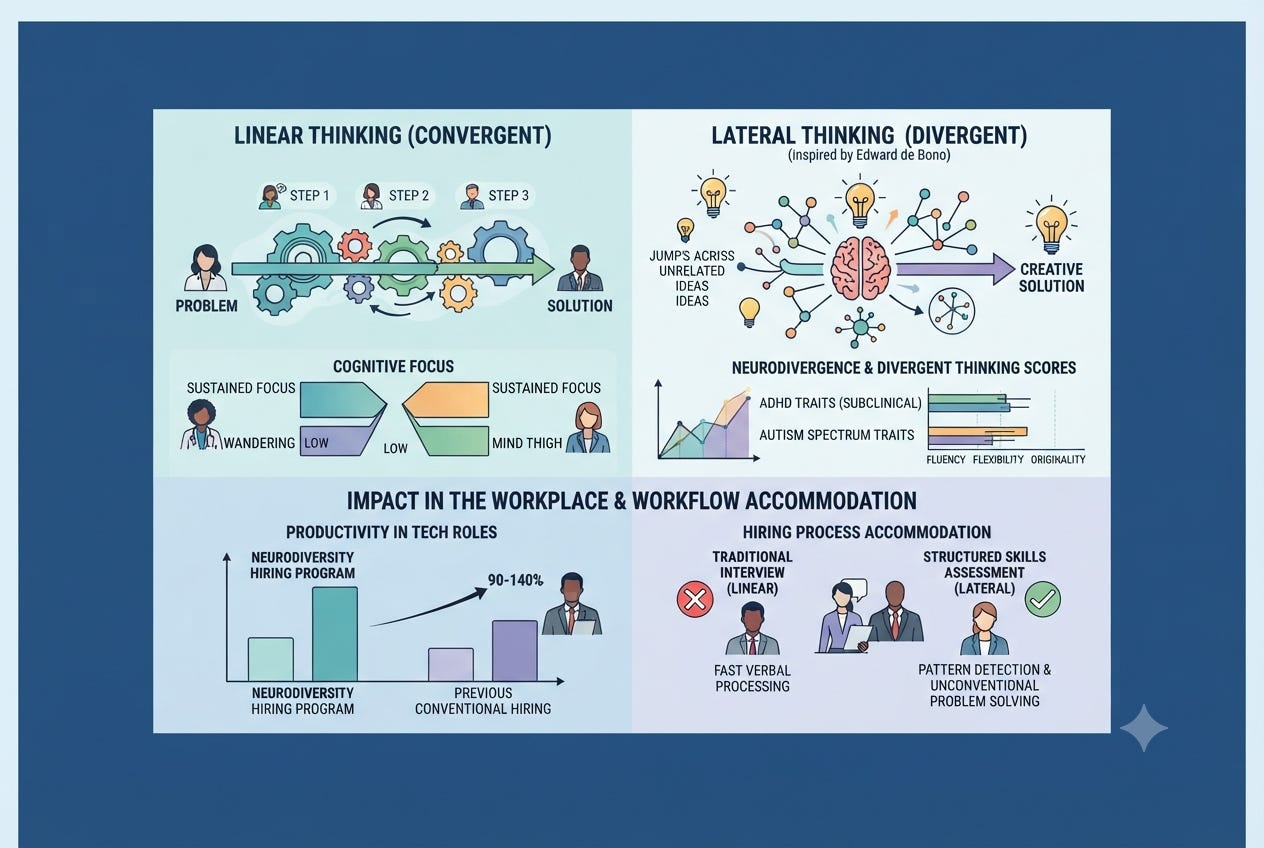
Beyond Linear Logic: Neurodivergence and the Business Case for Lateral Thinking
Description
Linear Thinking Versus Lateral Thinking and the Neurodivergent Mind
Lateral thinking, a term Edward de Bono coined in his 1967 book The Use of Lateral Thinking, is a nonlinear reasoning process now linked to ADHD and autism spectrum traits. Linear thinking proceeds step by step through a fixed sequence of logic, while lateral thinking jumps between unrelated associations to reach an answer that linear analysis would not reach on its own. A 2022 study published in Frontiers in Psychiatry found that adults reporting more attention deficit hyperactivity disorder symptoms scored higher on divergent thinking measures of fluency, flexibility, and originality. The Centers for Disease Control and Prevention estimates that 6.0 percent of American adults, roughly 15.5 million people, carry a current attention deficit hyperactivity disorder diagnosis, and roughly 2.2 percent of American adults are autistic. That distribution means the cognitive style long associated with lateral thinking runs through a substantial share of the working population rather than standing apart as a rare exception. The relationship is not uniform across every neurodivergent profile. Autism spectrum symptoms show a more complicated relationship to divergent thinking than attention deficit hyperactivity disorder symptoms do, and the fluency gains associated with attention deficit hyperactivity disorder traits appear strongest at subclinical symptom levels rather than at full diagnostic severity. For founders, investors, and executives building teams, the relevant question concerns how legal and organizational structures built around linear workflows and performance metrics should account for a cognitive style that maps unevenly onto both.
This Substack is reader-supported. To receive new posts and support my work, consider becoming a free or paid subscriber.
What is the difference between linear thinking and lateral thinking?
Linear thinking, also called vertical or convergent thinking, moves through a problem as a sequence of dependent steps, with each step following logically from the one before it. Edward de Bono, the Maltese psychologist who introduced the term lateral thinking in his 1967 book The Use of Lateral Thinking, defined the linear alternative as thinking built on rationality, rule following, and a single correct path from premise to conclusion.
Lateral thinking abandons that single path. de Bono described it as a deliberate jump from a familiar pattern of reasoning to an unfamiliar one, generating a new idea first and testing its correctness afterward rather than verifying each step before moving to the next. The two styles are not competitors in daily use. Most problem solving blends both: linear thinking supplies the structure that turns a raw idea into a workable plan, and lateral thinking supplies the raw idea in the first place.
Is lateral thinking a function of the right side of the brain?
Popular writing on creativity often attributes lateral thinking to the brain’s right hemisphere and linear thinking to the left, a claim that predates rigorous imaging research and has not held up under it. A 2013 study by Nielsen, Zielinski, Ferguson, Lainhart, and Anderson, published in PLOS ONE, used resting state functional connectivity magnetic resonance imaging on more than 1,000 subjects and found no evidence that individuals rely predominantly on one hemisphere’s network over the other. Lateral thinking is better understood as a mode of information processing that recruits distributed brain networks depending on the task, not a fixed hemisphere assignment. The popular hemisphere story persists in management training material because it is simple to teach, not because current neuroscience supports it.
What does the research show about lateral thinking and ADHD?
A 2022 study published in Frontiers in Psychiatry, titled Characterizing Creative Thinking and Creative Achievements in Relatio