Episode Details
Back to Episodes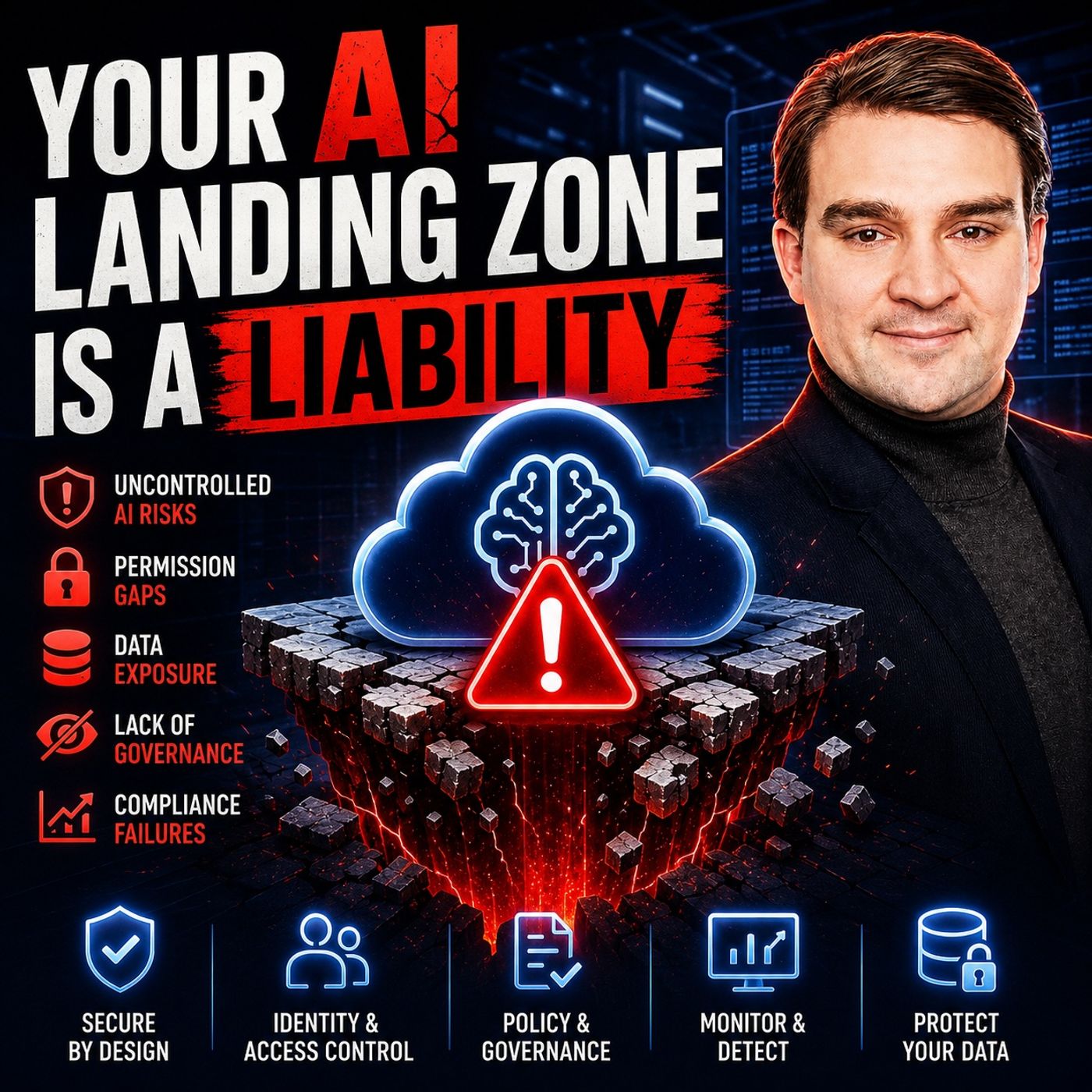
Your AI Landing Zone Is A Liability
Season 2
Published 3 weeks, 5 days ago
Description
Most organizations believe deploying Azure OpenAI is as simple as provisioning another Azure resource. Create an endpoint, generate an API key, connect your application, and start building AI experiences. While this approach may work for prototypes, it quickly becomes a serious liability in enterprise environments. In this episode of the M365 FM Podcast, host Mirko Peters explains why traditional Azure Landing Zones were never designed for modern AI workloads and why every successful enterprise AI platform needs a hardened governance perimeter built from day one. This episode explores the architectural shift from manual deployments to fully governed AI platforms powered by Azure Bicep, Azure AI Foundry, Azure Policy, Managed Identities, Private Endpoints, API Management, and Infrastructure as Code. You'll discover why Enterprise AI isn't about deploying large language models—it's about controlling identity, networking, governance, observability, and reasoning across every AI workload before technical debt turns into security debt.
WHY TRADITIONAL LANDING ZONES BREAK WITH AI
Azure Landing Zones were designed for predictable workloads with stable infrastructure patterns. AI changes everything. Large Language Models interact with multiple data sources, external APIs, retrieval systems, vector databases, and orchestration layers that continuously evolve. Traditional governance models simply weren't built for this level of complexity. Topics include:
THE HIDDEN COST OF MANUAL AI DEPLOYMENTS
Many organizations deploy their first AI solution through the Azure Portal. The first deployment succeeds. The second team copies the approach. The third team makes slight modifications. Months later, nobody knows which deployment uses Managed Identities, which relies on API keys, which workloads expose public endpoints, or where sensitive business data actually flows. The episode explains why configuration drift, inconsistent security controls, and invisible token consumption create financial, operational, and compliance risks that grow exponentially over time.
BUILDING THE HARDENED AI PERIMETER
Enterprise AI requires more than secure infrastructure. It requires an integrated perimeter where identity, networking, governance, reasoning, and monitoring work together as one architecture. Topics include:
BICEP AS THE CONTROL PLANE FOR AI
Azure Bicep is far more than a replacement for ARM Templates. It becomes the architectural language that defines identity, networking, monitoring, AI services, governance, and compliance as reusable modules. The discussion explores how reusable Bicep modules eliminate configuration drift while creating repeatable deployments that can be audited, versioned, and deployed consistently across hundreds of Azure subscriptions. Infrastructure stops being manually configured and becomes automatically governed.
AZURE AI FOUNDRY, RAG & MODERN AI ARCHITECTURE
Modern AI applications depend on Retrieval Augmented Generation (RAG), Azure AI Search, vector databases, and intelligent orchestration. The episode explains how Azure AI Foundry
WHY TRADITIONAL LANDING ZONES BREAK WITH AI
Azure Landing Zones were designed for predictable workloads with stable infrastructure patterns. AI changes everything. Large Language Models interact with multiple data sources, external APIs, retrieval systems, vector databases, and orchestration layers that continuously evolve. Traditional governance models simply weren't built for this level of complexity. Topics include:
- Azure Landing Zones
- AI workloads
- Configuration drift
- Shadow AI
- Governance gaps
- Enterprise architecture
- Cloud security
- Infrastructure evolution
- AI platforms
- Operational complexity
THE HIDDEN COST OF MANUAL AI DEPLOYMENTS
Many organizations deploy their first AI solution through the Azure Portal. The first deployment succeeds. The second team copies the approach. The third team makes slight modifications. Months later, nobody knows which deployment uses Managed Identities, which relies on API keys, which workloads expose public endpoints, or where sensitive business data actually flows. The episode explains why configuration drift, inconsistent security controls, and invisible token consumption create financial, operational, and compliance risks that grow exponentially over time.
BUILDING THE HARDENED AI PERIMETER
Enterprise AI requires more than secure infrastructure. It requires an integrated perimeter where identity, networking, governance, reasoning, and monitoring work together as one architecture. Topics include:
- Managed Identities
- Private Endpoints
- Azure Policy
- Azure AI Foundry
- API Management
- Azure Bicep
- RBAC
- Key Vault
- Zero Trust
- Governance as Code
BICEP AS THE CONTROL PLANE FOR AI
Azure Bicep is far more than a replacement for ARM Templates. It becomes the architectural language that defines identity, networking, monitoring, AI services, governance, and compliance as reusable modules. The discussion explores how reusable Bicep modules eliminate configuration drift while creating repeatable deployments that can be audited, versioned, and deployed consistently across hundreds of Azure subscriptions. Infrastructure stops being manually configured and becomes automatically governed.
AZURE AI FOUNDRY, RAG & MODERN AI ARCHITECTURE
Modern AI applications depend on Retrieval Augmented Generation (RAG), Azure AI Search, vector databases, and intelligent orchestration. The episode explains how Azure AI Foundry