Episode Details
Back to Episodes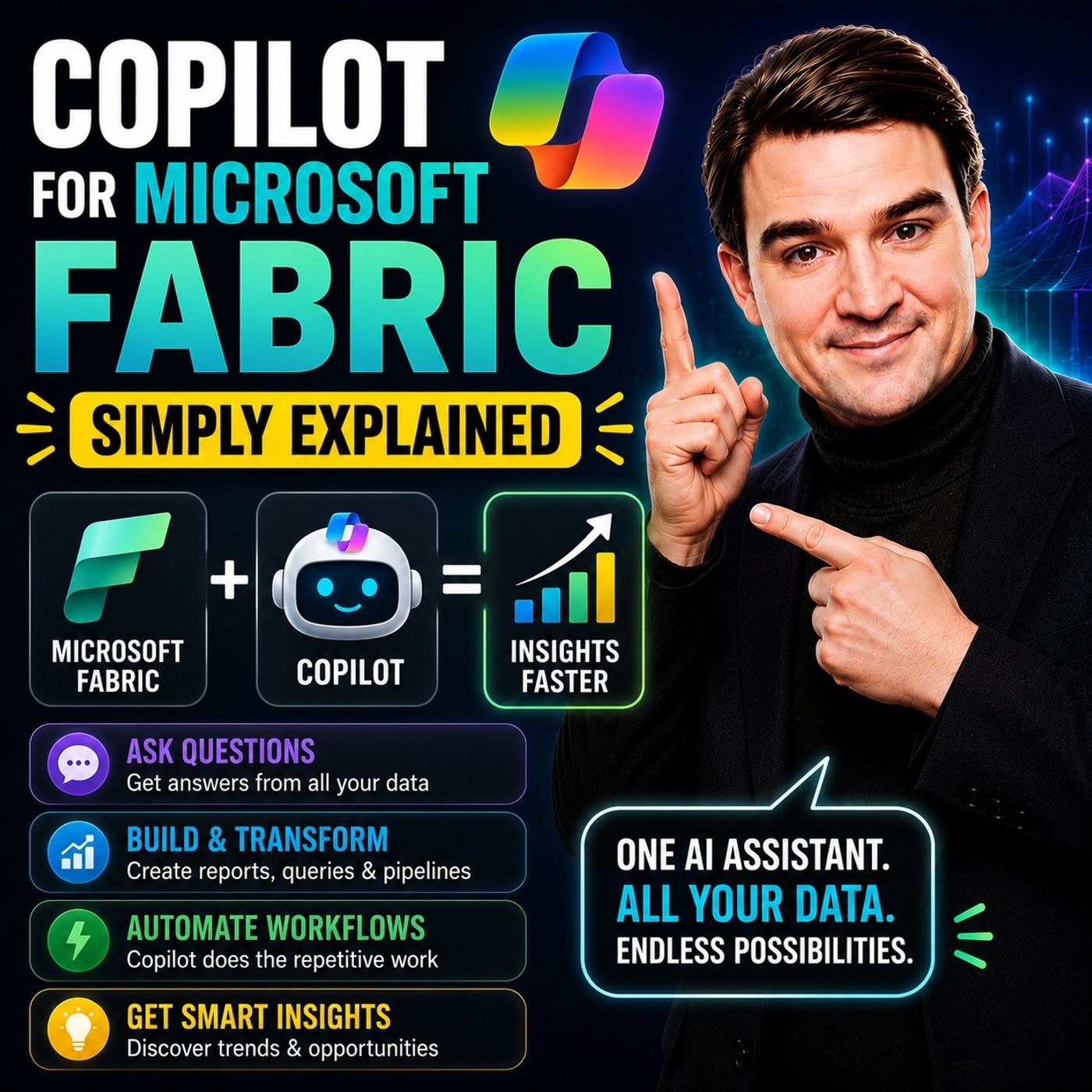
Copilot for Microsoft Fabric - Simply Explained
Season 3
Published 3 weeks, 6 days ago
Description
Microsoft has several Copilots, but each one serves a completely different purpose. Microsoft 365 Copilot helps you write documents and summarize meetings. GitHub Copilot helps developers write code. Copilot for Microsoft Fabric is designed specifically for data and analytics. It acts as an AI-powered data assistant that helps you write SQL, generate DAX measures, build reports, create data pipelines, and transform datasets using plain English. Instead of memorizing complex syntax, you simply describe what you want, and Copilot generates a working first draft that you can review and refine.
AN AI ASSISTANT FOR YOUR DATA
Copilot is built directly into Microsoft Fabric and understands your organization's data. Powered by Azure OpenAI, it doesn't rely on generic internet knowledge. Instead, it understands your Fabric workspace, semantic models, tables, schemas, and relationships. Whether you're asking for a SQL query, a Power BI report, or a PySpark transformation, Copilot generates content based on your actual business data. Think of it as a junior data engineer who works incredibly fast—but still needs your review before anything goes into production.
WHERE COPILOT WORKS
Copilot is integrated across several Microsoft Fabric workloads. Inside Data Factory, it helps build Power Query transformations and data pipelines using natural language. Within Data Engineering, it generates PySpark code for Fabric Notebooks, explains existing code, and helps developers understand complex data transformations. In the Data Warehouse, Copilot converts plain English into SQL queries, making data exploration much easier for users who don't write SQL every day. Finally, in Power BI, Copilot creates dashboards, generates DAX measures, builds visualizations, and summarizes reports in natural language for business users.
REAL-WORLD EXAMPLES
Different roles benefit from Copilot in different ways. A data engineer can generate PySpark code to clean and transform raw datasets without manually writing every line of code. A business analyst can describe a dashboard in plain English and have Copilot build the initial Power BI report, complete with charts, KPIs, and calculated measures. A SQL user can request a query such as "Show total sales by region for last quarter," allowing Copilot to generate the SQL automatically instead of manually writing joins and aggregations. Each scenario dramatically reduces repetitive work while allowing experts to focus on analysis rather than syntax.
GETTING STARTED
Using Copilot requires very little setup. Organizations need Microsoft Fabric running on a paid Fabric capacity (F2 or higher), and a Fabric administrator must enable Copilot within the tenant settings. Once enabled, Copilot appears directly inside the supported Fabric experiences without requiring additional installation or configuration. It also respects existing security permissions, meaning users only receive AI assistance for data they are already authorized to access.
WHY BEGINNERS SHOULD CARE
One of the biggest barriers to analytics has always been learning technical languages such as SQL, DAX, and PySpark. Copilot dramatically lowers that barrier by allowing users to describe business problems in natural language instead of writing code from scratch. Rather than spending weeks learning syntax before becoming productive, beginners can start building reports, exploring data, and learning by reviewing the code Copilot generates. It accelerates learning while making self-service analytics accessible to a much wider audience.
THE HUMAN STILL MATTERS
Despite its impressive capabilities, Copilot should never be treated as an autonomous data engineer. It can misunderstand prompts, generate inefficient SQL, select the wrong visual, or produce calculations that require refinement. Every generated query, DAX measure, notebook
AN AI ASSISTANT FOR YOUR DATA
Copilot is built directly into Microsoft Fabric and understands your organization's data. Powered by Azure OpenAI, it doesn't rely on generic internet knowledge. Instead, it understands your Fabric workspace, semantic models, tables, schemas, and relationships. Whether you're asking for a SQL query, a Power BI report, or a PySpark transformation, Copilot generates content based on your actual business data. Think of it as a junior data engineer who works incredibly fast—but still needs your review before anything goes into production.
WHERE COPILOT WORKS
Copilot is integrated across several Microsoft Fabric workloads. Inside Data Factory, it helps build Power Query transformations and data pipelines using natural language. Within Data Engineering, it generates PySpark code for Fabric Notebooks, explains existing code, and helps developers understand complex data transformations. In the Data Warehouse, Copilot converts plain English into SQL queries, making data exploration much easier for users who don't write SQL every day. Finally, in Power BI, Copilot creates dashboards, generates DAX measures, builds visualizations, and summarizes reports in natural language for business users.
REAL-WORLD EXAMPLES
Different roles benefit from Copilot in different ways. A data engineer can generate PySpark code to clean and transform raw datasets without manually writing every line of code. A business analyst can describe a dashboard in plain English and have Copilot build the initial Power BI report, complete with charts, KPIs, and calculated measures. A SQL user can request a query such as "Show total sales by region for last quarter," allowing Copilot to generate the SQL automatically instead of manually writing joins and aggregations. Each scenario dramatically reduces repetitive work while allowing experts to focus on analysis rather than syntax.
GETTING STARTED
Using Copilot requires very little setup. Organizations need Microsoft Fabric running on a paid Fabric capacity (F2 or higher), and a Fabric administrator must enable Copilot within the tenant settings. Once enabled, Copilot appears directly inside the supported Fabric experiences without requiring additional installation or configuration. It also respects existing security permissions, meaning users only receive AI assistance for data they are already authorized to access.
WHY BEGINNERS SHOULD CARE
One of the biggest barriers to analytics has always been learning technical languages such as SQL, DAX, and PySpark. Copilot dramatically lowers that barrier by allowing users to describe business problems in natural language instead of writing code from scratch. Rather than spending weeks learning syntax before becoming productive, beginners can start building reports, exploring data, and learning by reviewing the code Copilot generates. It accelerates learning while making self-service analytics accessible to a much wider audience.
THE HUMAN STILL MATTERS
Despite its impressive capabilities, Copilot should never be treated as an autonomous data engineer. It can misunderstand prompts, generate inefficient SQL, select the wrong visual, or produce calculations that require refinement. Every generated query, DAX measure, notebook