Episode Details
Back to Episodes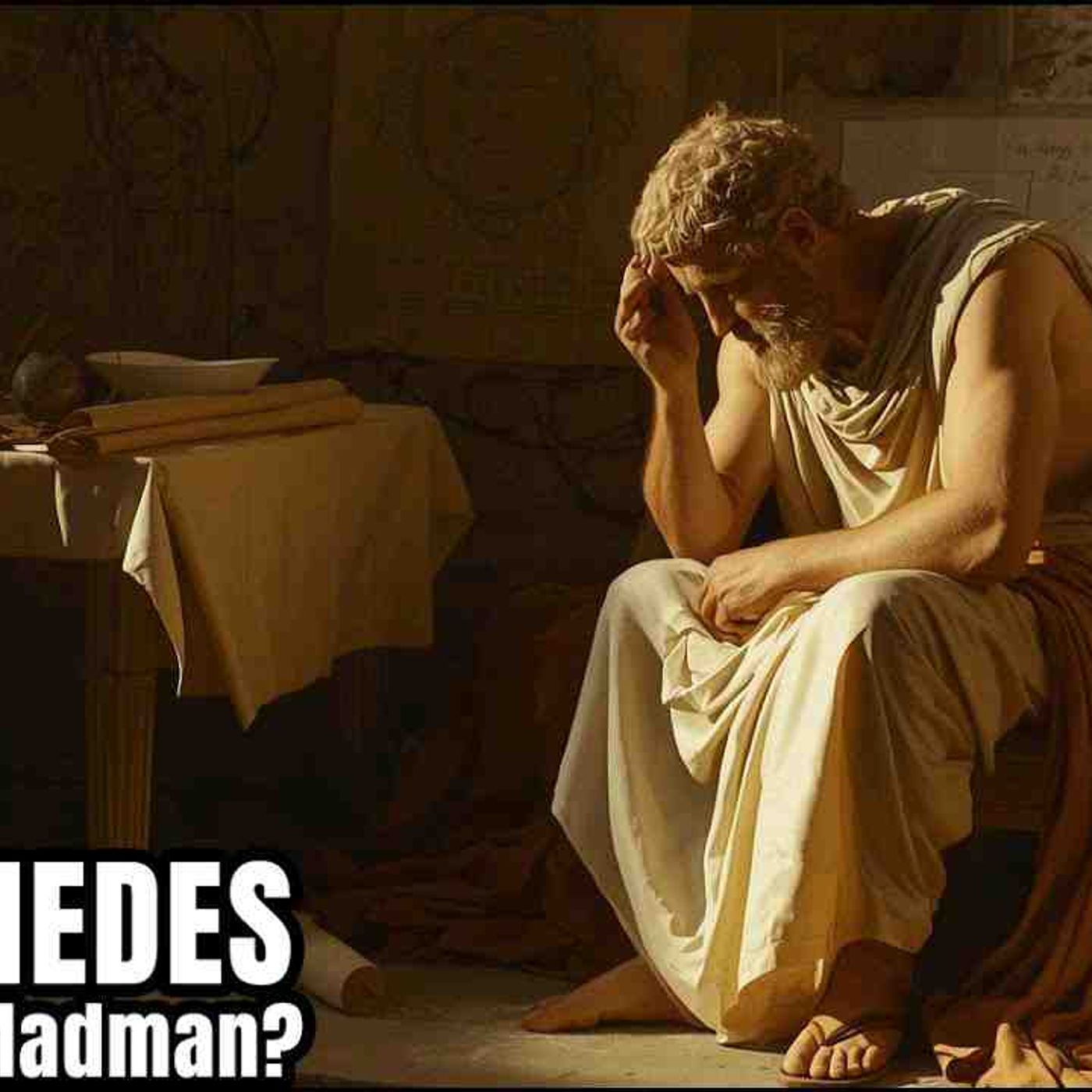
Archimedes Genius Who Changed the World
Season 1
Episode 4
Published 23 hours ago
Description
He was the man who said, "Give me a place to stand, and I will move the Earth" [citation:2][citation:8]. But more than a slogan, Archimedes of Syracuse gave us the fundamental principles that built the modern world—from the pulley systems that lift our buildings to the calculus that powers our computers [citation:2][citation:3].
Born in Syracuse, Sicily, around 287 BC, Archimedes is widely considered the greatest mathematician of antiquity and one of the greatest scientists of all time [citation:1][citation:9][citation:10]. He didn't just theorize; he revolutionized the application of science. He invented the Archimedes screw for irrigation, a device still used today [citation:1][citation:3][citation:10]. He laid the foundations of hydrostatics by discovering that a body immersed in fluid is pushed up by a force equal to the weight of the fluid it displaces—a principle famously discovered during a bath, leading to his legendary cry of "Eureka!" [citation:1][citation:2][citation:10].
His mathematical achievements were centuries ahead of his time. He used the "method of exhaustion" to calculate areas and volumes, effectively inventing integral calculus over 1,800 years before Newton and Leibniz [citation:2][citation:3][citation:8]. He proved that the volume of a sphere is two-thirds that of the cylinder enclosing it, a result so precious he asked for it to be engraved on his tomb [citation:1][citation:2][citation:10]. When the Romans attacked his city, he turned his genius to engineering, building war machines including powerful catapults and the legendary "Claw of Archimedes" that lifted ships out of the water [citation:2][citation:3][citation:9]. He held off the Roman army for years until he was killed in 212 BC by a soldier who did not recognize him, allegedly while he was studying a diagram in the sand [citation:1][citation:2][citation:9]. Subscribe and hit the bell for more episodes revealing the minds that truly changed the course of history.
Born in Syracuse, Sicily, around 287 BC, Archimedes is widely considered the greatest mathematician of antiquity and one of the greatest scientists of all time [citation:1][citation:9][citation:10]. He didn't just theorize; he revolutionized the application of science. He invented the Archimedes screw for irrigation, a device still used today [citation:1][citation:3][citation:10]. He laid the foundations of hydrostatics by discovering that a body immersed in fluid is pushed up by a force equal to the weight of the fluid it displaces—a principle famously discovered during a bath, leading to his legendary cry of "Eureka!" [citation:1][citation:2][citation:10].
His mathematical achievements were centuries ahead of his time. He used the "method of exhaustion" to calculate areas and volumes, effectively inventing integral calculus over 1,800 years before Newton and Leibniz [citation:2][citation:3][citation:8]. He proved that the volume of a sphere is two-thirds that of the cylinder enclosing it, a result so precious he asked for it to be engraved on his tomb [citation:1][citation:2][citation:10]. When the Romans attacked his city, he turned his genius to engineering, building war machines including powerful catapults and the legendary "Claw of Archimedes" that lifted ships out of the water [citation:2][citation:3][citation:9]. He held off the Roman army for years until he was killed in 212 BC by a soldier who did not recognize him, allegedly while he was studying a diagram in the sand [citation:1][citation:2][citation:9]. Subscribe and hit the bell for more episodes revealing the minds that truly changed the course of history.