Episode Details
Back to Episodes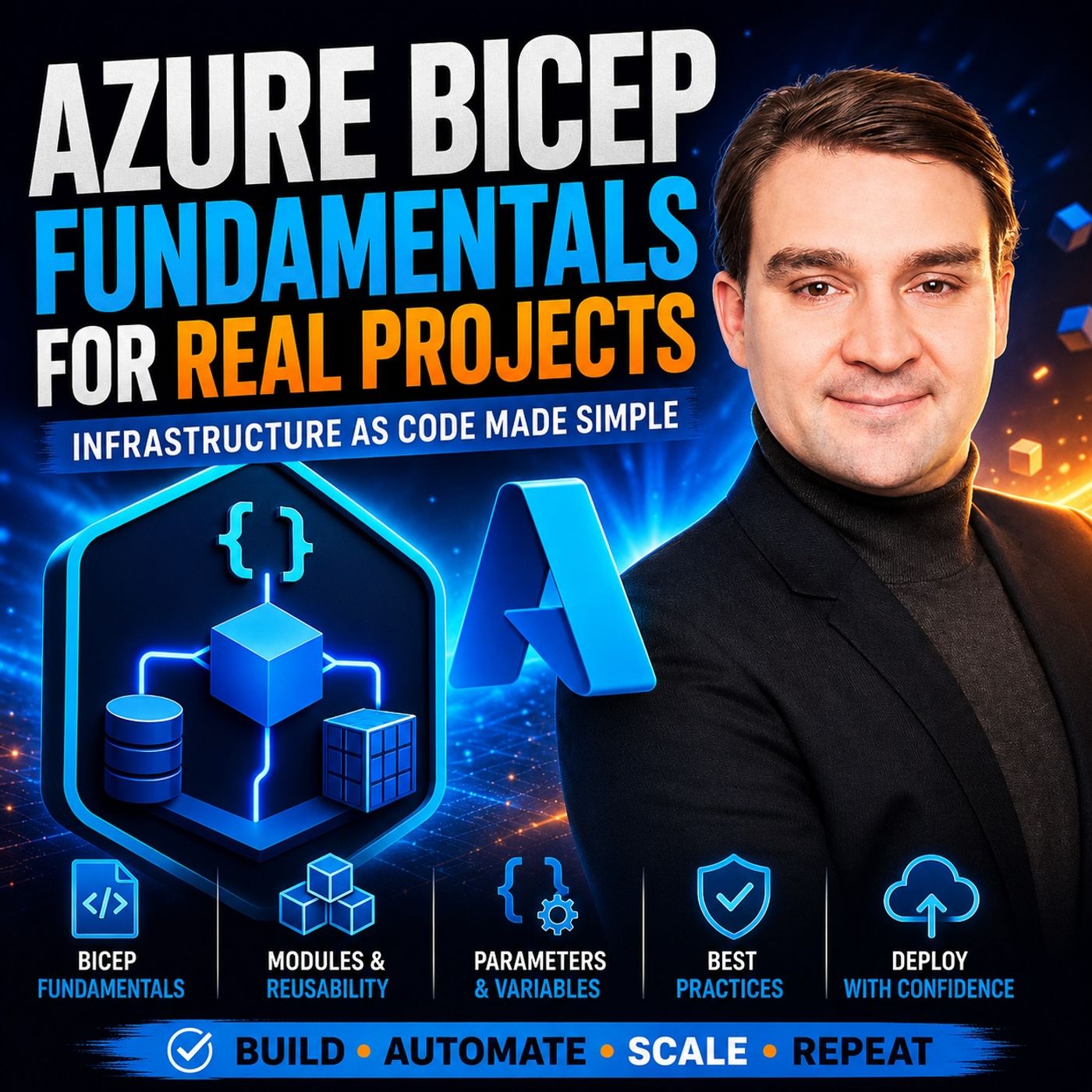
Azure Bicep Fundamentals for Real Projects
Season 2
Published 4 weeks, 2 days ago
Description
Learning Azure Bicep is easy. Building infrastructure that survives real-world enterprise environments is something entirely different. In this episode of the M365 FM Podcast, host Mirko Peters explores what separates hobbyist Infrastructure as Code from production-ready cloud architecture. Rather than focusing on syntax alone, this episode dives into the architectural thinking behind Azure Bicep, showing how modern organizations design scalable, secure, and governable Azure environments using Infrastructure as Code, Azure Policy, Deployment Stacks, Azure Verified Modules, Management Groups, and enterprise governance. You'll learn why Bicep is far more than a replacement for ARM Templates. It has become Microsoft's strategic language for defining Azure infrastructure, enforcing governance, automating deployments, and enabling cloud platforms that remain maintainable as organizations grow. Whether you're deploying your first storage account or designing enterprise landing zones across hundreds of Azure subscriptions, this episode provides the principles needed to build infrastructure that lasts.
WHY BICEP IS MORE THAN BETTER SYNTAX
Many developers view Bicep simply as an easier way to write ARM Templates. While the cleaner syntax, reusable modules, and improved readability are significant improvements, Microsoft's long-term vision goes much further. Bicep has evolved into the language that defines Azure governance, policy, security baselines, and infrastructure lifecycle management. Modern Infrastructure as Code is no longer about automating deployments—it's about codifying architectural decisions that remain consistent across teams, subscriptions, and cloud environments.
THINKING LIKE A CLOUD ARCHITECT
One of the central themes throughout the episode is the difference between automation and architecture. Real-world Bicep projects are built around organizational standards rather than individual deployments. Topics include:
BUILDING REUSABLE BICEP MODULES
As Azure environments become larger, reusable modules become the foundation of maintainable infrastructure. The episode explains how well-designed modules encapsulate organizational decisions including security baselines, naming conventions, monitoring requirements, compliance standards, and networking patterns. Rather than copying infrastructure between projects, organizations build internal module libraries that allow development teams to deploy secure infrastructure while automatically following corporate standards. The discussion covers:
One of Microsoft's biggest Infrastructure as Code innovations is Deployment Stacks. Unlike traditional ARM deployments, Deployment Stacks introduce state awareness, allowing Azure to understand which resources belong together throughout their lifecycle. The episode explores how Deployment Stacks simplify environment management, resource cleanup, brownfield migrations, and governance while reducing orphaned resources and configuration drift. You'll also learn how Deployment Stacks compare with Terraform's state management model and why this represents a major architectural shift for Azure-nat
WHY BICEP IS MORE THAN BETTER SYNTAX
Many developers view Bicep simply as an easier way to write ARM Templates. While the cleaner syntax, reusable modules, and improved readability are significant improvements, Microsoft's long-term vision goes much further. Bicep has evolved into the language that defines Azure governance, policy, security baselines, and infrastructure lifecycle management. Modern Infrastructure as Code is no longer about automating deployments—it's about codifying architectural decisions that remain consistent across teams, subscriptions, and cloud environments.
THINKING LIKE A CLOUD ARCHITECT
One of the central themes throughout the episode is the difference between automation and architecture. Real-world Bicep projects are built around organizational standards rather than individual deployments. Topics include:
- Infrastructure as Code
- Enterprise architecture
- Governance as Code
- Management Groups
- Azure Landing Zones
- Resource ownership
- Organizational standards
- Platform engineering
- Cloud operating models
- Infrastructure lifecycle
BUILDING REUSABLE BICEP MODULES
As Azure environments become larger, reusable modules become the foundation of maintainable infrastructure. The episode explains how well-designed modules encapsulate organizational decisions including security baselines, naming conventions, monitoring requirements, compliance standards, and networking patterns. Rather than copying infrastructure between projects, organizations build internal module libraries that allow development teams to deploy secure infrastructure while automatically following corporate standards. The discussion covers:
- Azure Verified Modules (AVM)
- Resource modules
- Pattern modules
- Platform modules
- Module registries
- Versioning
- Parameter validation
- Variables
- Outputs
- Semantic versioning
One of Microsoft's biggest Infrastructure as Code innovations is Deployment Stacks. Unlike traditional ARM deployments, Deployment Stacks introduce state awareness, allowing Azure to understand which resources belong together throughout their lifecycle. The episode explores how Deployment Stacks simplify environment management, resource cleanup, brownfield migrations, and governance while reducing orphaned resources and configuration drift. You'll also learn how Deployment Stacks compare with Terraform's state management model and why this represents a major architectural shift for Azure-nat