Episode Details
Back to Episodes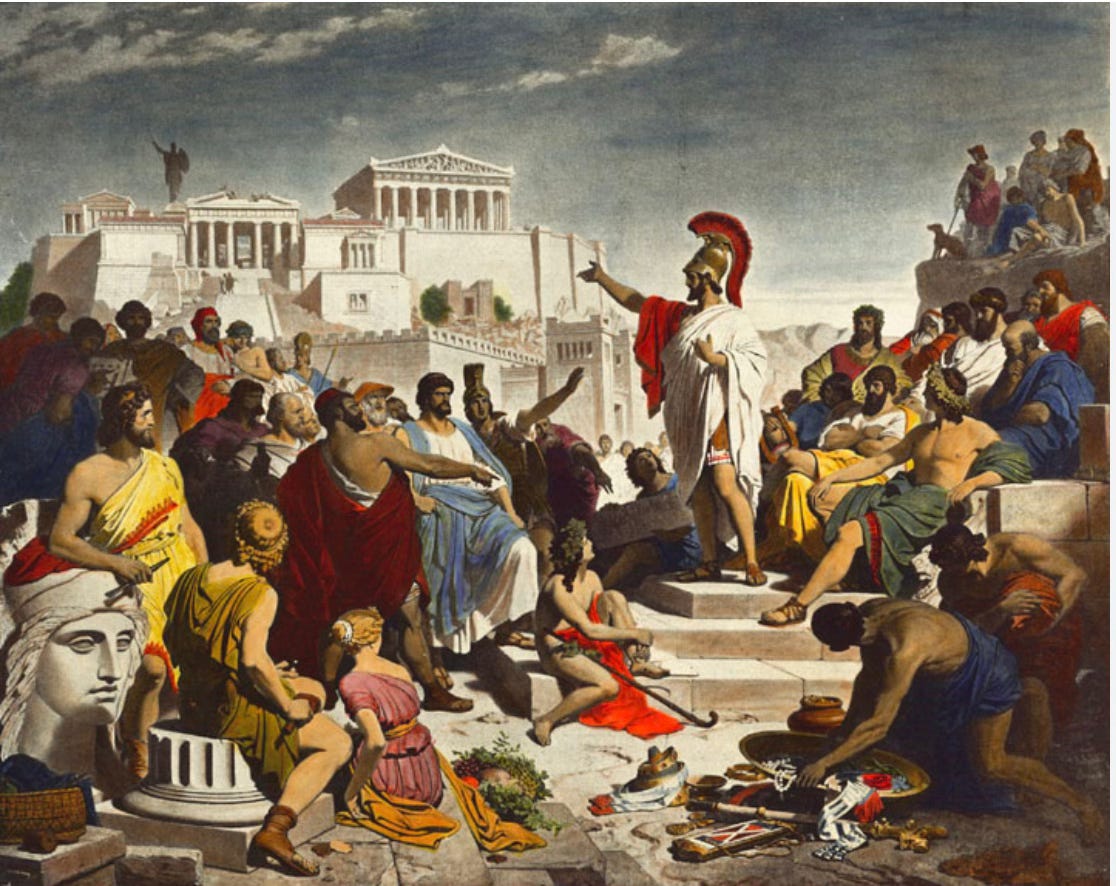
Donni Wang | Democracy Without Separation: Why the Ancient Greeks Never Believed in “The Economy”
Description
Note:This essay is based on a presentation delivered at the conference Degrowth: Bridging Green and Just in Central and Eastern Europe (Kraków, Poland, June 2026).
Many critics argue that modern economics can impede urgently needed social and political change by concealing questions of justice, equality, and social cohesion within the language of scale, optimization, and equilibrium. A fundamental reason for this is that the economy is formally treated as a distinct, value-neutral, expert-led sphere. This essay therefore turns to ancient Athens, the earliest democracy in the West (albeit a deeply flawed one), as a concrete illustration of a society in which economic life was not allowed to remain independent.
In Athens, financial decisions were understood as part of broader deliberations about collective flourishing rather than a conduit for competing self-interests. A close reading of evidence on public finance, employment, and wealth accumulation suggests that material activities were aligned with the democratic goals of mutual aid, communal wellbeing, and public honor in a consistent manner, resulting in non-separation between politics and economics.
Through juxtaposition with Athens, the special jurisdiction claimed for economic life in the modern era must contend not only with many Indigenous and non-Western traditions, but also with the democratic heritage of the West itself. Revisiting this important historical precedent forces adherents of modern economics to confront their own intellectual anomaly.
Part 1
Part 2
On the 500th anniversary of Martin Luther’s posting of his Ninety-Five Theses on a church door in Germany, a carefully staged reenactment took place in England. This time, a group of students and professors posted a long list of grievances at the entrances of the London School of Economics, calling for a fundamental overhaul of the economic discipline.
The symbolism was unmistakable. The protesters saw a direct relationship between mainstream economic theory on one the hand and widespread social inequality and ecological crisis on the other. Yet the field continues to enjoy special authority, enabled by an a priori assumption that economics operates according to objective rules and criteria. Yet for such a self-proclaimed science, its lack of basic predictive power was laid bare by the 2008 financial crisis, when some of the highly trained economists “failed” to anticipate the catastrophe. While afterwards they excused themselves by citing glitches in their mathematical models, the result was the suffering of millions and the bailout of irresponsible banks—results that were both politically devastating and ethically troubling.
Yet this separation of economics from society and politics represents a profound departure from the self-identified traditions of the West. This rift becomes especially apparent when modern economic thinking is placed alongside the ideas and practices of Athenian democracy. In Athens, wealth, power, and status were understood to carry meaning only within a strong polity, thus constituting a model of non-separation. It turns out that even though economic activity was robust in ancient Greece, much of it was integrated into political life and household management rather than unfolding in a distinct and autonomous sphere. This integration of economics and politics will hereafter be referred to as non-separation, while modern economic theory constitutes a model of separation.
However, a caveat about ancient Greece is