Episode Details
Back to Episodes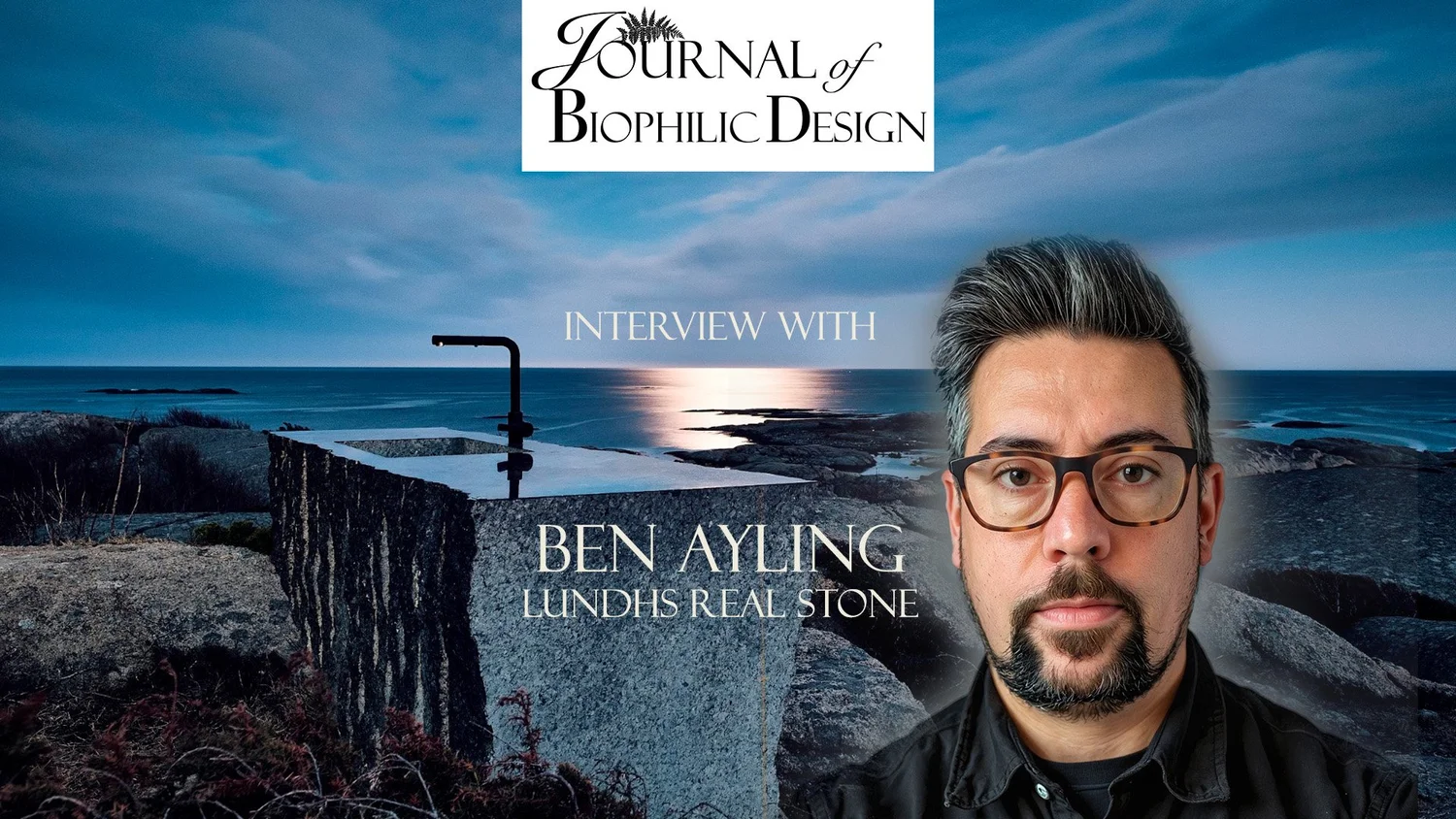
Dare to Dream - Touching Time
Description
"Engage with the material… don't dictate. Let the material help dictate the design… and dare to dream." — Benjamin Ayling
There is something deeply timeless about holding a piece of natural stone. Perhaps it is the cool surface beneath our fingertips. Perhaps it is the intricate mineral patterns that could never be replicated twice. Or perhaps it is something much older than conscious thought—a recognition that for almost all of human history, stone has been our shelter, our monuments, our meeting places and our memories.
While we are searching for healthier, more sustainable ways to design our buildings, natural stone deserves to be part of the Biophilic Design conversation once again.
During this conversation on The Journal of Biophilic Design Podcast, Benjamin Ayling, UK Business Development Manager for Lundhs and founding member of the Stone Collective, reflected on why this ancient material still resonates so deeply today.
More than a material
"It's not just a material, it's a geological process," Ben explains.
Every slab tells the story of immense natural forces—volcanoes, minerals, pressure and time. Lundhs' Larvikite, quarried in Norway, is around 300 million years old, while its anorthosite dates back almost one billion years. That perspective alone shifts the way we think about specification.
Rather than seeing stone as another surface finish, we begin to understand it as a fragment of Earth's history. Every vein, crystal and fossil record tells a story that simply cannot be manufactured.
As biophilic designers, we often talk about our innate connection to nature. Stone reminds us that nature is not simply something outside the window—it can become part of the spaces we inhabit every day.
The memory of the cave
Biophilic Design is built upon our evolutionary relationship with the natural world.
Ben suggests that perhaps our attraction to stone runs even deeper than aesthetics.
"Humans have evolved around rock and timber and water."
Listen Now
Love PodBriefly?
If you like Podbriefly.com, please consider donating to support the ongoing development.
Support Us