Episode Details
Back to Episodes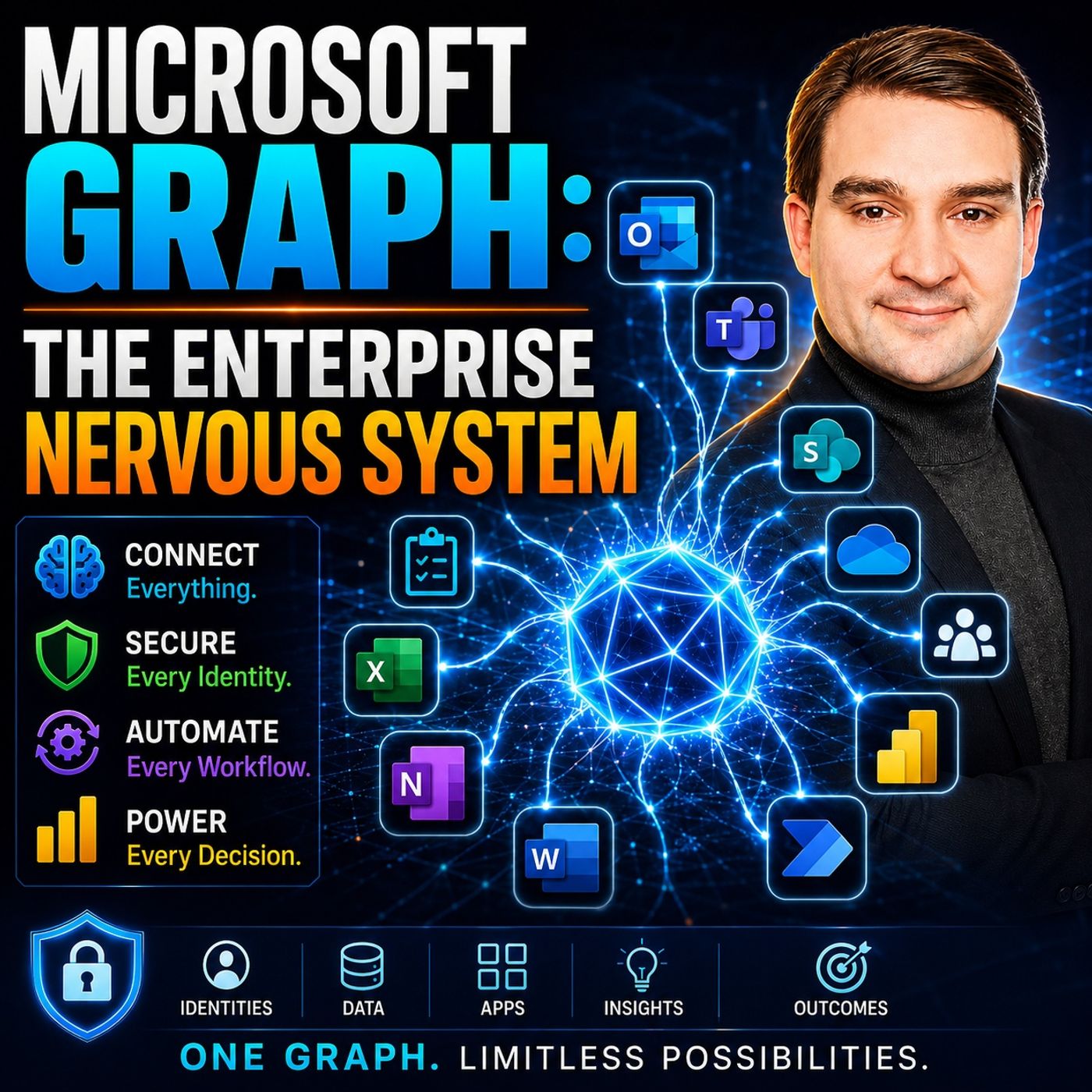
Microsoft Graph: The Enterprise Nervous System
Season 2
Published 1 month ago
Description
Enterprise IT has reached a tipping point. Organizations now manage millions of identities, files, applications, permissions, policies, and AI-powered workloads across Microsoft 365. Yet many IT departments still rely on manual administration, periodic audits, and reactive governance that simply cannot keep pace with modern business. In this episode, we explore why Microsoft Graph is evolving far beyond a developer API and becoming the enterprise nervous system that continuously detects, evaluates, and responds to changes across the entire Microsoft ecosystem. You'll discover how autonomous governance, AI agents, and policy-driven automation are transforming IT operations while preparing organizations for the next generation of intelligent infrastructure.
FROM MANUAL ADMINISTRATION TO AUTONOMOUS GOVERNANCE
Enterprise administration has continuously evolved over the past decades. Organizations moved from graphical interfaces to PowerShell scripting and eventually toward Microsoft Graph. Each generation reduced manual effort while increasing automation capabilities. However, Graph represents something fundamentally different. Rather than simply providing another API, it enables systems to monitor themselves, evaluate compliance continuously, and automatically remediate issues without requiring human intervention. This architectural shift transforms IT teams from administrators performing repetitive operational tasks into architects defining governance policies that intelligent systems enforce automatically across the tenant.
WHY MANUAL GOVERNANCE NO LONGER SCALES
Modern Microsoft 365 environments change every second. New Teams are created, permissions evolve, applications receive additional access, users change roles, and AI services continuously consume organizational data. Manual governance simply cannot keep pace with this level of complexity. As organizations grow, configuration drift, inconsistent security policies, excessive permissions, and undocumented exceptions become unavoidable. Traditional audits discover problems weeks or months after they occur, while autonomous governance identifies and resolves them almost immediately. Critical challenges include:
Rather than thinking of Microsoft Graph as another REST API, this episode presents Graph as the unified operational layer connecting Microsoft Entra ID, Teams, SharePoint, Exchange Online, OneDrive, Microsoft Defender, Microsoft Purview, and countless Microsoft 365 services. Like the human nervous system, Graph constantly collects signals, distributes information, coordinates decisions, and enables automated responses. Every identity change, permission update, compliance event, and security alert becomes part of a single operational data plane that intelligent systems can consume in real time. This unified architecture enables organizations to correlate events across multiple services instead of managing isolated technology silos.
THE THREE LAYERS OF AUTONOMOUS OPERATIONS
Building a self-managing tenant requires more than automation. Successful architectures combine three essential operational layers. The detection layer continuously observes tenant activity using Microsoft Graph change notifications, event-driven architectures, anomaly detection, and continuous compliance monitoring. The evaluation layer compares detected changes against governance policies, classifies risk, enriches context, and determines the appropriate response. Finally, the remediation layer automatically restores the desired state by adjusting permissions, applying labels, updating ownership, or enforcing compliance through Microsoft Graph APIs. Together these layers create infrastructure capable of maintaining itself
FROM MANUAL ADMINISTRATION TO AUTONOMOUS GOVERNANCE
Enterprise administration has continuously evolved over the past decades. Organizations moved from graphical interfaces to PowerShell scripting and eventually toward Microsoft Graph. Each generation reduced manual effort while increasing automation capabilities. However, Graph represents something fundamentally different. Rather than simply providing another API, it enables systems to monitor themselves, evaluate compliance continuously, and automatically remediate issues without requiring human intervention. This architectural shift transforms IT teams from administrators performing repetitive operational tasks into architects defining governance policies that intelligent systems enforce automatically across the tenant.
WHY MANUAL GOVERNANCE NO LONGER SCALES
Modern Microsoft 365 environments change every second. New Teams are created, permissions evolve, applications receive additional access, users change roles, and AI services continuously consume organizational data. Manual governance simply cannot keep pace with this level of complexity. As organizations grow, configuration drift, inconsistent security policies, excessive permissions, and undocumented exceptions become unavoidable. Traditional audits discover problems weeks or months after they occur, while autonomous governance identifies and resolves them almost immediately. Critical challenges include:
- Configuration drift
- Shadow IT
- Permission sprawl
- Manual compliance reviews
- Delayed incident response
Rather than thinking of Microsoft Graph as another REST API, this episode presents Graph as the unified operational layer connecting Microsoft Entra ID, Teams, SharePoint, Exchange Online, OneDrive, Microsoft Defender, Microsoft Purview, and countless Microsoft 365 services. Like the human nervous system, Graph constantly collects signals, distributes information, coordinates decisions, and enables automated responses. Every identity change, permission update, compliance event, and security alert becomes part of a single operational data plane that intelligent systems can consume in real time. This unified architecture enables organizations to correlate events across multiple services instead of managing isolated technology silos.
THE THREE LAYERS OF AUTONOMOUS OPERATIONS
Building a self-managing tenant requires more than automation. Successful architectures combine three essential operational layers. The detection layer continuously observes tenant activity using Microsoft Graph change notifications, event-driven architectures, anomaly detection, and continuous compliance monitoring. The evaluation layer compares detected changes against governance policies, classifies risk, enriches context, and determines the appropriate response. Finally, the remediation layer automatically restores the desired state by adjusting permissions, applying labels, updating ownership, or enforcing compliance through Microsoft Graph APIs. Together these layers create infrastructure capable of maintaining itself