Episode Details
Back to Episodes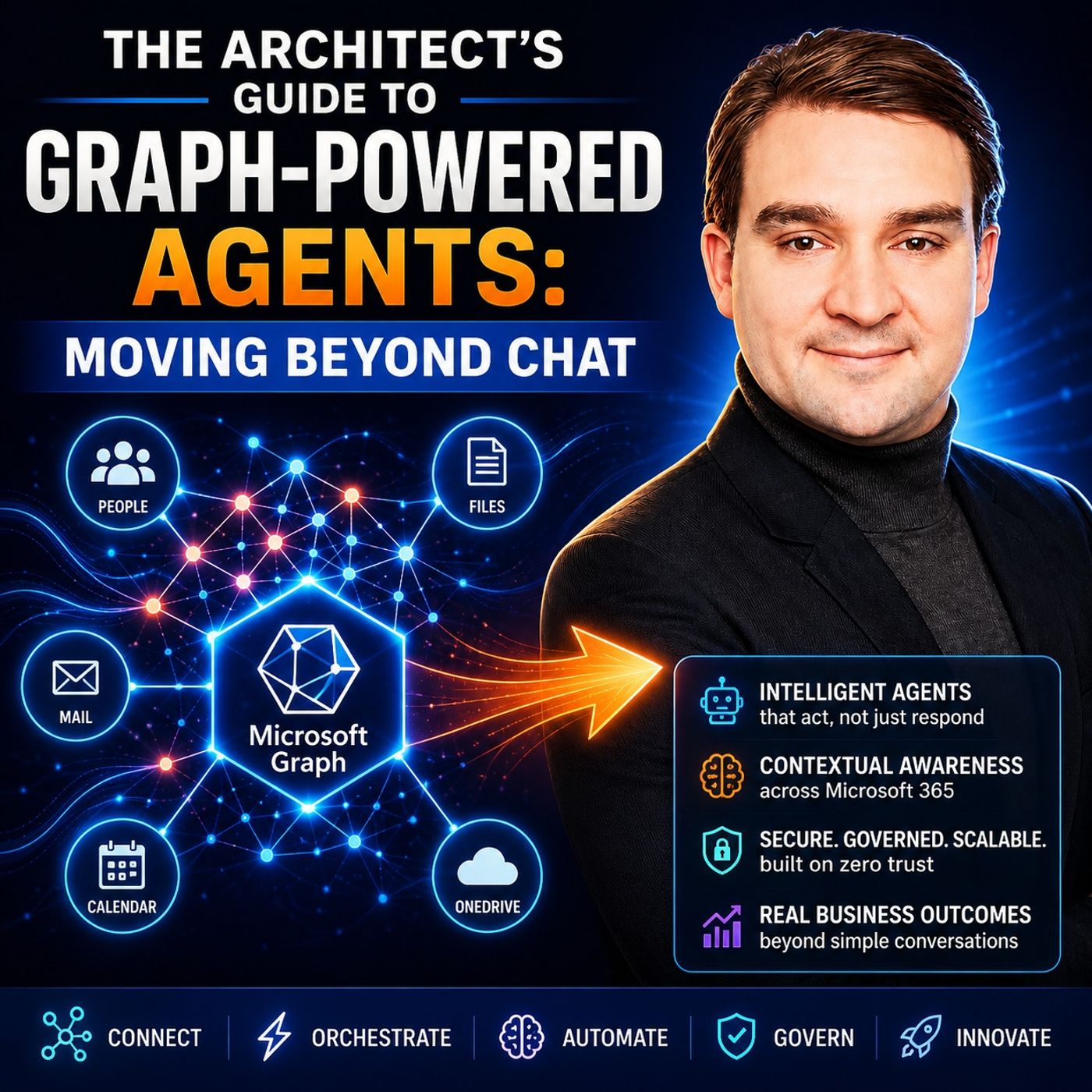
The Architect's Guide to Graph-Powered Agents: Moving Beyond Chat
Season 2
Published 1 month ago
Description
Artificial Intelligence has rapidly evolved from simple chatbots into sophisticated enterprise agents capable of reasoning, orchestrating workflows, and executing business processes. Yet many organizations are still approaching AI from the wrong perspective. They focus on building conversational interfaces while overlooking the critical infrastructure that transforms a chatbot into a true business agent. In this episode, we explore why Microsoft Graph has become the foundation for enterprise AI and how modern organizations are building Graph-powered agents that understand organizational context, securely access business data, coordinate across systems, and deliver measurable business outcomes.
WHY CHAT ALONE ISN'T ENOUGH
Large Language Models are incredibly powerful at generating text, summarizing information, and answering questions. However, they know nothing about your organization unless you provide context. Without access to company knowledge, relationships, permissions, workflows, and governance, AI simply predicts likely answers based on public training data rather than making informed business decisions.Enterprise AI requires far more than conversational intelligence. Successful agents combine organizational context, persistent memory, secure identities, and the authority to execute business actions. Microsoft Graph provides this missing layer by connecting people, documents, meetings, communications, identities, and workflows into a unified knowledge graph.
MICROSOFT GRAPH AS THE ENTERPRISE MEMORY
Microsoft Graph is much more than an API. It serves as the digital nervous system of Microsoft 365, exposing relationships between employees, Teams conversations, Outlook calendars, SharePoint content, OneDrive files, and Entra identities.Instead of treating information as isolated documents, Graph allows AI agents to understand how work actually flows throughout an organization. Rather than simply searching files, Graph-powered agents discover experts, identify collaboration patterns, recognize business relationships, and provide recommendations based on real organizational behavior.This dramatically improves AI accuracy while reducing hallucinations because decisions are grounded in live enterprise data instead of generic internet knowledge.
MOVING FROM ASSISTANTS TO AUTONOMOUS AGENTS
Most AI deployments today remain read-only assistants. They retrieve information but require humans to perform every business action manually. Modern enterprise agents go much further by interacting directly with Microsoft Graph, business applications, and enterprise systems.Typical capabilities include:
TOOL CALLING, MCP, AND MODERN AGENT ARCHITECTURE
One of the most important architectural advances is the introduction of structured tool calling and the Model Context Protocol (MCP). Rather than manually building integrations for every AI model, MCP provides a standardized communication layer between enterprise agents and business systems.This significantly reduces integration complexity while allowing organizations to expose Microsoft Graph capabilities securely across multiple AI platforms. Combined with orchestration frameworks such as LangGraph, organizations can build sophisticated workflows where AI agents reason, invoke tools, validate results, request human approval when necessary, and continue execution without losing context.Modern agent architectures rely on:
WHY CHAT ALONE ISN'T ENOUGH
Large Language Models are incredibly powerful at generating text, summarizing information, and answering questions. However, they know nothing about your organization unless you provide context. Without access to company knowledge, relationships, permissions, workflows, and governance, AI simply predicts likely answers based on public training data rather than making informed business decisions.Enterprise AI requires far more than conversational intelligence. Successful agents combine organizational context, persistent memory, secure identities, and the authority to execute business actions. Microsoft Graph provides this missing layer by connecting people, documents, meetings, communications, identities, and workflows into a unified knowledge graph.
MICROSOFT GRAPH AS THE ENTERPRISE MEMORY
Microsoft Graph is much more than an API. It serves as the digital nervous system of Microsoft 365, exposing relationships between employees, Teams conversations, Outlook calendars, SharePoint content, OneDrive files, and Entra identities.Instead of treating information as isolated documents, Graph allows AI agents to understand how work actually flows throughout an organization. Rather than simply searching files, Graph-powered agents discover experts, identify collaboration patterns, recognize business relationships, and provide recommendations based on real organizational behavior.This dramatically improves AI accuracy while reducing hallucinations because decisions are grounded in live enterprise data instead of generic internet knowledge.
MOVING FROM ASSISTANTS TO AUTONOMOUS AGENTS
Most AI deployments today remain read-only assistants. They retrieve information but require humans to perform every business action manually. Modern enterprise agents go much further by interacting directly with Microsoft Graph, business applications, and enterprise systems.Typical capabilities include:
- Scheduling meetings automatically
- Updating CRM records
- Creating Microsoft Planner tasks
- Sending emails
- Managing approvals
- Executing business workflows
TOOL CALLING, MCP, AND MODERN AGENT ARCHITECTURE
One of the most important architectural advances is the introduction of structured tool calling and the Model Context Protocol (MCP). Rather than manually building integrations for every AI model, MCP provides a standardized communication layer between enterprise agents and business systems.This significantly reduces integration complexity while allowing organizations to expose Microsoft Graph capabilities securely across multiple AI platforms. Combined with orchestration frameworks such as LangGraph, organizations can build sophisticated workflows where AI agents reason, invoke tools, validate results, request human approval when necessary, and continue execution without losing context.Modern agent architectures rely on:
- Microsoft Graph
- Model Context Protocol (MCP)
- Azure OpenAI Function Call