Episode Details
Back to Episodes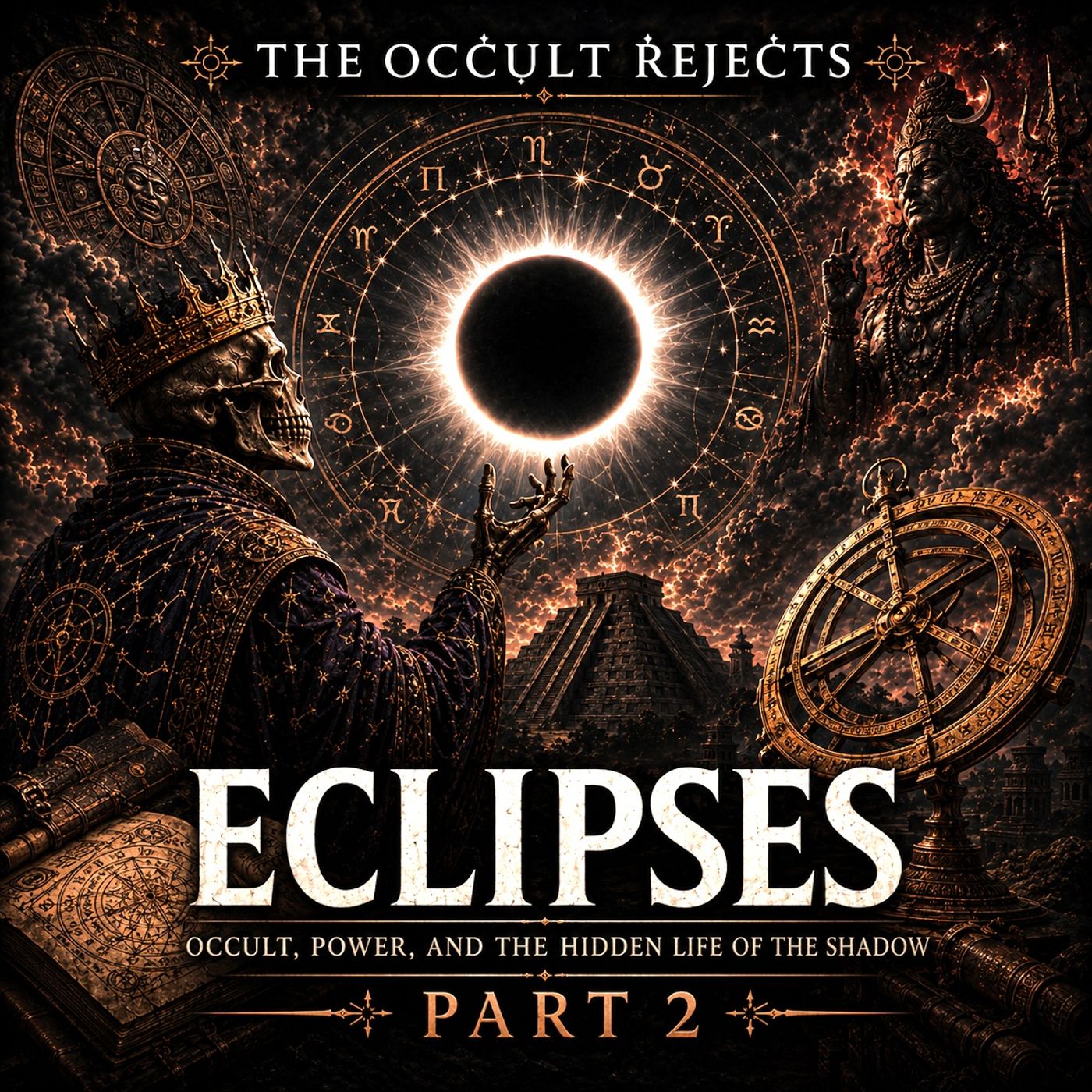
Eclipses Part 2- Occult, Power & The Hidden Life of The Shadow
Published 3 months, 2 weeks ago
Description
Links For The Occult Rejects
https://linktr.ee/theoccultrejects
Occult Research Institute
https://www.occultresearchinstitute.org/
Substack
https://substack.com/@theoccultrejects?r=7auau0&utm_campaign=profile&utm_medium=profile-page
Cash App
https://cash.app/$theoccultrejects
Venmo
@TheOccultRejects
Buy Me A Coffee
buymeacoffee.com/TheOccultRejects
Patreon
https://www.patreon.com/TheOccultRejects
Bibliography
Aldana, Gerardo. “Maya Calendar and Mesoamerican Astronomy.” Used for the connection between Maya astronomy, the Dresden Codex, ritual activity timed by the 260-day count, priestly governance, and the larger fusion of astronomy, sacred calendars, art, and political order.
Britannica. “9 Celestial Omens.” Used for the Columbus-Jamaica eclipse story, especially the account of Columbus using astronomical tables to predict the February 1504 lunar eclipse and pressure Indigenous Jamaicans into resuming food supplies.
Britannica. “Al-Battānī.” Used for medieval Islamic astronomy and al-Battānī’s refinement of values for the length of the year, seasons, precession of the equinoxes, and inclination of the ecliptic.
Britannica. “Astrology.” Used for the distinction between personal astrology and mundane astrology, especially the treatment of eclipses as events connected to peoples, nations, rulers, and large-scale worldly affairs.
Britannica. “Dresden Codex.” Used for the Maya manuscript tradition, astronomical calculations, and eclipse-prediction material in the Dresden Codex.
Britannica. “History of Astronomy.” Used for the broader path from Babylonian observation to Greek mathematical astronomy, Islamic astronomy, and later European traditions, supporting the episode’s argument that eclipse fear and eclipse prediction helped push astronomy forward.
Britannica. “Inti.” Used for the Inca Sun god, solar state religion, and the connection between Inti, imperial legitimacy, and eclipse as disturbance of divine order.
Britannica. “Mama Quilla.” Used for the Inca Moon Mother, lunar cycles, women’s rhythms, festival timing, and the Moon’s role in sacred calendrical order.
Britannica. “Navagraha.” Used for Rahu and Ketu as eclipse-associated shadow powers, with Rahu connected to the ascending lunar node and Ketu to the descending lunar node.
Cambridge University Press. “Greco-Roman Astronomy and Astrology.” In The Cambridge History of Science. Used for Greco-Roman astral omen traditions and the point that eclipses were among the chief astral events treated as ominous.
Cambridge University Press. Religion in Sixteenth-Century Mexico. Used for the Tzitzimimeh as female star beings connected to eclipse danger and the threat of cosmic disorder when the Sun weakens.
Exploratorium. “Eclipse Stories from Around the World.” Used for comparative global eclipse traditions, including Inuit Malina and Igaluk/Anningan-style pursuit traditions, Aymara fires, and other recurring mythic patterns around eclipse as devouring, sickness, pursuit, and sacred disruption.
Exploratorium. “Navajo Knowledge of the Cosmos.” Used for Diné eclipse teaching, especially eclipse as sacred time requiring reverence rather than spectacle.
Hamacher, Duane W., and Ray P. Norris. “Eclipses in Australian Aboriginal Astronomy.” Used for Aboriginal eclipse traditions, including negative associations with bad omens, evil magic, disease, blood, and death, along with evidence that many Aboriginal groups also understood relationships between Sun, Earth, and Moon.
Jones, Alexander. “The Astronomical Resources for Ancient Astral Prognostications.” Used for ancient omen astrology, especially the point that scholars could forecast likely occurrences of ominous astral events such as eclipses while still requiring interpretation of the actual event in context.
Kumar, S. P. “Astronomy and Colonial Rule in Madras, 1791–1835.” Used for
https://linktr.ee/theoccultrejects
Occult Research Institute
https://www.occultresearchinstitute.org/
Substack
https://substack.com/@theoccultrejects?r=7auau0&utm_campaign=profile&utm_medium=profile-page
Cash App
https://cash.app/$theoccultrejects
Venmo
@TheOccultRejects
Buy Me A Coffee
buymeacoffee.com/TheOccultRejects
Patreon
https://www.patreon.com/TheOccultRejects
Bibliography
Aldana, Gerardo. “Maya Calendar and Mesoamerican Astronomy.” Used for the connection between Maya astronomy, the Dresden Codex, ritual activity timed by the 260-day count, priestly governance, and the larger fusion of astronomy, sacred calendars, art, and political order.
Britannica. “9 Celestial Omens.” Used for the Columbus-Jamaica eclipse story, especially the account of Columbus using astronomical tables to predict the February 1504 lunar eclipse and pressure Indigenous Jamaicans into resuming food supplies.
Britannica. “Al-Battānī.” Used for medieval Islamic astronomy and al-Battānī’s refinement of values for the length of the year, seasons, precession of the equinoxes, and inclination of the ecliptic.
Britannica. “Astrology.” Used for the distinction between personal astrology and mundane astrology, especially the treatment of eclipses as events connected to peoples, nations, rulers, and large-scale worldly affairs.
Britannica. “Dresden Codex.” Used for the Maya manuscript tradition, astronomical calculations, and eclipse-prediction material in the Dresden Codex.
Britannica. “History of Astronomy.” Used for the broader path from Babylonian observation to Greek mathematical astronomy, Islamic astronomy, and later European traditions, supporting the episode’s argument that eclipse fear and eclipse prediction helped push astronomy forward.
Britannica. “Inti.” Used for the Inca Sun god, solar state religion, and the connection between Inti, imperial legitimacy, and eclipse as disturbance of divine order.
Britannica. “Mama Quilla.” Used for the Inca Moon Mother, lunar cycles, women’s rhythms, festival timing, and the Moon’s role in sacred calendrical order.
Britannica. “Navagraha.” Used for Rahu and Ketu as eclipse-associated shadow powers, with Rahu connected to the ascending lunar node and Ketu to the descending lunar node.
Cambridge University Press. “Greco-Roman Astronomy and Astrology.” In The Cambridge History of Science. Used for Greco-Roman astral omen traditions and the point that eclipses were among the chief astral events treated as ominous.
Cambridge University Press. Religion in Sixteenth-Century Mexico. Used for the Tzitzimimeh as female star beings connected to eclipse danger and the threat of cosmic disorder when the Sun weakens.
Exploratorium. “Eclipse Stories from Around the World.” Used for comparative global eclipse traditions, including Inuit Malina and Igaluk/Anningan-style pursuit traditions, Aymara fires, and other recurring mythic patterns around eclipse as devouring, sickness, pursuit, and sacred disruption.
Exploratorium. “Navajo Knowledge of the Cosmos.” Used for Diné eclipse teaching, especially eclipse as sacred time requiring reverence rather than spectacle.
Hamacher, Duane W., and Ray P. Norris. “Eclipses in Australian Aboriginal Astronomy.” Used for Aboriginal eclipse traditions, including negative associations with bad omens, evil magic, disease, blood, and death, along with evidence that many Aboriginal groups also understood relationships between Sun, Earth, and Moon.
Jones, Alexander. “The Astronomical Resources for Ancient Astral Prognostications.” Used for ancient omen astrology, especially the point that scholars could forecast likely occurrences of ominous astral events such as eclipses while still requiring interpretation of the actual event in context.
Kumar, S. P. “Astronomy and Colonial Rule in Madras, 1791–1835.” Used for