Episode Details
Back to Episodes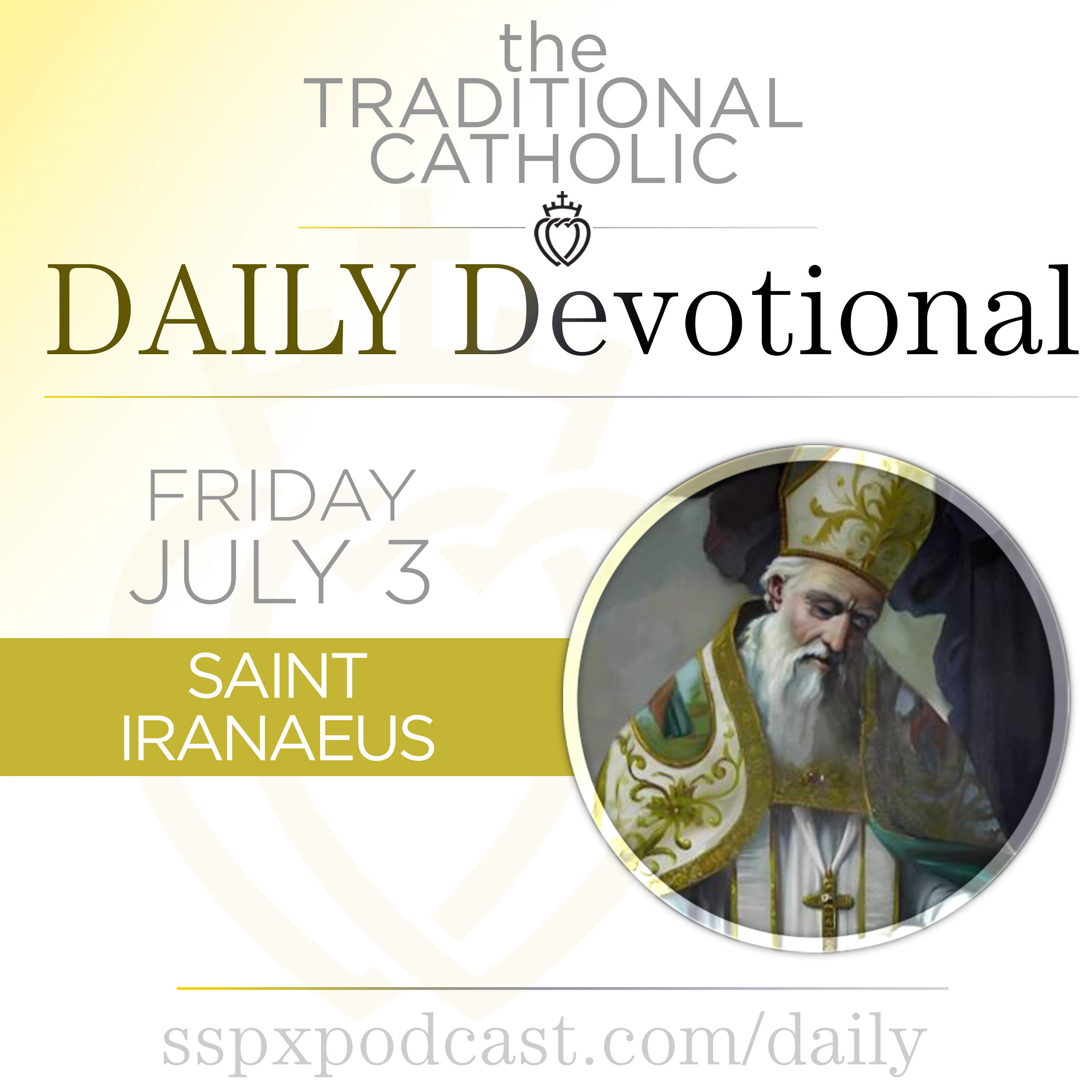
Jul 3 – S Irenaus
Description
Sources Used Today:
- "Christian Charity" — From Trinity Sunday to the Assumption
- "Declaration read before the episcopal consecrations" (FSSPX.news)
- The Spiritual Life — Archbishop Marcel Lefebvre (Angelus Press)
Please support our new project, the Archbishop Lefebvre Biography Audiobook!
- Learn more:https://www.youtube.com/watch?v=Y-Wp4MQdK2o
- Donate:https://sspx.gifts/audiobook
and the rest of Christian history. He wasn't one of the Twelve, but he knew men who were. In fact, he spent part of his youth listening to the preaching of Polycarp of Smyrna, who had himself been a disciple of the Apostle John.
Imagine that for a moment.
When Irenaeus spoke about the Apostles, he wasn't repeating stories that had been passed down for centuries. He was remembering conversations with someone who had actually known them.
Born around the year 130, probably in Asia Minor, Irenaeus grew up in a world where Christianity was still young. The memories of the Apostles were fresh, but so were the dangers. False teachers were appearing throughout the Church, offering secret doctrines and claiming to possess hidden knowledge that only a select few could understand.
Irenaeus wasn't impressed.
Instead of inventing something new, he pointed people back to something very old. He argued that the true faith wasn't hidden at all. It had been preached publicly by the Apostles, handed down through the bishops, and preserved in the Church. That simple idea became one of the strongest arguments for what Catholics now call Apostolic Tradition.
His greatest work, Against Heresies, wasn't written merely to win arguments. It was written to protect ordinary Christians from confusion. Again and again, Irenaeus reminded his readers that God is not trying to hide Himself behind secret codes or mysterious teachings. The Gospel is meant to be proclaimed openly to the whole world.
Later, Irenaeus became Bishop of Lyons in what is now France.