Episode Details
Back to Episodes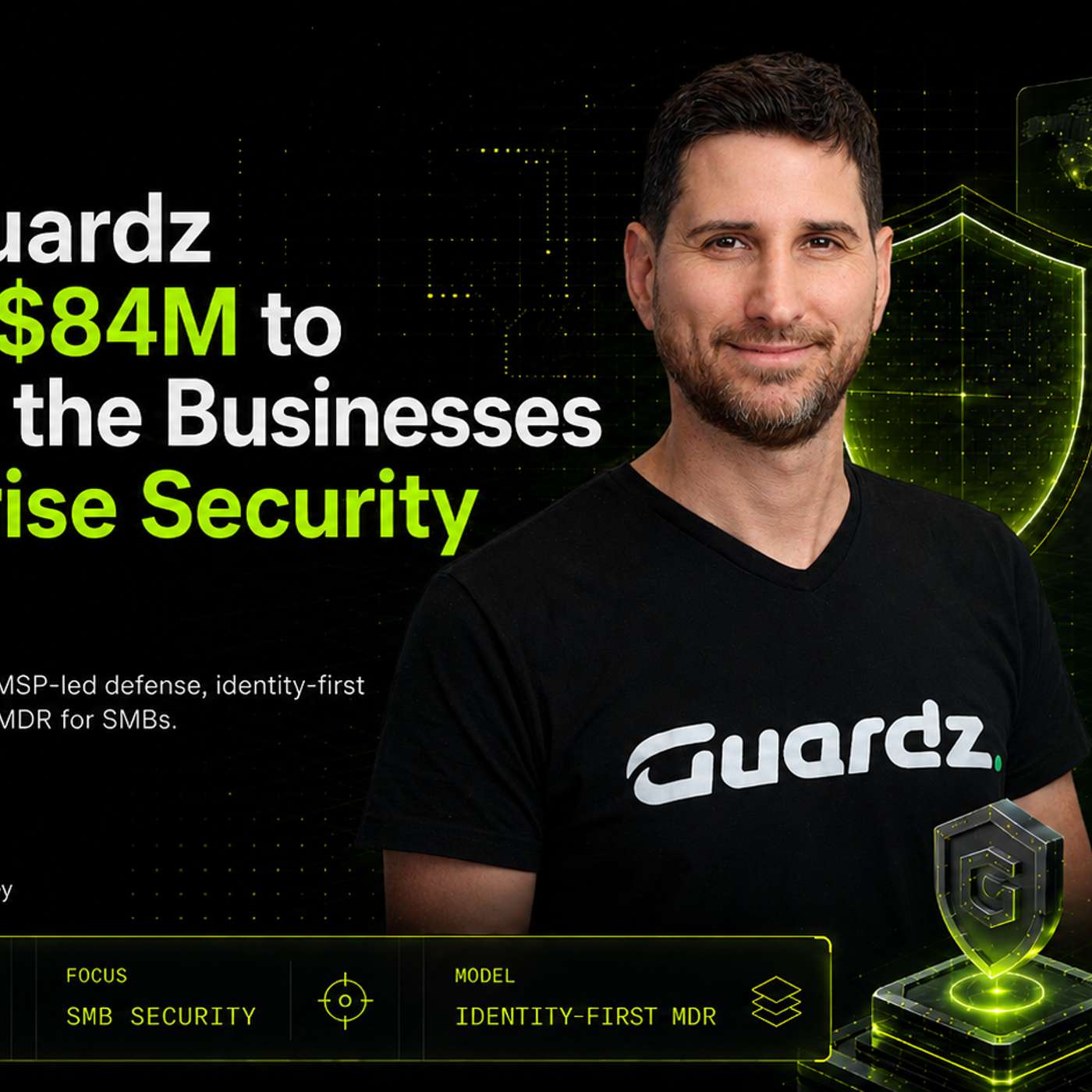
Why Guardz Raised $84M to Defend the Businesses Enterprise Security Forgot
Description
This story was originally published on HackerNoon at: https://hackernoon.com/why-guardz-raised-$84m-to-defend-the-businesses-enterprise-security-forgot.
Guardz CEO Dor Eisner on why identity is the new perimeter, what AI-native security really means, and the $84M bet on MSPs defending SMBs.
Check more stories related to undefined at: https://hackernoon.com/c/undefined.
You can also check exclusive content about #guardz, #cyber-security, #software-engineering, #technology, #artificial-intelligence, #threat-intelligence, #good-company, #dor-eisner, and more.
This story was written by: @ishanpandey. Learn more about this writer by checking @ishanpandey's about page,
and for more stories, please visit hackernoon.com.
What is Guardz? Guardz is an Israeli-founded, Miami-anchored cybersecurity company that sells a unified, AI-native detection-and-response platform to Managed Service Providers (MSPs), who in turn secure small and mid-sized businesses (SMBs). It was founded in 2022 by Dor Eisner and Alon Lavi and launched from stealth in early 2023.
Who is Dor Eisner? Eisner is co-founder and CEO of Guardz. He served in Israel's Unit 8200 and was a founding executive at IntSights, the threat-intelligence firm acquired by Rapid7 for roughly $350m in 2021.
How much has Guardz raised? A total of $84m: a $10m seed (January 2023), an $18m Series A (December 2023), and a $56m Series B led by ClearSky (June 2025).
What is Guardz's core thesis? That cybercrime has industrialised down to the smallest victim, so defence must be automated and delivered through the MSP channel, which amortises one expert across hundreds of clients. Identity, not the endpoint, is the centre of the modern attack.
Key data points:
Stolen credentials appear in 88% of basic web-application attacks and remain the leading initial access vector across breaches (Verizon 2025 DBIR).
43% of all cyberattacks target small businesses; 88% of SMB breaches involve ransomware, versus 39% at large organisations (Verizon 2025 DBIR; StationX).
Underground phishing kits sell for under $25-50, a 24-hour DDoS-for-hire for about $45, and verified corporate access from initial-access brokers for an average of roughly $2,700 (Deepstrike; Stingr.ai, 2025-26).
A typical SOC sees about 2,992 alerts a day; 46% are false positives and 63% go unaddressed (Vectra AI 2026; Microsoft/Omdia 2026).