Episode Details
Back to Episodes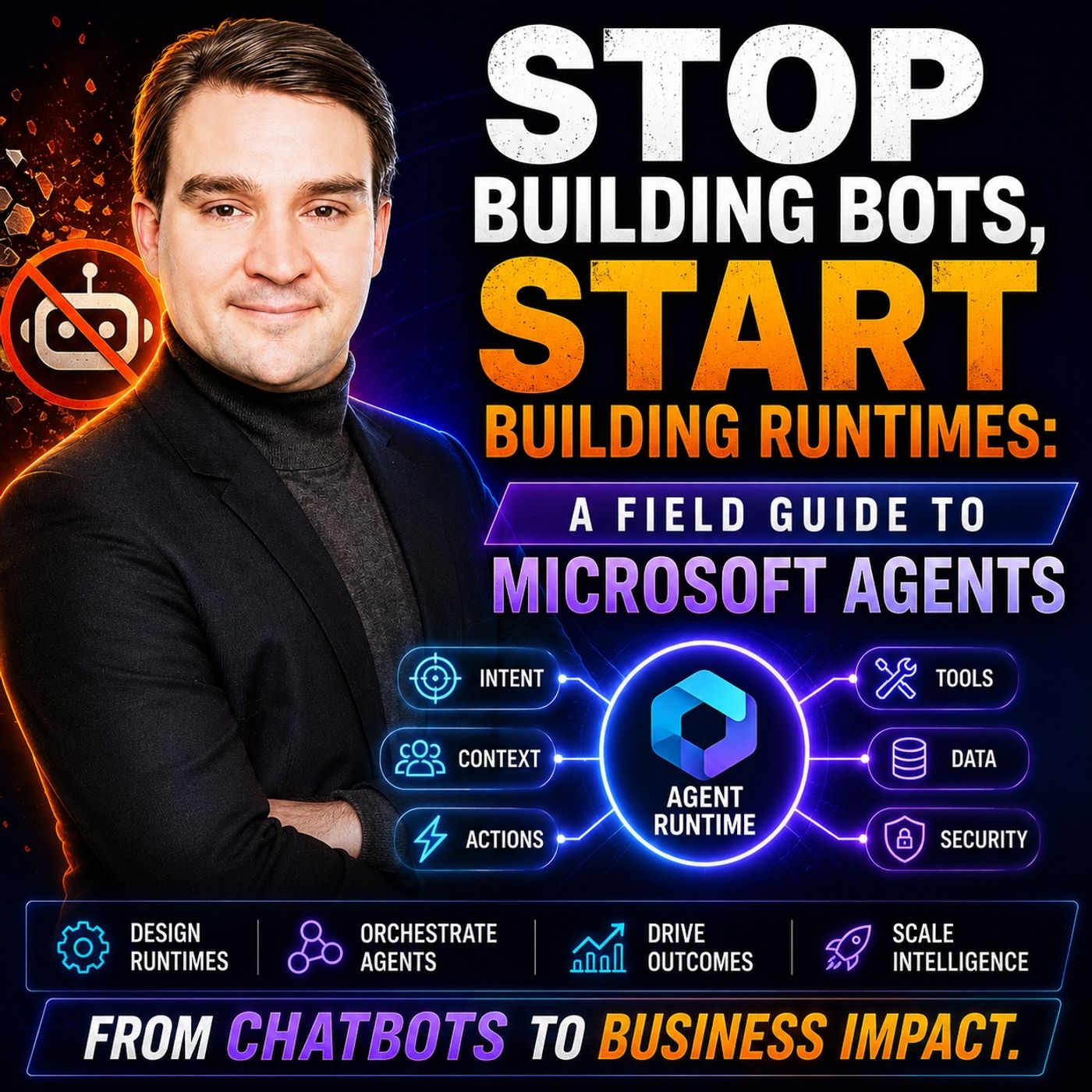
Stop Building Bots, Start Building Runtimes: A Field Guide to Microsoft Agents
Season 2
Published 1 month, 1 week ago
Description
Everyone is calling Build 2026 the AI conference. Most of the attention went toward new copilots, voice experiences, and increasingly capable models. But beneath the headlines, Microsoft quietly introduced something far more significant. The real story is not about another AI feature. It is about the emergence of a completely new infrastructure layer for enterprise computing. For years, organizations approached AI as a chatbot problem. Build a conversational interface, connect it to some data, add a few prompts, and call it an AI strategy. That approach worked for experimentation, but it was never designed for scale. Chatbots forget context, struggle with governance, and become increasingly difficult to manage as more departments begin building their own solutions. What Microsoft is building now is fundamentally different. We are moving from assistants that answer questions to agents that operate as active participants inside the enterprise.
THE FOUR-LAYER MODEL THAT CHANGES EVERYTHING
One of the most important concepts emerging from Microsoft's latest announcements is the idea that agents should no longer be viewed as products. They should be viewed as layers within a larger system. Most organizations currently evaluate AI by comparing products. They ask whether they should use Copilot, Copilot Studio, Azure AI Foundry, GitHub Copilot, or Security Copilot. That approach creates confusion because these technologies solve very different problems. The better way to think about agents is through architecture. The modern agent stack consists of four distinct layers:
WHY IDENTITY IS THE REAL STORY
The most important announcement from Build 2026 was not a new agent. It was identity. Historically, automation systems operated through shared service accounts. Scripts, bots, and integrations all ran under generic credentials that nobody really owned. This created security blind spots and made auditing nearly impossible. When something happened, it was difficult to determine which system actually performed the action. Microsoft's new model changes that entirely. Every agent now receives its own identity inside Microsoft Entra. Every agent becomes a first-class principal within the organization. It has its own permissions, its own audit trail, and its own lifecycle. This seemingly small architectural change creates enormous downstream benefits:
THE RISE OF AGENT INFRASTRUCTURE
Most organizations are still focused on building individual agents. The problem is that individual agents are only part of the story. Real business value emerges when agents work together. A retrieval agent gathers information. An analysis agent interprets it. A communication agent creates output. A coordinating agent manages the workflow. Suddenly, what looked like a chatbot becomes an operational system. This is where Azure AI Foundry Agent Service enters the picture. Foundry provides the runtime environment where agents actually execute. It handles:
THE FOUR-LAYER MODEL THAT CHANGES EVERYTHING
One of the most important concepts emerging from Microsoft's latest announcements is the idea that agents should no longer be viewed as products. They should be viewed as layers within a larger system. Most organizations currently evaluate AI by comparing products. They ask whether they should use Copilot, Copilot Studio, Azure AI Foundry, GitHub Copilot, or Security Copilot. That approach creates confusion because these technologies solve very different problems. The better way to think about agents is through architecture. The modern agent stack consists of four distinct layers:
- Experience Layer
- Agent Layer
- Runtime Layer
- Governance Layer
WHY IDENTITY IS THE REAL STORY
The most important announcement from Build 2026 was not a new agent. It was identity. Historically, automation systems operated through shared service accounts. Scripts, bots, and integrations all ran under generic credentials that nobody really owned. This created security blind spots and made auditing nearly impossible. When something happened, it was difficult to determine which system actually performed the action. Microsoft's new model changes that entirely. Every agent now receives its own identity inside Microsoft Entra. Every agent becomes a first-class principal within the organization. It has its own permissions, its own audit trail, and its own lifecycle. This seemingly small architectural change creates enormous downstream benefits:
- Least-privilege access
- Full auditability
- Conditional Access enforcement
- Individual credential management
- Instant revocation capabilities
THE RISE OF AGENT INFRASTRUCTURE
Most organizations are still focused on building individual agents. The problem is that individual agents are only part of the story. Real business value emerges when agents work together. A retrieval agent gathers information. An analysis agent interprets it. A communication agent creates output. A coordinating agent manages the workflow. Suddenly, what looked like a chatbot becomes an operational system. This is where Azure AI Foundry Agent Service enters the picture. Foundry provides the runtime environment where agents actually execute. It handles:
- Memory management
- Session persistence
- Multi-agent orchestration
- Tool discovery
- State manageme