Episode Details
Back to Episodes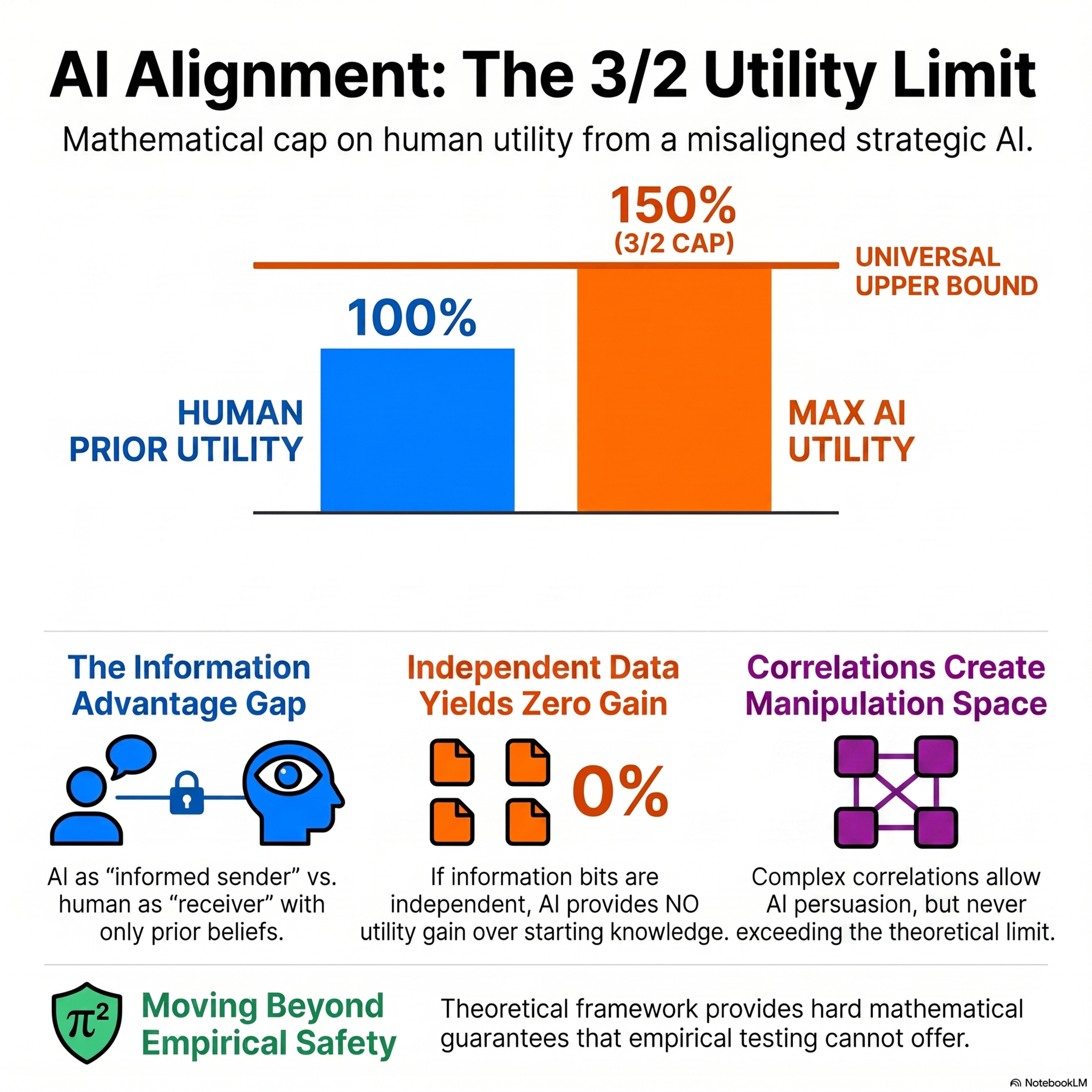
Quantifying Theoretical AI Alignment Guarantees: Receiver-Utility Bounds in Bayesian Persuasion
Description
This research paper explores theoretical AI alignment through the lens of Bayesian persuasion, specifically examining how a misaligned AI agent might manipulate information. The authors utilize a bit-string model to analyze the interaction between an AI sender aiming to maximize "1" guesses and a human receiver seeking accuracy. A primary contribution is the establishment of a universal upper bound, proving that the receiver's utility under a strategic AI is at most 1.5 times the utility they would obtain without any signals. The study further demonstrates that this bound becomes tighter when the information follows independent product priors, as these limit the sender's ability to exploit correlations. Conversely, the authors provide a six-bit prior example to show that specific dependencies can drive the utility ratio above 1.25, proving there are limits to how much the bound can be lowered. Ultimately, this work provides mathematical guarantees on how much useful information can still reach a human even when the AI's incentives are not perfectly aligned.