Episode Details
Back to Episodes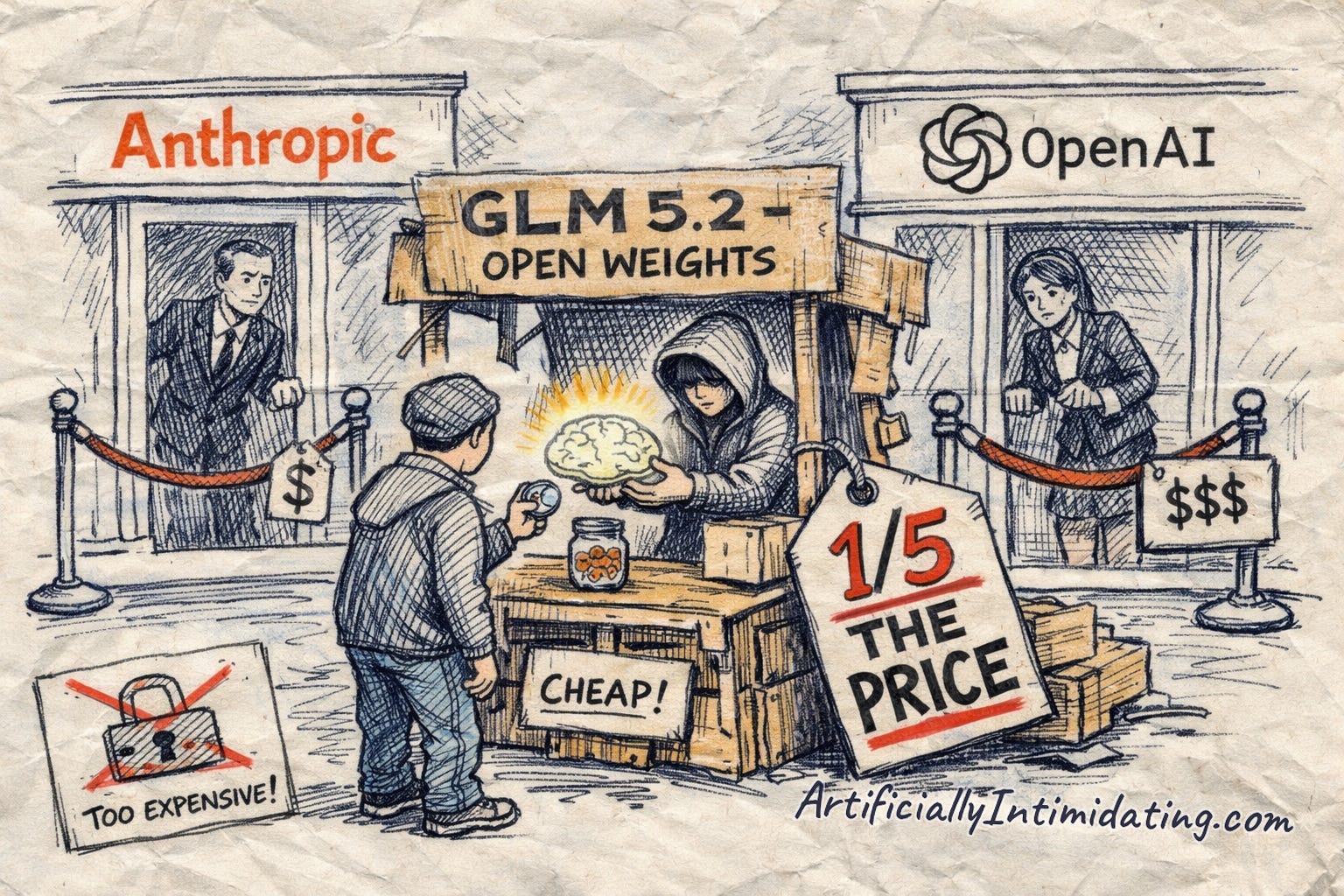
Frontier AI Got 80% Cheaper and Named After a Crypto Crash -- AI Brief June 28
Description
Good day, humans. The theme writes itself today: the best coding model of the weekend is free and Chinese, the most powerful American one is locked behind a government velvet rope, and somewhere in the middle a philosopher is calling your chatbot Satan. On deck — Zhipu's GLM 5.2 gutting frontier pricing, OpenAI's crypto-coded model names, a nasty new attack on coding agents, what Georgia's teachers really think of AI, and Žižek's prog-rock theology. Let's get into it.
China's Open Model Just Undercut the Frontier by 80%
What happened: Chinese lab Zhipu AI (a.k.a. Z.ai) dropped GLM 5.2, a 744-billion-parameter open-weight model under the permissive MIT license that lands within a few points of Anthropic's Claude Opus 4.8 on agentic coding benchmarks — at roughly one-fifth the cost to run. It posts 81.0 on Terminal-Bench 2.1 to Opus's 85.0, and ships a one-million-token context window big enough to swallow an entire codebase at once.
Why it matters: Earlier this week we covered enterprises dumping pricey tokens for DeepSeek — this is the next chapter, and a louder one. “Open weight” means anyone can download GLM 5.2, run it on their own servers, and pay the lab that built it nothing. When a free model gets within arm's reach of the most expensive one on the market, frontier-grade AI stops being a moat and starts being a commodity.
What everyone's saying: Comparisons to early-2025's “DeepSeek shock” are everywhere, but practitioners argue this one sticks: unlike DeepSeek, GLM 5.2 is genuinely strong at agentic work — planning, coding, testing, looping — the autonomous tasks enterprises actually want to automate. Harvey co-founder Gabe Pereyra and a chorus of developers have called it the first open model that feels competitive in daily use.
My read between the lines: The quiet kicker is regulatory. A June executive order now grants Washington up to 30 days of pre-release access to “covered frontier models” — which is exactly why OpenAI's newest model is trickling out to a handful of approved partners (more on that below). Zhipu, sitting outside that framework, simply gets to ship. We may have built a world where the safest models are the hardest to obtain and the Chinese one is a free download.
📖 Further reading: Thanks to Apple, Your Favorite AI Tool Is a Dead Tool Walking — our case that frontier models are sliding into interchangeable commodities just got a 744-billion-parameter exhibit.
A frontier-grade model for a fifth of the price is great — but a cheaper brain still doesn't do the work for you. Viktor does. It's an AI agent that lives in your Slack and plugs into 3,000+ tools, shipping real output: research reports, live dashboards, working code, entire campaigns. Not a chatbot you babysit all day — a coworker you hand things to. New readers get $50 off their first month. Hire Viktor →
OpenAI Named Its New Models After a Crypto Crash
What happened: OpenAI launched a limited preview of its GPT-5.6 family on Friday, splitting it into three permanent tiers — Sol (flagship reasoning and coding), Terra (an everyday model at about half the cost of GPT-5.5), and Luna (the fastest and cheapest). The structure mirrors Anthropic's Opus / Sonnet / Haiku; the names, less intentionally, mirror three of crypto's most infamous tick