Episode Details
Back to Episodes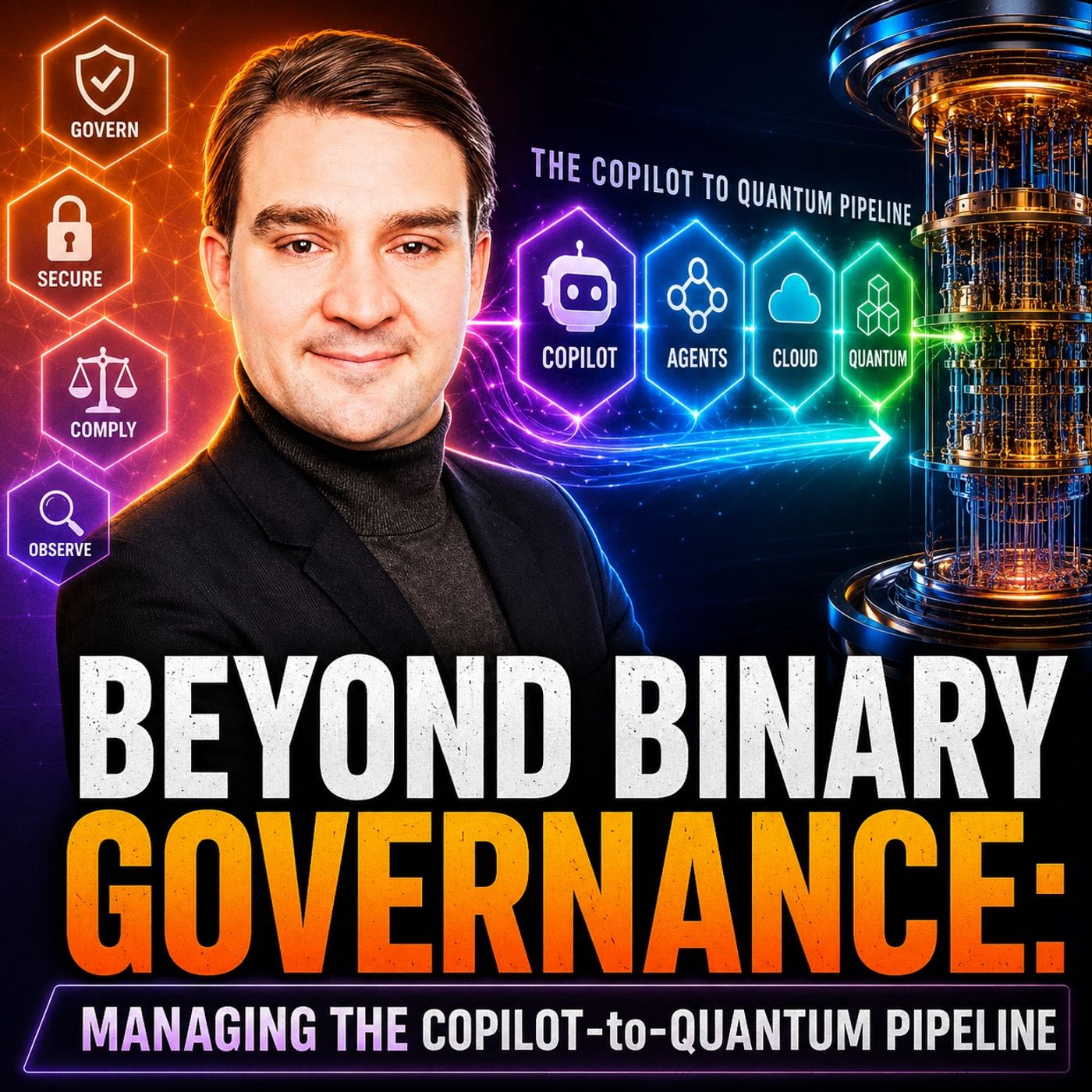
Beyond Binary Governance: Managing the Copilot-to-Quantum Pipeline
Season 2
Published 1 month, 1 week ago
Description
The enterprise AI conversation is focused on copilots, agents, automation, and productivity. But beneath the excitement lies a much bigger challenge that few organizations are discussing. The governance models that have guided enterprise technology for decades were built for a binary world—one based on certainty, permissions, and deterministic outcomes. The next generation of intelligent systems will not operate that way. In this episode of the m365.fm podcast, we explore why AI governance is rapidly evolving from a security discussion into an architectural challenge. As organizations deploy Microsoft Copilot, AI agents, Azure services, and prepare for the arrival of quantum computing, they are unknowingly creating intelligence pipelines that span multiple logical frameworks. Traditional governance models were designed around binary decisions. AI introduces probabilistic reasoning. Quantum computing introduces entirely new concepts such as superposition and measurement collapse. The result is a future where governance must operate across multiple layers simultaneously. This episode examines why organizations should stop treating quantum computing as a distant problem and start viewing it as a strategic governance constraint today. The decisions made around Microsoft 365, Copilot, data classification, encryption, identity, and compliance over the next few years will determine whether enterprises are ready for the hybrid intelligence era.
THE BREAKDOWN OF BINARY THINKING
Most governance frameworks assume clear answers. Access is either granted or denied. Data is either confidential or public. Policies are either compliant or non-compliant. AI changes this foundation. Large language models and AI agents operate using confidence scores and probabilities. Instead of certainty, organizations must learn how to govern systems that reason in shades of likelihood. The challenge becomes even more complex when future quantum workloads enter the equation.
WHY COPILOT IS ONLY THE BEGINNING
Many organizations view Microsoft Copilot as the destination. In reality, Copilot is only the entry point. As AI-generated insights influence business decisions, create new content, and trigger additional workflows, organizations create continuous feedback loops between data, decisions, and automation. These loops will eventually connect with optimization engines, intelligent agents, and future quantum services. Key topics include:
One of the most important discussions in the episode centers around post-quantum cryptography. Organizations often assume quantum threats begin when large-scale quantum computers arrive. In reality, the threat starts now through "harvest now, decrypt later" strategies, where encrypted data is collected today for future decryption. We discuss:
Microsoft's vision for Agent Fabric represents far more than AI orchestration. It may become the governance foundation for future hybrid intelligence systems that combine classical computing, AI agents, and quantum resources. The episode explores how orchestration platforms could evolve into enterprise control planes responsible for routing workloads, enforcing policy, maintaining compliance, and tracking auditability across increasingly complex environments.
BUILDING THE THREE LAYERS OF HYBRID GOVERNANCE
THE BREAKDOWN OF BINARY THINKING
Most governance frameworks assume clear answers. Access is either granted or denied. Data is either confidential or public. Policies are either compliant or non-compliant. AI changes this foundation. Large language models and AI agents operate using confidence scores and probabilities. Instead of certainty, organizations must learn how to govern systems that reason in shades of likelihood. The challenge becomes even more complex when future quantum workloads enter the equation.
WHY COPILOT IS ONLY THE BEGINNING
Many organizations view Microsoft Copilot as the destination. In reality, Copilot is only the entry point. As AI-generated insights influence business decisions, create new content, and trigger additional workflows, organizations create continuous feedback loops between data, decisions, and automation. These loops will eventually connect with optimization engines, intelligent agents, and future quantum services. Key topics include:
- The evolution from AI assistants to intelligent orchestration platforms
- How decision loops create new governance requirements
- Why auditability becomes more difficult as systems become more autonomous
- The hidden risks of hybrid intelligence architectures
One of the most important discussions in the episode centers around post-quantum cryptography. Organizations often assume quantum threats begin when large-scale quantum computers arrive. In reality, the threat starts now through "harvest now, decrypt later" strategies, where encrypted data is collected today for future decryption. We discuss:
- Quantum-safe cryptography roadmaps
- Crypto-agility as a business requirement
- Long-term confidentiality challenges
- The future of encryption in Microsoft ecosystems
Microsoft's vision for Agent Fabric represents far more than AI orchestration. It may become the governance foundation for future hybrid intelligence systems that combine classical computing, AI agents, and quantum resources. The episode explores how orchestration platforms could evolve into enterprise control planes responsible for routing workloads, enforcing policy, maintaining compliance, and tracking auditability across increasingly complex environments.
BUILDING THE THREE LAYERS OF HYBRID GOVERNANCE
Listen Now
Love PodBriefly?
If you like Podbriefly.com, please consider donating to support the ongoing development.
Support Us