Episode Details
Back to Episodes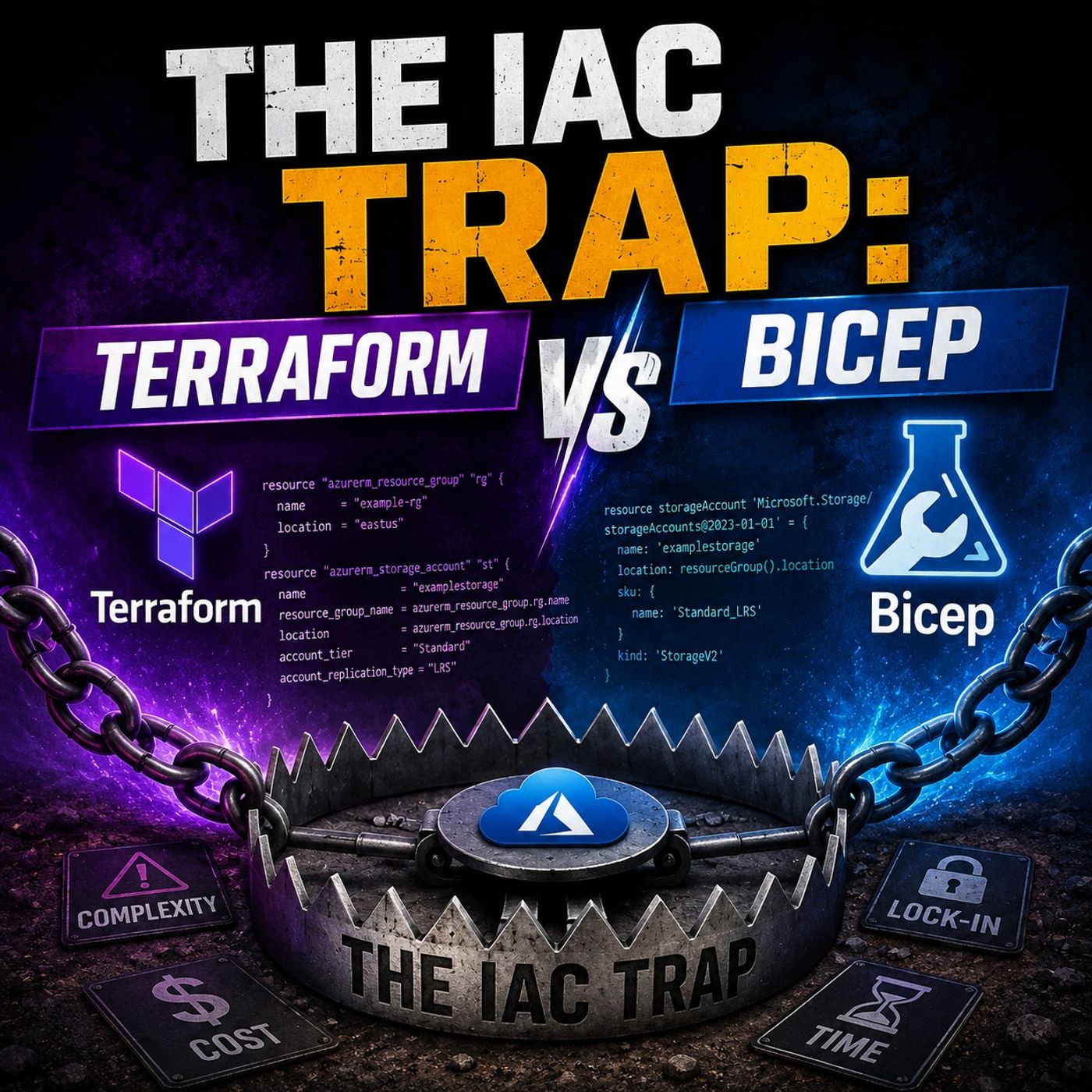
The IaC Trap:Terraform vs. Bicep – Which One Wins?
Season 2
Published 1 month, 1 week ago
Description
Infrastructure as Code has become one of the most important disciplines in modern cloud engineering. Whether you're deploying Azure landing zones, managing enterprise-scale infrastructure, implementing governance controls, or building platform engineering capabilities, Infrastructure as Code promises consistency, repeatability, and automation.Yet one of the biggest debates in the Azure ecosystem continues to divide architects, platform engineers, DevOps teams, and cloud administrators:Terraform or Bicep?At first glance, the answer appears simple. Terraform offers multi-cloud flexibility and a massive ecosystem. Bicep delivers native Azure integration, day-zero feature support, and seamless governance alignment.But the real story goes much deeper.In this episode, we explore the hidden architectural assumptions behind both tools and uncover what many organizations miss when evaluating Infrastructure as Code platforms. The discussion moves beyond syntax comparisons and feature checklists to examine operational models, governance implications, security considerations, platform engineering strategies, and long-term ownership costs.The real Infrastructure as Code trap isn't choosing Terraform or Bicep.The trap is choosing without understanding the operating model behind the tool.
WHY THE TOOL ISN'T THE MOST IMPORTANT DECISION
Most Infrastructure as Code discussions focus on technical features.People compare syntax, module ecosystems, deployment workflows, cloud support, and learning curves.While those factors matter, they often distract from the more important question:Where does the source of truth actually live?Terraform and Bicep answer this question very differently.Terraform relies on a persistent state file that acts as the memory of your infrastructure.Bicep relies on Azure Resource Manager itself as the source of truth.This single architectural difference influences almost every aspect of operations, governance, security, scalability, and platform engineering.
THE HIDDEN COST OF TERRAFORM STATE MANAGEMENT
One of the most overlooked topics in Infrastructure as Code is state management.Terraform's state file is effectively a database that tracks every resource, dependency, configuration, and relationship within your environment.That state must be stored somewhere.Organizations typically build:
THE SECURITY RISKS HIDING INSIDE STATE FILES
Security is often treated as a deployment concern.However, Terraform introduces an additional security consideration through its state architecture.State files frequently contain:
WHY THE TOOL ISN'T THE MOST IMPORTANT DECISION
Most Infrastructure as Code discussions focus on technical features.People compare syntax, module ecosystems, deployment workflows, cloud support, and learning curves.While those factors matter, they often distract from the more important question:Where does the source of truth actually live?Terraform and Bicep answer this question very differently.Terraform relies on a persistent state file that acts as the memory of your infrastructure.Bicep relies on Azure Resource Manager itself as the source of truth.This single architectural difference influences almost every aspect of operations, governance, security, scalability, and platform engineering.
THE HIDDEN COST OF TERRAFORM STATE MANAGEMENT
One of the most overlooked topics in Infrastructure as Code is state management.Terraform's state file is effectively a database that tracks every resource, dependency, configuration, and relationship within your environment.That state must be stored somewhere.Organizations typically build:
- Remote state backends
- Storage accounts
- Blob versioning
- State locking mechanisms
- Backup strategies
- Access control models
THE SECURITY RISKS HIDING INSIDE STATE FILES
Security is often treated as a deployment concern.However, Terraform introduces an additional security consideration through its state architecture.State files frequently contain:
- Database connection strings
- API keys
- Service credentials
- Access tokens
- Resource identifiers
- Network topology information