Episode Details
Back to Episodes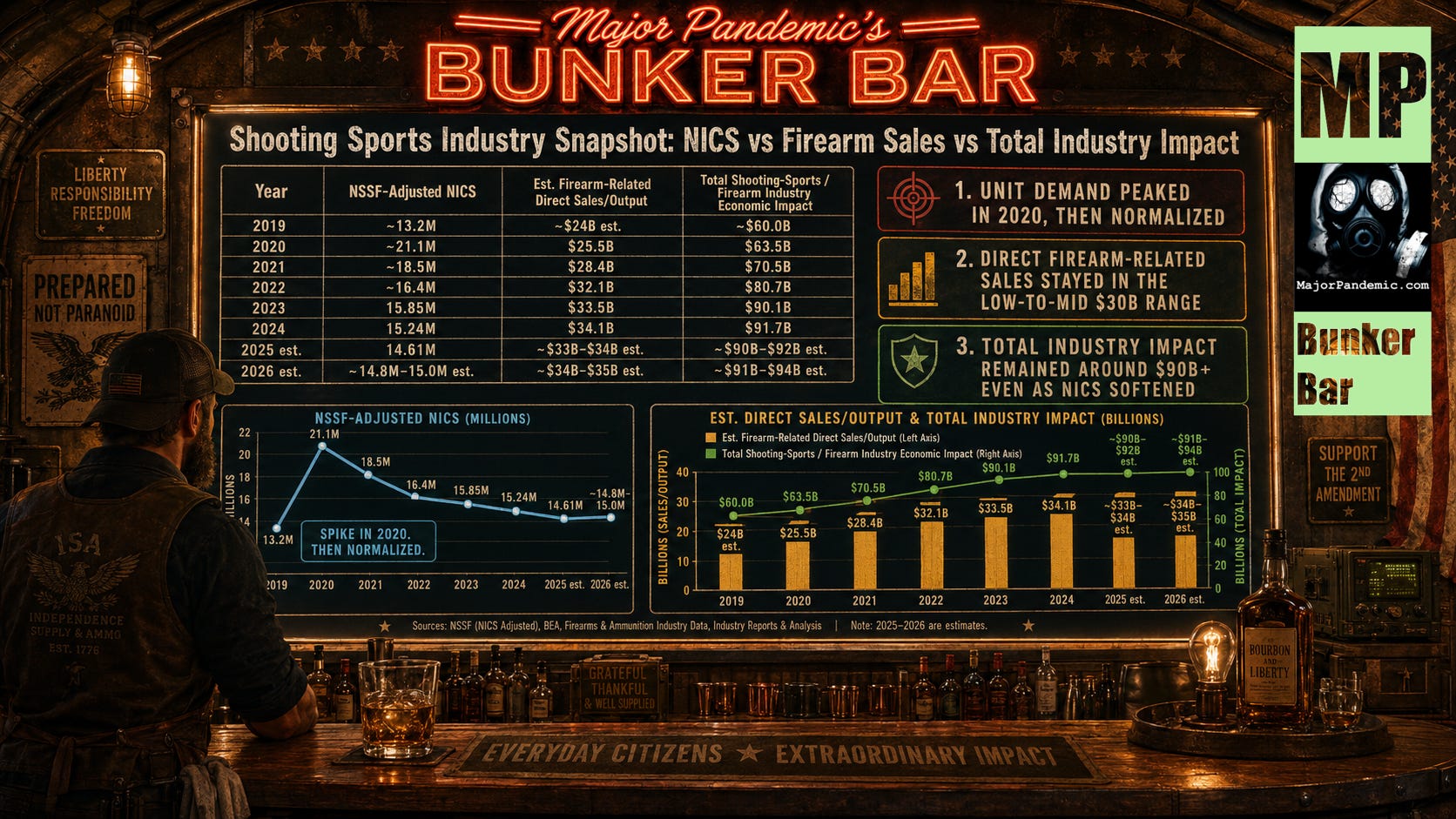
The Firearms Industry is Going Broke
Description
Why the Firearms Industry Is Struggling: The Post-2020 Gun Sales Hangover No One Wants to Talk About
SEO Title: Why the Firearms Industry Is Struggling in 2026: Gun Sales, NICS Checks, Inventory Glut & the Post-2020 HangoverMeta Description: The firearms industry is facing one of its toughest downturns in decades as post-2020 demand fades, NICS checks soften, inventory piles up, and manufacturers fight for fewer buyers.Suggested URL Slug: why-firearms-industry-is-struggling-2026Focus Keywords: firearms industry, gun sales, NICS checks, shooting sports industry, firearms market downturn, gun industry sales, firearm manufacturers, gun retailers, suppressor sales, firearms accessories
The Firearms Industry Is Not Dead — But It Is Absolutely in Trouble
Welcome back to Major Pandemic’s Bunker Bar, where the drinks are cold, the walls are reinforced, and the industry talk is brutally honest.
There is no soft way to say this: the firearms industry is struggling right now.
Not the Second Amendment. Not gun culture. Not shooting sports as a lifestyle. Those are still alive and well. But the actual business of selling new firearms, moving inventory, keeping manufacturers healthy, and keeping retailers profitable is in one of the roughest spots it has seen in decades.
The warning signs are everywhere: slow retail traffic, stacked distributor shelves, manufacturers fighting over the same shrinking demand, and accessory companies wondering where the next wave of customers is supposed to come from.
The problem is not that Americans suddenly stopped caring about guns. The problem is that the industry built itself for the boom — and the boom ended.
2020 Was the Peak, Not the New Normal
The firearms industry had an unbelievable run in 2020. Between COVID, riots, political uncertainty, personal-security concerns, and first-time buyers flooding the market, gun sales exploded.
NICS checks became the easiest public shorthand for that surge. They are not perfect, because a NICS check does not equal one gun sold, and not every firearm purchase requires a new background check. But they are still one of the best indicators of retail firearm demand.
The rough trend tells the story:
YearEstimated NSSF-Adjusted NICS Checks2019~13.2M2020~21.1M2021~18.5M2022~16.4M2023~15.85M2024~15.24M2025~14.61M2026 est.~14.8M–15.0M
That means the industry is down roughly 25% to 30% from the 2020 boom peak based on NICS-driven demand indicators.
That is a massive drop.
But here is where the story gets more complicated: the broader shooting sports industry can still look strong in dollars while firearm unit demand is clearly down.
The Dollar Numbers Can Be Misleading
Some people look at the shooting sports industry and say, “What are you talking about? The industry is up. The economic impact is huge.”
That is partly true — but it depends which number you are looking at.
There are really three different things people mix together:
* NICS checks — a proxy for firearm transaction volume.
* Firearm-related direct sales/output — closer to actual commercial revenue from firearms, ammo, accessories, retail, and related channels.
* Total shooting sports economic impact — the broader economic footprint, including jobs, wages, suppliers, taxes, and downstream spending.
Those are not the same thing.
A cleaner view looks like this:
YearNSSF-Adjusted NICSEst. Fire