Episode Details
Back to Episodes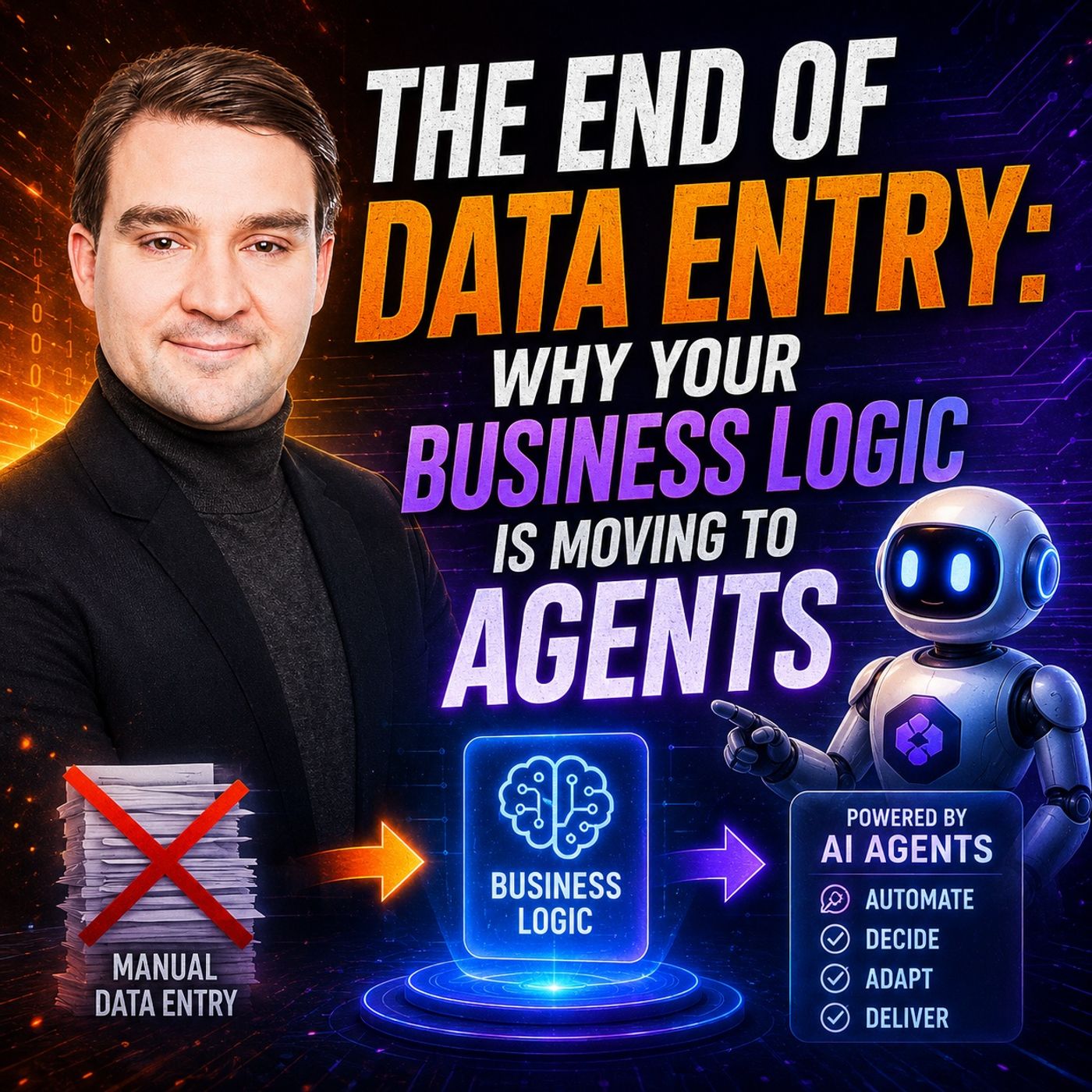
The End of Data Entry: Why Your Business Logic is Moving to Agents
Season 2
Published 1 month, 1 week ago
Description
For decades, enterprise software was built around a simple idea: store information in a central system and make it available when people need it. CRM systems stored customer data. ERP platforms stored transactions. Finance systems stored invoices. Organizations invested billions of dollars building systems of record designed to become the single source of truth. But something fundamental has changed. Enterprise software is no longer just storing information. Modern business platforms are beginning to observe events, reason about context, make decisions, and orchestrate actions across multiple systems. The future is no longer about systems of record. It is about systems of action powered by AI agents. In this episode, we explore why manual data entry is becoming obsolete, how agentic workflows are reshaping enterprise operations, and why organizations that adopt AI agents today will gain a significant competitive advantage over those that continue relying on humans as integration layers between disconnected systems.
THE SYSTEM OF RECORD ERA IS COMING TO AN END
For years, organizations believed that creating a centralized repository of business information would solve operational inefficiencies. The reality turned out very differently. Data may live inside business systems, but work often happens elsewhere. Employees spend countless hours moving information between emails, spreadsheets, CRMs, ERPs, ticketing systems, and procurement platforms. Sales representatives manually enter lead information. Finance teams reconcile invoices across multiple systems. Procurement managers spend their days reading supplier emails and updating purchase orders. Customer service teams route tickets manually based on limited information. These activities are not strategic work. They are operational workarounds. The episode explores how organizations unknowingly created an "integration tax" where highly skilled employees spend significant portions of their day acting as translators between systems that should already be communicating with each other.
FROM SYSTEM OF RECORD TO SYSTEM OF ACTION
The next evolution of enterprise software is already underway. Instead of simply storing information, modern platforms can now participate in business processes. This shift introduces a new operating model where software observes events, reasons using enterprise data, and executes actions automatically within predefined governance boundaries. Topics discussed include:
UNDERSTANDING THE AGENTIC SHIFT
Agentic AI represents a fundamental departure from traditional automation. Rather than following static workflows and rigid rules, agents continuously evaluate situations, gather context, apply business logic, and determine appropriate actions. Every agent follows a common pattern: First, an event occurs. Second, the agent reasons about that event using enterprise context. Third, the agent orchestrates actions across systems and workflows. This event-reasoning-orchestration model allows organizations to automate increasingly complex business scenarios while maintaining governance, compliance, and human oversight.
WHY GENERIC AI IS NOT ENOUGH
One of the most important discussions in this episode focuses on the difference between generic AI and enterprise agents. Large language models trained on public internet data can answer questions and generate content, but they do not understand the unique realities of your organization. They do not know:
THE SYSTEM OF RECORD ERA IS COMING TO AN END
For years, organizations believed that creating a centralized repository of business information would solve operational inefficiencies. The reality turned out very differently. Data may live inside business systems, but work often happens elsewhere. Employees spend countless hours moving information between emails, spreadsheets, CRMs, ERPs, ticketing systems, and procurement platforms. Sales representatives manually enter lead information. Finance teams reconcile invoices across multiple systems. Procurement managers spend their days reading supplier emails and updating purchase orders. Customer service teams route tickets manually based on limited information. These activities are not strategic work. They are operational workarounds. The episode explores how organizations unknowingly created an "integration tax" where highly skilled employees spend significant portions of their day acting as translators between systems that should already be communicating with each other.
FROM SYSTEM OF RECORD TO SYSTEM OF ACTION
The next evolution of enterprise software is already underway. Instead of simply storing information, modern platforms can now participate in business processes. This shift introduces a new operating model where software observes events, reasons using enterprise data, and executes actions automatically within predefined governance boundaries. Topics discussed include:
- Event-driven business processes
- Autonomous decision support
- Workflow orchestration
- Operational automation
- AI-powered execution
UNDERSTANDING THE AGENTIC SHIFT
Agentic AI represents a fundamental departure from traditional automation. Rather than following static workflows and rigid rules, agents continuously evaluate situations, gather context, apply business logic, and determine appropriate actions. Every agent follows a common pattern: First, an event occurs. Second, the agent reasons about that event using enterprise context. Third, the agent orchestrates actions across systems and workflows. This event-reasoning-orchestration model allows organizations to automate increasingly complex business scenarios while maintaining governance, compliance, and human oversight.
WHY GENERIC AI IS NOT ENOUGH
One of the most important discussions in this episode focuses on the difference between generic AI and enterprise agents. Large language models trained on public internet data can answer questions and generate content, but they do not understand the unique realities of your organization. They do not know:
- Customer relationships
- Contract terms
- Approval policies
- Security boundaries
- Bu