Episode Details
Back to Episodes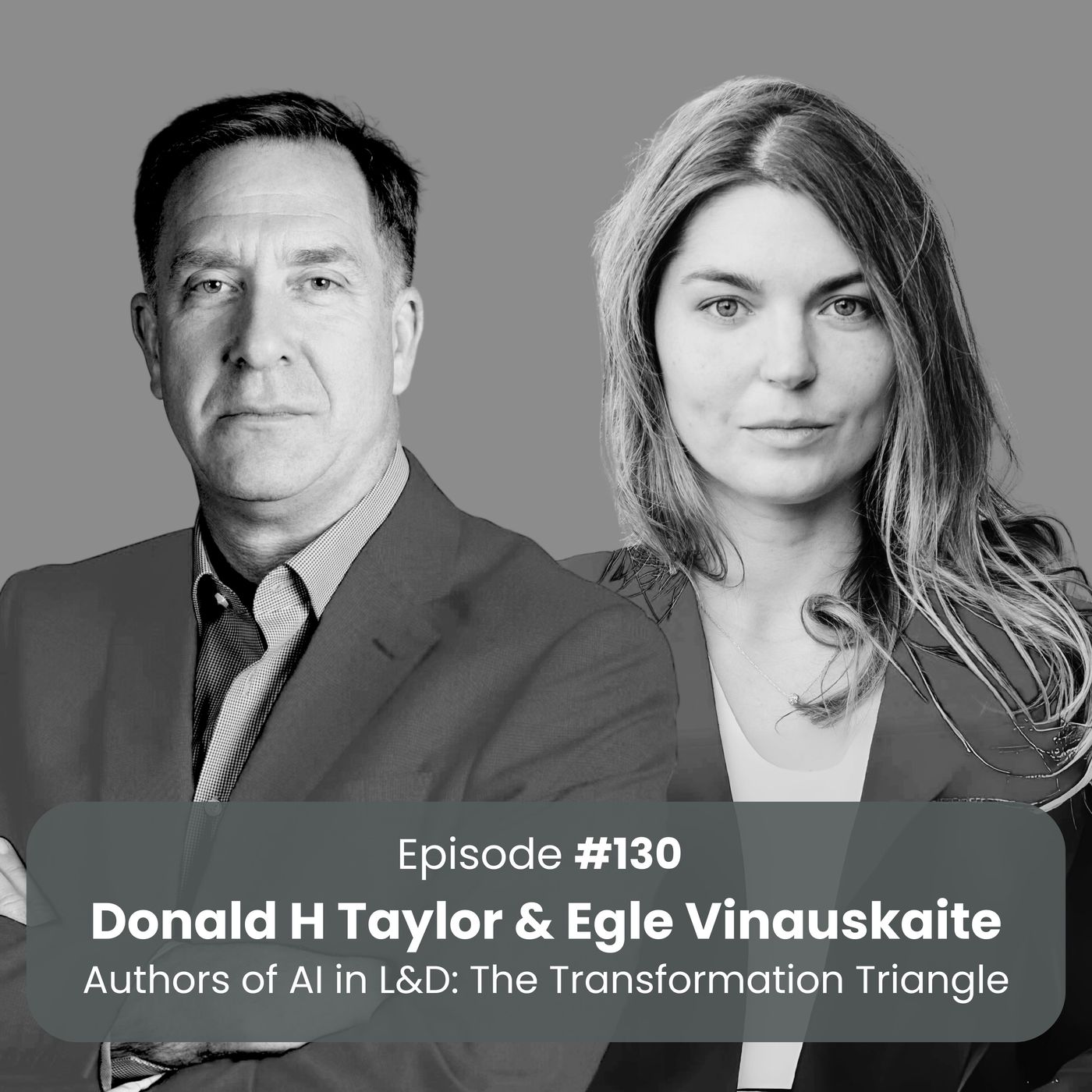
Three Paths for L&D in the Age of AI: Don Taylor & Egle Vinauskaite
Episode 130
Published 2 months, 3 weeks ago
Description
Learning and Development (L&D) is at a crossroads. As artificial intelligence (AI) accelerates changes in the workplace, L&D’s traditional stronghold—the creation and curation of content—is rapidly losing its strategic value. In this episode, I discuss the rapidly evolving intersection of AI and Learning & Development (L&D) with Don Taylor and Egla Vinauskaite. Our conversation explores how the AI “on ramp” has disappeared, leaving many L&D organizations feeling left behind, and highlights the importance of direction, not just decision, for real transformation.
You will want to hear this episode if you are interested in...
The Vanishing ‘On-Ramp’ and the Challenge of Catching Up
The rapid evolution of AI in the workplace has created a new sense of urgency for L&D teams. In 2023, everyone was at the same starting line, experimenting with generative AI tools for the first time. Now, the landscape has shifted dramatically, with advanced conversations moving toward AI agents and full-scale workforce transformation. Those who didn’t jump on the AI bandwagon early are finding it increasingly difficult to catch up, with the “on-ramp” to entry effectively gone for newcomers. This sense of inaccessibility is causing some people to self-select out of L&D entirely, feeling left behind by the accelerating pace of change.
The Disappearing Content Moat
For years, L&D has built its identity around its expertise in content creation—the so-called “moat” that protects its value. But the rise of AI has reduced the barriers to creating effective learning content. Anyone can now create quality resources with minimal expertise, eroding the unique advantage L&D once held. Content can no longer be the cornerstone of L&D’s strategy. Instead, L&D needs to determine its new value proposition in a world where content is ubiquitous.
The Transformation Triangle
The Transformation Triangle proposes three potential futures for L&D organizations.
Skills Authority: Organizations that pursue this path become the go-to stewards for everything related to skills in the business—tracking what skills exist, what’s needed, and how to develop them. They treat skills as a critical business asset and ensure the organization stays competitive by closing gaps efficiently.
Enablement Partner: Acting as connectors rather than creators, these organizations focus on surfacing, amplifying, and distributing the expertise already embedded within the workforce. Their role is to ensure knowledge flows efficiently where it’s needed to elevate performance organization-wide.
Adaptation Engine: The most transformative model, these teams see themselves as stewards of organizational adaptability. They diagnose and address performance issues as complex systems problems—sometimes solving them through learning, but often intervening through process or tool changes to maximize business impact.
None of these are final destinations—organizations may move between them, combine elements, or adapt over time.
Overcoming Structural, Cultural, and Capability Drag
Achieving escape velocity from the gravitational pull of content-focused L&D isn’t easy. In the conversation, we identify three types of “drag” that hold teams back:
You will want to hear this episode if you are interested in...
- [05:56] Early years of AI in L&D
- [08:16] Adapting to AI in Industry
- [18:44] Technological turmoil and AI evolution
- [20:29] Challenges in transforming organizations
- [25:40] Decision-making and organizational hierarchy
- [28:59] Importance of fieldwork and presence
- [37:42] Understanding Drag in L and D
- [46:49] Role of a Leader in Change
- [53:40] Activating independent organizational growth
The Vanishing ‘On-Ramp’ and the Challenge of Catching Up
The rapid evolution of AI in the workplace has created a new sense of urgency for L&D teams. In 2023, everyone was at the same starting line, experimenting with generative AI tools for the first time. Now, the landscape has shifted dramatically, with advanced conversations moving toward AI agents and full-scale workforce transformation. Those who didn’t jump on the AI bandwagon early are finding it increasingly difficult to catch up, with the “on-ramp” to entry effectively gone for newcomers. This sense of inaccessibility is causing some people to self-select out of L&D entirely, feeling left behind by the accelerating pace of change.
The Disappearing Content Moat
For years, L&D has built its identity around its expertise in content creation—the so-called “moat” that protects its value. But the rise of AI has reduced the barriers to creating effective learning content. Anyone can now create quality resources with minimal expertise, eroding the unique advantage L&D once held. Content can no longer be the cornerstone of L&D’s strategy. Instead, L&D needs to determine its new value proposition in a world where content is ubiquitous.
The Transformation Triangle
The Transformation Triangle proposes three potential futures for L&D organizations.
Skills Authority: Organizations that pursue this path become the go-to stewards for everything related to skills in the business—tracking what skills exist, what’s needed, and how to develop them. They treat skills as a critical business asset and ensure the organization stays competitive by closing gaps efficiently.
Enablement Partner: Acting as connectors rather than creators, these organizations focus on surfacing, amplifying, and distributing the expertise already embedded within the workforce. Their role is to ensure knowledge flows efficiently where it’s needed to elevate performance organization-wide.
Adaptation Engine: The most transformative model, these teams see themselves as stewards of organizational adaptability. They diagnose and address performance issues as complex systems problems—sometimes solving them through learning, but often intervening through process or tool changes to maximize business impact.
None of these are final destinations—organizations may move between them, combine elements, or adapt over time.
Overcoming Structural, Cultural, and Capability Drag
Achieving escape velocity from the gravitational pull of content-focused L&D isn’t easy. In the conversation, we identify three types of “drag” that hold teams back:
- Structural drag: Where L&D sits in the org chart and its direct a