Episode Details
Back to Episodes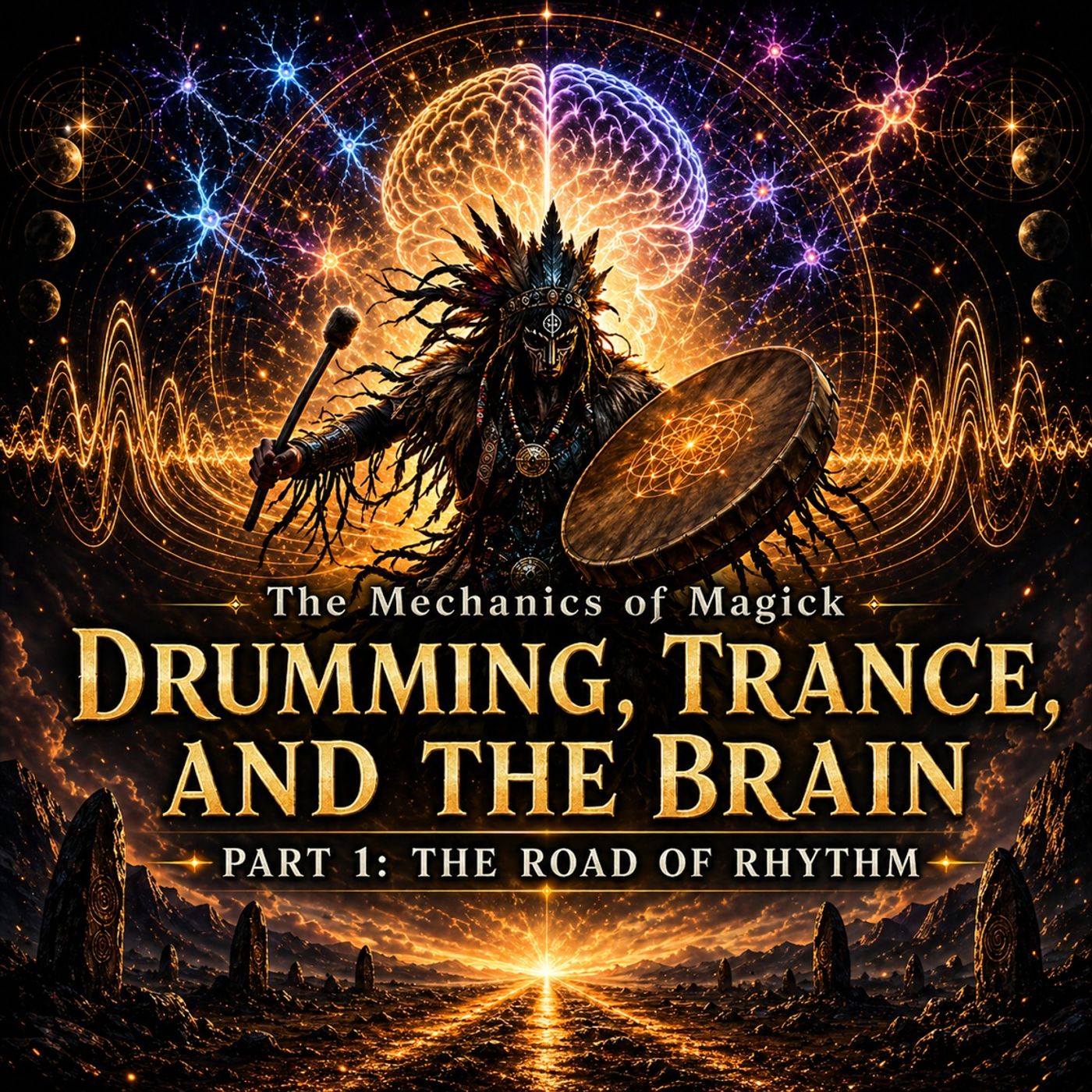
The Mechanics of Magick Drumming, Trance, and the Brain Part 1
Published 4 months ago
Description
Links For The Occult Rejects
https://linktr.ee/theoccultrejects
Occult Research Institute
https://www.occultresearchinstitute.org/
Substack
https://substack.com/@theoccultrejects?r=7auau0&utm_campaign=profile&utm_medium=profile-page
Cash App
https://cash.app/$theoccultrejects
Venmo
@TheOccultRejects
Buy Me A Coffee
buymeacoffee.com/TheOccultRejects
Patreon
https://www.patreon.com/TheOccultRejects
Part 1 focuses on the drum as an ancient technology of altered consciousness. The argument is not that every beat causes trance, or that neuroscience has proven spirits. The stronger argument is that rhythm enters the human organism through hearing, motor prediction, breath, movement, attention, emotion, expectation, culture, and social synchrony. The drum becomes powerful when sound, body, group, ritual frame, and meaning converge. These sources support the archaeology, neuroscience, EEG research, shamanic studies, possession studies, Indigenous and culturally specific drum traditions, ritual theory, placebo and meaning-response research, ceremonial magic, and modern witchcraft material used in the episode.
Core Academic and Scientific Sources
Huels, Emma R., Hyoungkyu Kim, UnCheol Lee, Tirsa Bel-Bahar, Ana V. Colmenero, Alexandra Nelson, Stefanie Blain-Moraes, George A. Mashour, and Richard E. Harris. “Neural Correlates of the Shamanic State of Consciousness.” Frontiers in Human Neuroscience 15 (2021): 610466.
Gordon, Yoel, Golan Karvat, Noa Dagan, and Ayelet N. Landau. “Neural Tracking at Theta Predicts Drumming-Induced Altered States of Consciousness.” Scientific Reports 16, no. 1 (2026): Article 10204.
Aparicio-Terrés, R., et al. “The Neurobiology of Altered States of Consciousness Induced by Drumming and Other Rhythmic Sound Patterns.” Annals of the New York Academy of Sciences, 2025.
Neher, Andrew. “Auditory Driving Observed with Scalp Electrodes in Normal Subjects.” Electroencephalography and Clinical Neurophysiology 13 (1961): 449–451.
Neher, Andrew. “A Physiological Explanation of Unusual Behavior in Ceremonies Involving Drums.” Human Biology 34, no. 2 (1962): 151–160.
Maurer, R., V. K. Kumar, L. Woodside, and R. J. Pekala. “Phenomenological Experience in Response to Monotonous Drumming and Hypnotizability.” American Journal of Clinical Hypnosis 40, no. 2 (1997): 130–145.
Use for monotonous drumming, subjective altered experience, imagery, absorption, and hypnotizability.
Maxfield, Melinda C. “Effects of Rhythmic Drumming on EEG and Subjective Experience.” PhD diss., Institute of Transpersonal Psychology, 1990.
Use as older supporting context on drumming, EEG, imagery, body-image changes, and subjective altered experience. Do not make this the main scientific proof; use it as background.
Nozaradan, Sylvie, Isabelle Peretz, and André Mouraux. “Tagging the Neuronal Entrainment to Beat and Meter.” The Journal of Neuroscience 31, no. 28 (2011): 10234–10240.
Use for EEG evidence that the brain can track beat and meter. This supports the claim that the brain does not merely hear rhythm as background sound; it can represent rhythmic structure in measurable ways.
Nozaradan, Sylvie. “Exploring How Musical Rhythm Entrains Brain Activity with Electroencephalogram Frequency-Tagging.” Philosophical Transactions of the Royal Society B 369, no. 1658 (2014).
Use as broader rhythm/EEG entrainment support. This helps explain frequency-tagging, beat tracking, meter, neural entrainment, and the measurable relationship between rhythmic structure and brain activity.
Thaut, Michael H., Gerald C. McIntosh, and Volker Hoemberg. “Neurobiological Foundations of Neurologic Music Therapy: Rhythmic Entrainment and the Motor System.” Frontiers in Psychology 5 (2015).
Use for rhythm as motor-system timing information. This supports t
https://linktr.ee/theoccultrejects
Occult Research Institute
https://www.occultresearchinstitute.org/
Substack
https://substack.com/@theoccultrejects?r=7auau0&utm_campaign=profile&utm_medium=profile-page
Cash App
https://cash.app/$theoccultrejects
Venmo
@TheOccultRejects
Buy Me A Coffee
buymeacoffee.com/TheOccultRejects
Patreon
https://www.patreon.com/TheOccultRejects
Part 1 focuses on the drum as an ancient technology of altered consciousness. The argument is not that every beat causes trance, or that neuroscience has proven spirits. The stronger argument is that rhythm enters the human organism through hearing, motor prediction, breath, movement, attention, emotion, expectation, culture, and social synchrony. The drum becomes powerful when sound, body, group, ritual frame, and meaning converge. These sources support the archaeology, neuroscience, EEG research, shamanic studies, possession studies, Indigenous and culturally specific drum traditions, ritual theory, placebo and meaning-response research, ceremonial magic, and modern witchcraft material used in the episode.
Core Academic and Scientific Sources
Huels, Emma R., Hyoungkyu Kim, UnCheol Lee, Tirsa Bel-Bahar, Ana V. Colmenero, Alexandra Nelson, Stefanie Blain-Moraes, George A. Mashour, and Richard E. Harris. “Neural Correlates of the Shamanic State of Consciousness.” Frontiers in Human Neuroscience 15 (2021): 610466.
Gordon, Yoel, Golan Karvat, Noa Dagan, and Ayelet N. Landau. “Neural Tracking at Theta Predicts Drumming-Induced Altered States of Consciousness.” Scientific Reports 16, no. 1 (2026): Article 10204.
Aparicio-Terrés, R., et al. “The Neurobiology of Altered States of Consciousness Induced by Drumming and Other Rhythmic Sound Patterns.” Annals of the New York Academy of Sciences, 2025.
Neher, Andrew. “Auditory Driving Observed with Scalp Electrodes in Normal Subjects.” Electroencephalography and Clinical Neurophysiology 13 (1961): 449–451.
Neher, Andrew. “A Physiological Explanation of Unusual Behavior in Ceremonies Involving Drums.” Human Biology 34, no. 2 (1962): 151–160.
Maurer, R., V. K. Kumar, L. Woodside, and R. J. Pekala. “Phenomenological Experience in Response to Monotonous Drumming and Hypnotizability.” American Journal of Clinical Hypnosis 40, no. 2 (1997): 130–145.
Use for monotonous drumming, subjective altered experience, imagery, absorption, and hypnotizability.
Maxfield, Melinda C. “Effects of Rhythmic Drumming on EEG and Subjective Experience.” PhD diss., Institute of Transpersonal Psychology, 1990.
Use as older supporting context on drumming, EEG, imagery, body-image changes, and subjective altered experience. Do not make this the main scientific proof; use it as background.
Nozaradan, Sylvie, Isabelle Peretz, and André Mouraux. “Tagging the Neuronal Entrainment to Beat and Meter.” The Journal of Neuroscience 31, no. 28 (2011): 10234–10240.
Use for EEG evidence that the brain can track beat and meter. This supports the claim that the brain does not merely hear rhythm as background sound; it can represent rhythmic structure in measurable ways.
Nozaradan, Sylvie. “Exploring How Musical Rhythm Entrains Brain Activity with Electroencephalogram Frequency-Tagging.” Philosophical Transactions of the Royal Society B 369, no. 1658 (2014).
Use as broader rhythm/EEG entrainment support. This helps explain frequency-tagging, beat tracking, meter, neural entrainment, and the measurable relationship between rhythmic structure and brain activity.
Thaut, Michael H., Gerald C. McIntosh, and Volker Hoemberg. “Neurobiological Foundations of Neurologic Music Therapy: Rhythmic Entrainment and the Motor System.” Frontiers in Psychology 5 (2015).
Use for rhythm as motor-system timing information. This supports t