Episode Details
Back to Episodes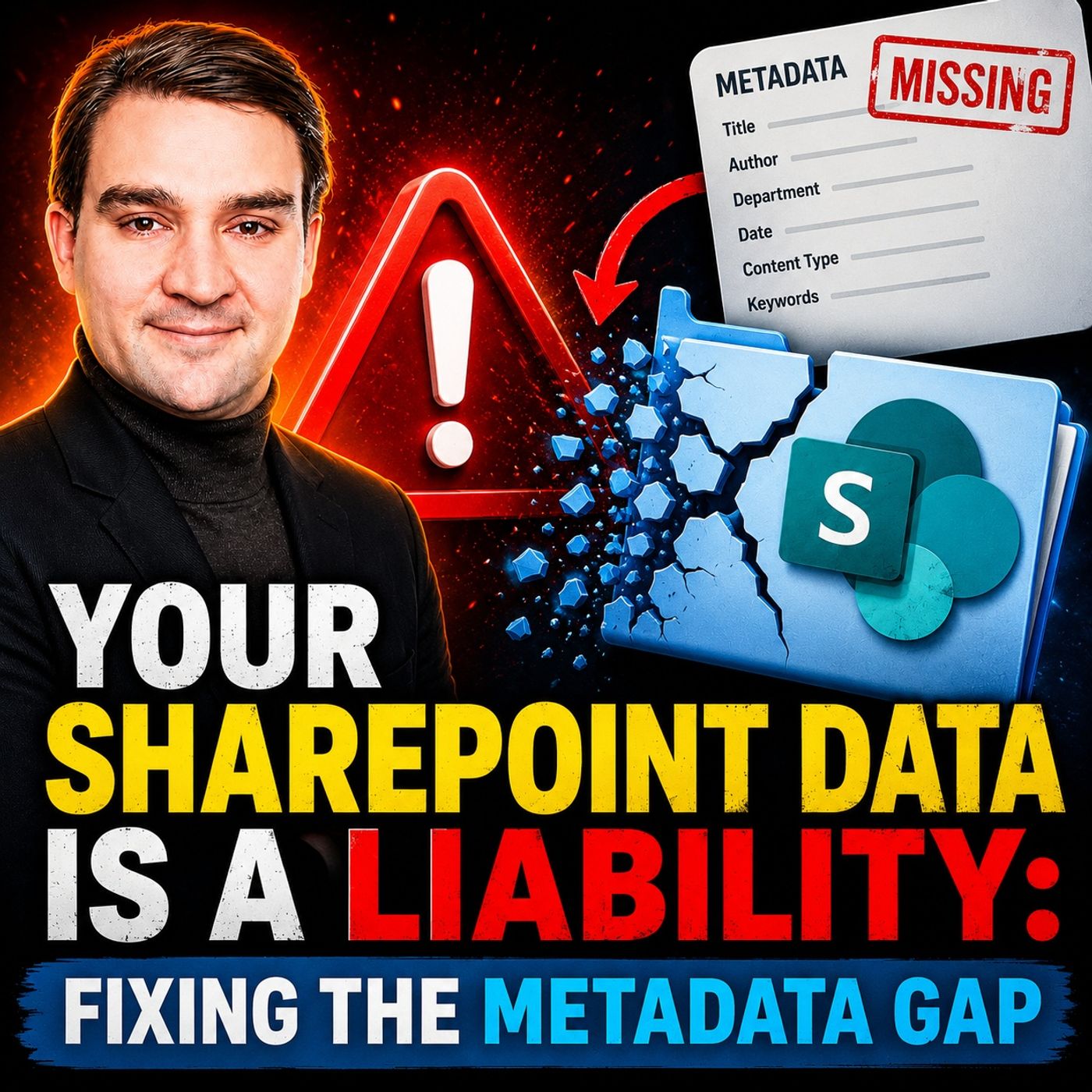
Your SharePoint Data is a Liability: Fixing the Metadata Gap
Season 2
Published 1 month, 2 weeks ago
Description
SharePoint has become the backbone of information management for countless organizations, storing everything from contracts and policies to invoices, project documentation, and business-critical records. Yet beneath the surface of many Microsoft 365 environments lies a hidden problem that continues to grow with every uploaded file. The issue is not storage capacity, search performance, or even user adoption. The real problem is the metadata gap.In this episode, we explore why poorly classified and unstructured SharePoint content has become one of the biggest obstacles to productivity, governance, compliance, and AI readiness. We examine how organizations unknowingly create massive information liabilities when documents lack proper metadata and why this challenge becomes even more critical as Microsoft 365 Copilot and AI-powered experiences become embedded into everyday work.
WHY SHAREPOINT DATA BECOMES A LIABILITY
Many organizations continue to organize content using folder structures designed for a very different era of work. While folders may seem familiar, they fail to provide the context modern businesses need to locate, govern, and automate information effectively.When files lack meaningful metadata, organizations face challenges such as:
THE CRITICAL ROLE OF METADATA
Metadata is far more than simply data about data. It provides the context that allows systems and people to understand, classify, govern, and act upon information. Proper metadata enables organizations to transform document repositories into intelligent knowledge platforms.During this conversation, we discuss how metadata supports:
COPILOT READINESS STARTS WITH CONTENT QUALITY
Many organizations assume that deploying Microsoft 365 Copilot automatically unlocks the value of their knowledge estate. In reality, AI systems are only as effective as the data they consume.We explore how missing metadata directly impacts semantic search, retrieval-augmented generation, document grounding, and AI-generated responses. Listeners will learn why poor information architecture creates inconsistent Copilot experiences and how metadata quality influences trust in AI-generated answers.
INTELLIGENT DOCUMENT PROCESSING EXPLAINED
Modern AI technologies make it possible to automatically classify documents, extract business information, and populate metadata at scale. Intelligent Document Processing combines OCR, machine learning, natural language processing, and AI-powered classification to turn unstructured content into structured business assets.Topics include:
THE EVOLUTION OF MICROSOFT SYNTEX AND SHAREPOINT PREMIUM
Microsoft's content AI journey has undergone multiple transformations over the past several years. From Project Cortex to SharePoint Syntex, Microsoft Syntex, SharePoint Premium, and now Document Processing f
WHY SHAREPOINT DATA BECOMES A LIABILITY
Many organizations continue to organize content using folder structures designed for a very different era of work. While folders may seem familiar, they fail to provide the context modern businesses need to locate, govern, and automate information effectively.When files lack meaningful metadata, organizations face challenges such as:
- Poor search relevance and content discoverability
- Duplicate documents and inconsistent versions
- Increased compliance and audit risks
- Reduced effectiveness of Microsoft 365 Copilot
THE CRITICAL ROLE OF METADATA
Metadata is far more than simply data about data. It provides the context that allows systems and people to understand, classify, govern, and act upon information. Proper metadata enables organizations to transform document repositories into intelligent knowledge platforms.During this conversation, we discuss how metadata supports:
- Enterprise search and content discovery
- Records management and retention policies
- Compliance and eDiscovery requirements
- AI-powered content retrieval and automation
COPILOT READINESS STARTS WITH CONTENT QUALITY
Many organizations assume that deploying Microsoft 365 Copilot automatically unlocks the value of their knowledge estate. In reality, AI systems are only as effective as the data they consume.We explore how missing metadata directly impacts semantic search, retrieval-augmented generation, document grounding, and AI-generated responses. Listeners will learn why poor information architecture creates inconsistent Copilot experiences and how metadata quality influences trust in AI-generated answers.
INTELLIGENT DOCUMENT PROCESSING EXPLAINED
Modern AI technologies make it possible to automatically classify documents, extract business information, and populate metadata at scale. Intelligent Document Processing combines OCR, machine learning, natural language processing, and AI-powered classification to turn unstructured content into structured business assets.Topics include:
- Structured versus unstructured documents
- Entity extraction and document classification
- Automated metadata generation
- Business process automation through AI
THE EVOLUTION OF MICROSOFT SYNTEX AND SHAREPOINT PREMIUM
Microsoft's content AI journey has undergone multiple transformations over the past several years. From Project Cortex to SharePoint Syntex, Microsoft Syntex, SharePoint Premium, and now Document Processing f