Episode Details
Back to Episodes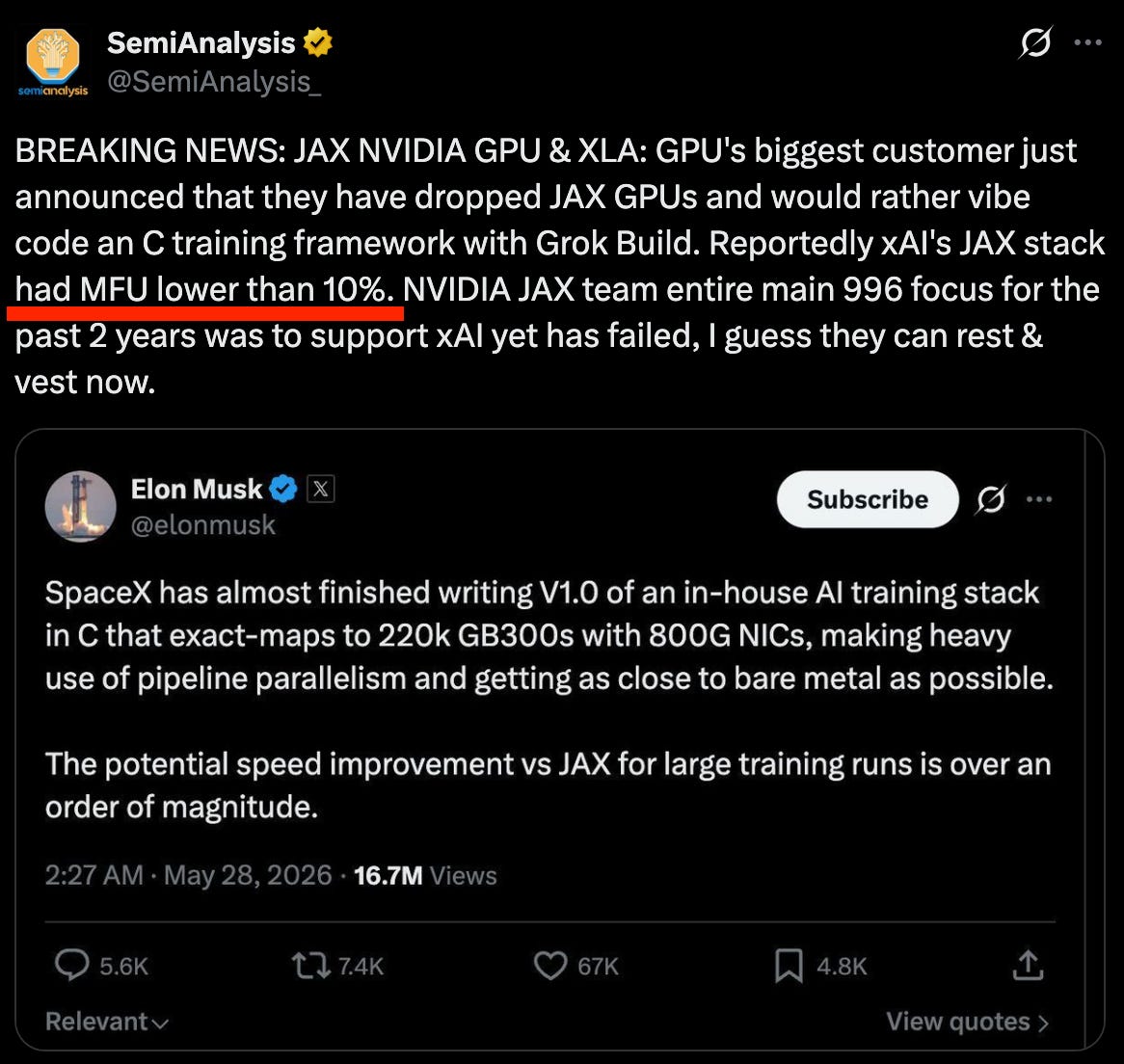
The Professor of Outputmaxxing — Anjney Midha, AMP
Description
Last 4 days before regular tickets sell out at AI Engineer World’s Fair - this is the single biggest gathering of AI Engineers, Founders, Leaders, and Researchers in the world. Attendees get >$5000 worth of sponsor credits and talk tracks are looking FANTASTIC. Join us!
The AI scaling debate always focuses on the question of “how do we get more GPUs?” but the better question may be: how do we make the most of ones we already have.
The fact that a frontier lab like xAI could be running at sub-10% MFU (Model FLOPs Utilization) is just a hint at what the real problem may be.
For context, older frontier-scale training runs were already much higher than 10%. GPT-3 was around 21% MFU. Gopher was around 32%. Megatron-Turing NLG was around 30%. PaLM reached around 46%. And our guest Anjney says best-in-class MFU today is closer to 60–70%.
It’s not necessarily that xAI is uniquely incompetent (it’s clear they have talented folks) but rather the priorities may be flipped in the GPU arms race.
While GPU access is a bottleneck, simply increasing CapEx won’t automatically translate to better models as frontier AI is increasingly a systems problem: scheduling, utilization, networking, kernels, frameworks, data pipelines, parallelism, cluster reliability, and the thousand small decisions that determine whether your theoretical FLOPs become real training progress.
From building Discord’s developer platform and backing frontier AI companies like Anthropic, Mistral, Black Forest Labs, and Periodic Labs to now building AMP’s independent compute grid, Anjney Midha has spent years close to the real bottlenecks of AI scaling. In this episode, Anjney joins swyx at Periodic Labs to unpack why the AI race is not just about buying more GPUs, why 95% utilization would have been considered an outage at Google, and why the next era of AI infrastructure has to be more aligned, more efficient, and more responsible.
We go deep on AMP’s vision for a compute grid that makes FLOPs flow like megawatts, the difference between full-stack AI labs and horizontal pooling, why AI data centers need community buy-in, and how compute markets could evolve into something closer to an independent system operator. Anjney also explains why DeepMind’s unpublished research points to a market failure, why end-of-life prediction remains one of the most important AI applications he has thought about for fourteen years, and why “output maxing” may become a new discipline for frontier systems.
We also discuss Anthropic’s culture, why “luck favors the prepared mind” in coding models, how Claude cracked coding, why too much capital too early can make AI labs fragile, what Periodic Labs is trying to do with science and superconductors, why great researchers can become great CEOs, and why Silicon Valley is both deeply missionary and deeply mercenary.
We discuss:
* Why 95% utilization was considered an outage at Google
* Why AI infrastructure waste compounds at frontier-lab scale
* Why “move fast and break things” does not work for AI data centers
* How data center backlash, power grids, and community incentives shape AI scaling
* AMP’s vision for making FLOPs flow like megawatts
* Why compute needs an independent system operator
* How interruptible demand and dynamic prioritization worked inside Google
* Why DeepMind research hoarding
Listen Now
Love PodBriefly?
If you like Podbriefly.com, please consider donating to support the ongoing development.
Support Us