Episode Details
Back to Episodes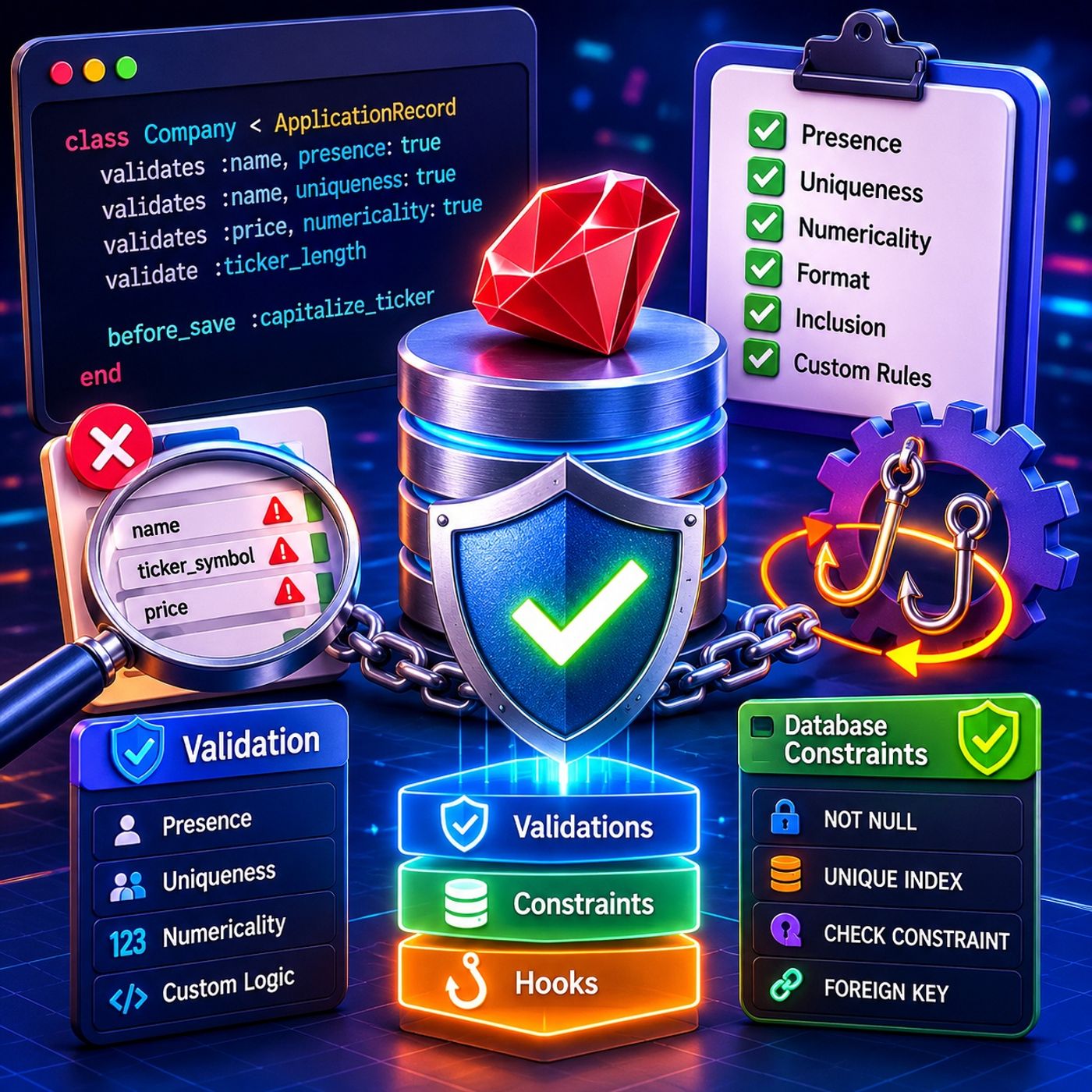
Course 37 - Building Web Apps with Ruby On Rails | Episode 5: Implementing Business Rules through Validations, Migrations, and Lifecycle Hoo
Published 2 months, 1 week ago
Description
In this lesson, you’ll learn about: enforcing low-level business rules in Ruby on Rails using validations, database constraints, and lifecycle hooks to ensure strong data integrity1. Understanding Business Rules🔹 Definition:
Business rules translate real-world requirements into enforceable logic2. Application-Level ValidationsUsing Ruby on Rails built-in validators:🔹 Common validations:
Validations act as the first line of defense against invalid data3. Testing Validations in Console🔹 Tool:
Error messages clearly explain why validation failed4. Custom Validation Logic🔹 When to use:
Custom validations give full control over complex business logic5. Why Validations Alone Are Not Enough🔹 Problem:
Application-level protection is not sufficient for critical data integrity6. Database-Level Constraints🔹 Solution:
Database constraints create a “bulletproof” safety layer7. Model Lifecycle Hooks🔹 Concept:
Hooks automate data consistency without manual intervention8. Combining All Layers🔹 Full protection strategy:
Multiple layers ensure maximum reliability and consistencyKey Takeaways
👉 Prevent invalid or inconsistent records
👉 Build reliable and production-ready systemsMental ModelDefine rules → validate data → enforce constraints → automate with hooks → ensure integrity across all layers
You can listen and download our episodes for free on more than 10 different platforms:
- Business rules = constraints that define how data should behave
- Low-level rules → apply directly to model attributes
- A name must exist
- A ticker symbol must follow a specific format
Business rules translate real-world requirements into enforceable logic2. Application-Level ValidationsUsing Ruby on Rails built-in validators:🔹 Common validations:
- presence → value must exist
- uniqueness → no duplicates allowed
- numericality → must be a number
- inclusion → must match allowed values
Validations act as the first line of defense against invalid data3. Testing Validations in Console🔹 Tool:
- rails console
- Attempt invalid saves
- Inspect error messages
Error messages clearly explain why validation failed4. Custom Validation Logic🔹 When to use:
- When built-in validators are not enough
Custom validations give full control over complex business logic5. Why Validations Alone Are Not Enough🔹 Problem:
- Validations can be bypassed (e.g., direct database access)
Application-level protection is not sufficient for critical data integrity6. Database-Level Constraints🔹 Solution:
- Enforce rules at the database level
- null: false → prevents empty values
- Unique indexes → prevent duplicates
Database constraints create a “bulletproof” safety layer7. Model Lifecycle Hooks🔹 Concept:
- Run logic automatically at specific stages
- before_save
Hooks automate data consistency without manual intervention8. Combining All Layers🔹 Full protection strategy:
- Validations (application layer)
- Constraints (database layer)
- Hooks (automation layer)
Multiple layers ensure maximum reliability and consistencyKey Takeaways
- Business rules define how data should behave
- Validations prevent invalid data at the application level
- Custom validators handle complex logic
- Database constraints enforce rules at the lowest level
- Hooks automate transformations and consistency
👉 Prevent invalid or inconsistent records
👉 Build reliable and production-ready systemsMental ModelDefine rules → validate data → enforce constraints → automate with hooks → ensure integrity across all layers
You can listen and download our episodes for free on more than 10 different platforms:
Listen Now
Love PodBriefly?
If you like Podbriefly.com, please consider donating to support the ongoing development.
Support Us