Episode Details
Back to Episodes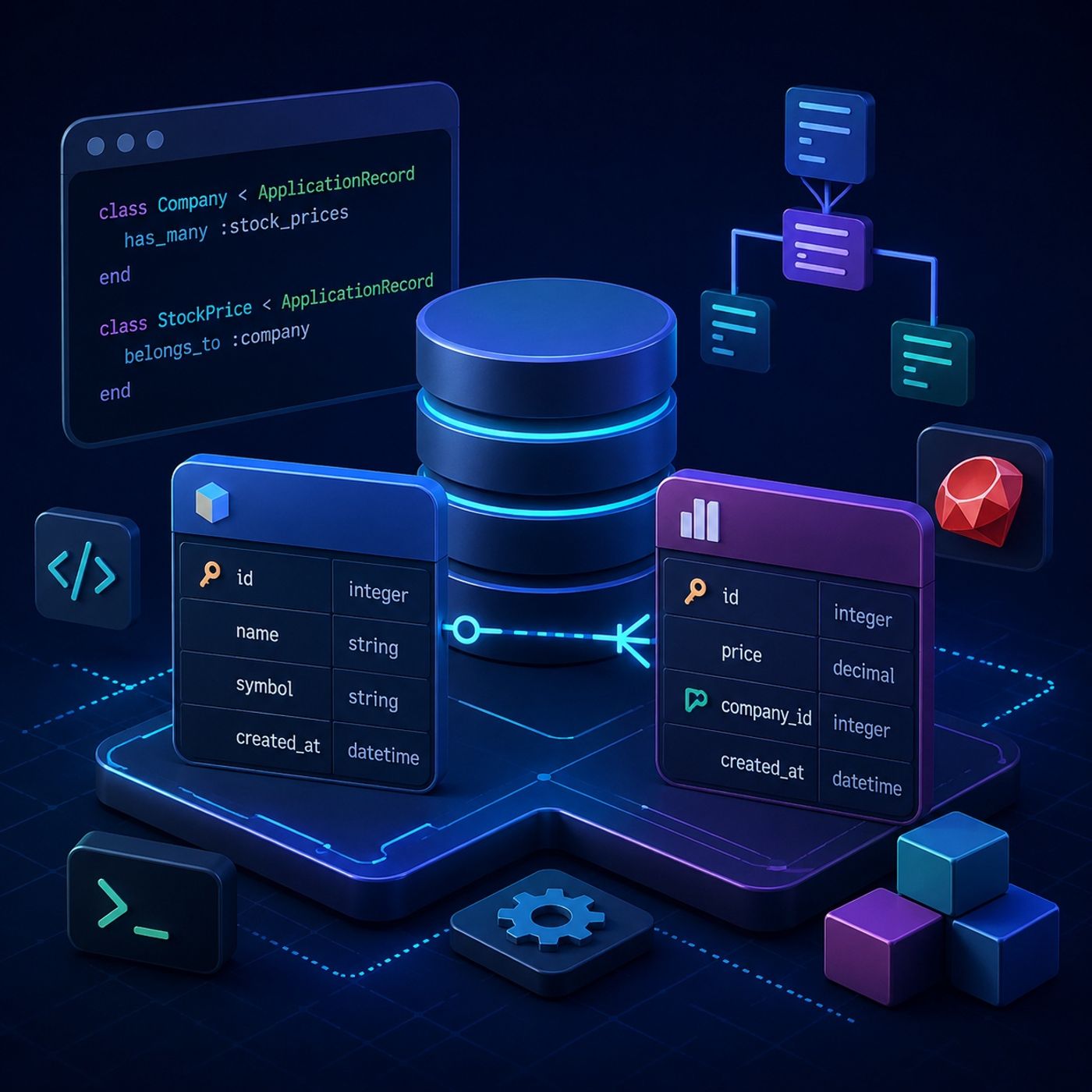
Course 37 - Building Web Apps with Ruby On Rails | Episode 4: Mastering Data Modeling and Resource Relationships in Rails
Published 2 months, 1 week ago
Description
In this lesson, you’ll learn about: data modeling and resource management in Ruby on Rails, from conceptual design to real-world implementation and testing1. Conceptual Data Modeling🔹 Core concepts:
A well-designed data model is the foundation of any scalable application2. Designing Relationships🔹 Relationship types:
Relationships define how data connects and interacts across the system3. Implementing Models in RailsUsing Ruby on Rails:🔹 Command:
Rails automates database structure creation through generators4. Database Migrations🔹 Command:
Migrations allow you to evolve your database safely over time5. Active Record (ORM)🔹 Concept:
ORM removes the need to write raw SQL for most operations6. Defining Associations🔹 In models:class Company < ApplicationRecord has_many :stock_prices end class StockPrice < ApplicationRecord belongs_to :company end 👉 Key Insight
Associations enable powerful and intuitive data access in Rails7. Working with Rails Console🔹 Command:
The console is one of the most powerful tools for learning and debugging8. CRUD Operations in Practice🔹 Create:company = Company.create(name: "Apple") 🔹 Read:Company.all 🔹 Update:company.update(name: "Apple Inc.") 🔹 Delete:company.destroy 👉 Key Insight
CRUD operations are the core of any data-driven application9. Querying Relationships🔹 Examples:company.stock_prices stock_price.company 👉 Key Insight
Rails makes relational queries simple and readable10. Testing Data Integrity🔹 What to verify:
Testing ensures your data model behaves correctly before productionKey Takeaways
👉 Implement it in Rails generators and migrations
👉 Test and validate it interactively
- Entities → represent real-world objects (e.g., Company, Stock)
- Attributes → properties of entities (name, price, symbol)
- Data types → string, integer, decimal, etc.
- Primary Key (ID) → unique identifier for each record
- Foreign Key → links one entity to another
A well-designed data model is the foundation of any scalable application2. Designing Relationships🔹 Relationship types:
- One-to-Many (most common in Rails apps)
- A Company has many stock prices
- A Stock Price belongs to a company
Relationships define how data connects and interacts across the system3. Implementing Models in RailsUsing Ruby on Rails:🔹 Command:
- rails generate model Company name:string
- rails generate model StockPrice price:decimal company:references
- Model files are created
- Migration files are generated
- Database schema is defined
Rails automates database structure creation through generators4. Database Migrations🔹 Command:
- rails db:migrate
- Apply structural changes to the database
Migrations allow you to evolve your database safely over time5. Active Record (ORM)🔹 Concept:
- Maps Ruby classes to database tables
- Class → Table
- Object → Row (record)
- Company model ↔ companies table
ORM removes the need to write raw SQL for most operations6. Defining Associations🔹 In models:class Company < ApplicationRecord has_many :stock_prices end class StockPrice < ApplicationRecord belongs_to :company end 👉 Key Insight
Associations enable powerful and intuitive data access in Rails7. Working with Rails Console🔹 Command:
- rails console
- Interact with models in real time
- Test logic without running the full app
The console is one of the most powerful tools for learning and debugging8. CRUD Operations in Practice🔹 Create:company = Company.create(name: "Apple") 🔹 Read:Company.all 🔹 Update:company.update(name: "Apple Inc.") 🔹 Delete:company.destroy 👉 Key Insight
CRUD operations are the core of any data-driven application9. Querying Relationships🔹 Examples:company.stock_prices stock_price.company 👉 Key Insight
Rails makes relational queries simple and readable10. Testing Data Integrity🔹 What to verify:
- Records are saved correctly
- Relationships work as expected
- Queries return correct results
Testing ensures your data model behaves correctly before productionKey Takeaways
- Data modeling starts with entities, attributes, and relationships
- Primary and foreign keys connect your data logically
- Active Record simplifies database interaction
- Associations enable powerful data queries
- Rails console is essential for testing and debugging
👉 Implement it in Rails generators and migrations
👉 Test and validate it interactively