Episode Details
Back to Episodes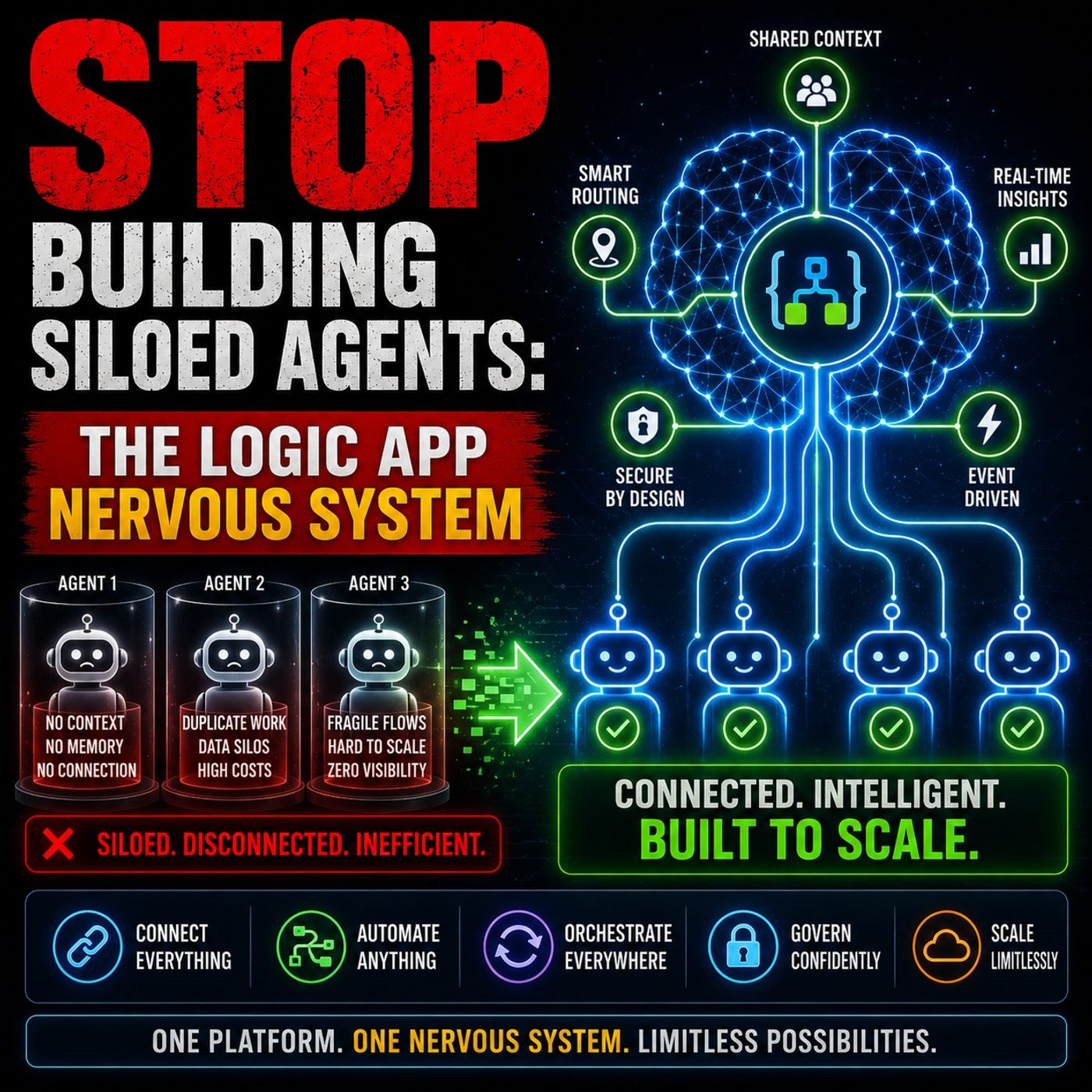
STOP BUILDING SILOED AGENTS: The Logic App Nervous System
Season 2
Published 1 month, 3 weeks ago
Description
Everyone is building AI agents.Very few organizations are building agent architectures.Across Microsoft 365, Copilot Studio, Azure OpenAI, Power Platform, and custom AI solutions, enterprises are racing to deploy copilots, bots, assistants, and autonomous workflows. Teams are creating agents for customer service, IT support, HR onboarding, knowledge discovery, incident management, and business operations.Most of them work.At least in the demo.But something very different happens when organizations move beyond a single agent and attempt to coordinate dozens of AI-powered systems across multiple business units, multiple platforms, and multiple Microsoft 365 tenants.The result is often chaos.Disconnected bots. Duplicate integrations. Credential sprawl. Governance gaps. Broken workflows. Untraceable actions. And increasingly, AI agents that cannot collaborate because they were never designed to operate as part of a larger system.In this episode, we explore why enterprise AI is repeating the same architectural mistakes organizations made during the early API revolution, why point-to-point agent integrations are becoming unsustainable, and how Azure Logic Apps is emerging as the orchestration layer that connects reasoning, execution, governance, identity, and automation into a single enterprise nervous system.If your organization is investing in Copilot Studio, Azure OpenAI, Microsoft 365 Copilot, Power Platform, or custom AI agents, this episode provides a blueprint for building agent ecosystems that actually scale.
THE CHATBOT MIRAGE
Most enterprise AI projects begin with a simple success story.A team creates a bot.The bot answers questions.The demo works.The project gets funded.Then another department builds another bot.And another.And another.Soon the organization has dozens of isolated AI systems solving local problems but creating enterprise-wide complexity.We explore:
THE POINT-TO-POINT INTEGRATION TRAP
Every agent needs data.Most agents get it the wrong way.Organizations frequently allow agents to connect directly to APIs, databases, SaaS platforms, and Microsoft Graph endpoints.Initially this feels efficient.Eventually it becomes unmanageable.This episode examines:
WHY AGENTS FAIL AT ENTERPRISE SCALE
The most advanced language model in the world cannot compensate for poor architecture.We discuss why:
THE STATEFUL GAPOne of the most important concepts in this episode is the distinction between reasoning and memory.Most AI agents are stateless.Enterprise processes are not.We explore:
WHY COP
THE CHATBOT MIRAGE
Most enterprise AI projects begin with a simple success story.A team creates a bot.The bot answers questions.The demo works.The project gets funded.Then another department builds another bot.And another.And another.Soon the organization has dozens of isolated AI systems solving local problems but creating enterprise-wide complexity.We explore:
- Why AI demos rarely reveal architectural weaknesses
- The difference between local optimization and enterprise orchestration
- How siloed agents create operational debt
- Why successful pilots often fail at scale
- The hidden cost of disconnected automation
THE POINT-TO-POINT INTEGRATION TRAP
Every agent needs data.Most agents get it the wrong way.Organizations frequently allow agents to connect directly to APIs, databases, SaaS platforms, and Microsoft Graph endpoints.Initially this feels efficient.Eventually it becomes unmanageable.This episode examines:
- Point-to-point integration sprawl
- Credential proliferation
- Duplicate business logic
- Decentralized error handling
- Governance fragmentation
- Observability challenges
WHY AGENTS FAIL AT ENTERPRISE SCALE
The most advanced language model in the world cannot compensate for poor architecture.We discuss why:
- Reasoning is not orchestration
- Intelligence is not governance
- Conversation is not workflow management
- Tool calling is not process execution
- AI is not a replacement for enterprise integration
THE STATEFUL GAPOne of the most important concepts in this episode is the distinction between reasoning and memory.Most AI agents are stateless.Enterprise processes are not.We explore:
- Stateless automation
- Stateful orchestration
- Long-running workflows
- Process persistence
- Workflow recovery
- Correlation and context management
WHY COP