Episode Details
Back to Episodes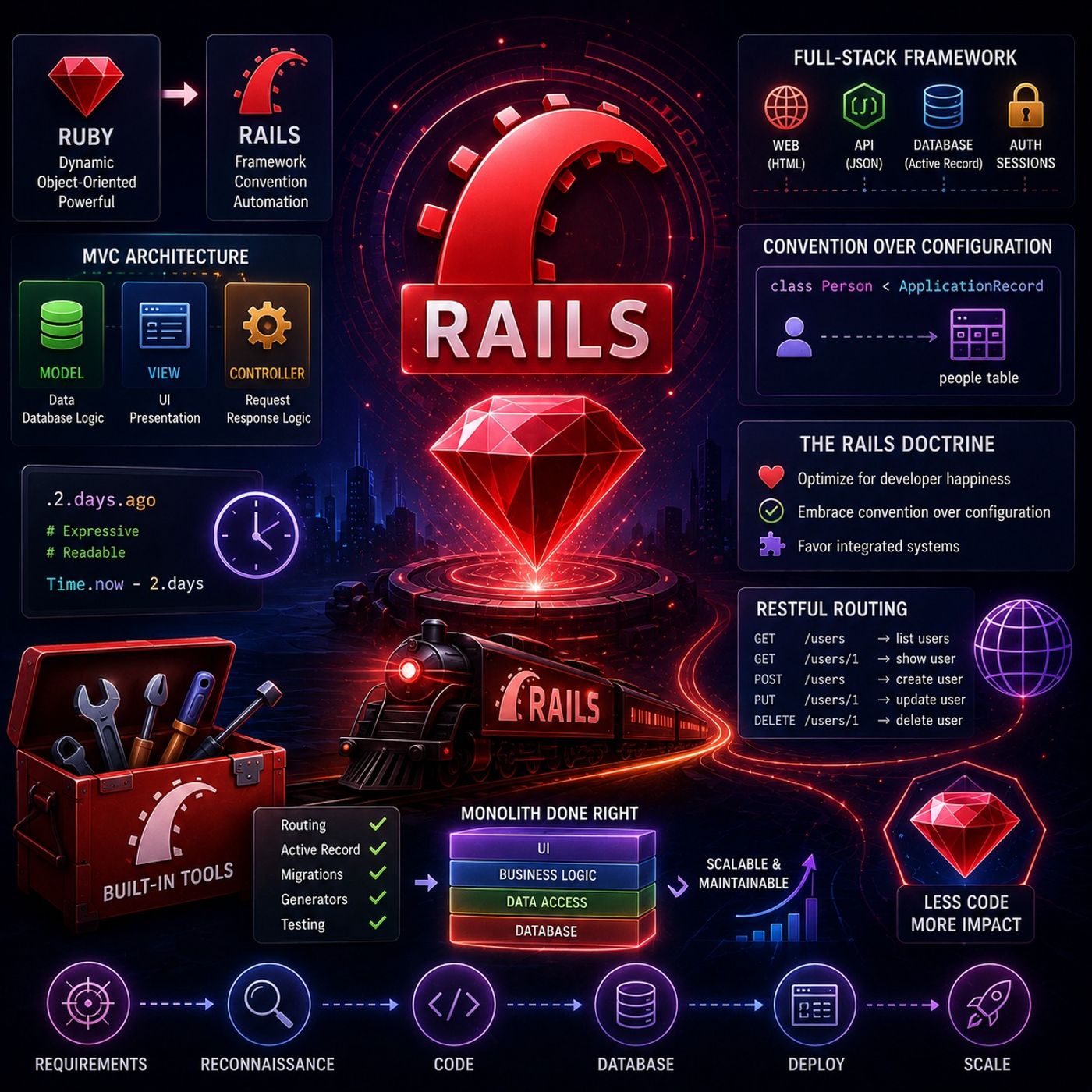
Course 37 - Building Web Apps with Ruby On Rails | Episode 1: From Ruby Basics to Web Development Conventions
Published 2 months, 2 weeks ago
Description
In this lesson, you’ll learn about: Ruby on Rails, its architecture, philosophy, and how it simplifies modern web development 1. What Is Ruby on Rails? Ruby on Rails is a full-stack web framework used to build:
Rails is a complete development toolkit that handles everything from backend logic to routing and database interaction. 2. Ruby vs Rails (Core Difference) 🔹 Ruby
Ruby provides the power, Rails provides the structure and automation 3. MVC Architecture (Core Design Pattern) 🔹 MVC stands for:
MVC separates responsibilities, making applications easier to manage and scale. 4. Rails as a Full-Stack Framework Rails can:
Rails acts like a multi-tool for building complete applications 5. The Power of Ruby (Why Rails Feels “Magic”) 🔹 Ruby features:
Ruby allows Rails to write less code while doing more work 6. Convention Over Configuration 🔹 What it means:
Developers don’t waste time making small decisions—Rails handles them 7. The Rails Doctrine Created by David Heinemeier Hansson 🔹 Core principles:
Rails is opinionated to make development faster and more enjoyable 8. Routing and RESTful Design 🔹 Rails automatically generates:
Routing becomes standardized and easy to understand 9. Monolith vs Microservices 🔹 Rails philosophy:
A well-structured monolith can scale efficiently without microservices complexity Key Takeaways
👉 Focus on logic instead of configuration
👉 Scale applications using structured conventions Mental Model Ruby language → Rails framework → MVC structure → conventions applied → rapid web development
You can listen and download our episodes for free on more than 10 different platforms:
- Web applications
- APIs
- Database-driven platforms
Rails is a complete development toolkit that handles everything from backend logic to routing and database interaction. 2. Ruby vs Rails (Core Difference) 🔹 Ruby
- A dynamic, object-oriented programming language
- A framework built on top of Ruby
Ruby provides the power, Rails provides the structure and automation 3. MVC Architecture (Core Design Pattern) 🔹 MVC stands for:
- Model → Handles data and database logic
- View → Handles UI and presentation
- Controller → Handles request/response logic
MVC separates responsibilities, making applications easier to manage and scale. 4. Rails as a Full-Stack Framework Rails can:
- Render HTML pages (server-side)
- Serve JSON APIs
- Handle routing, sessions, and authentication
Rails acts like a multi-tool for building complete applications 5. The Power of Ruby (Why Rails Feels “Magic”) 🔹 Ruby features:
- Highly expressive syntax
- Object-oriented design
- Flexible and dynamic behavior
- .2.days.ago → human-readable time calculation
Ruby allows Rails to write less code while doing more work 6. Convention Over Configuration 🔹 What it means:
- Rails follows predefined conventions instead of requiring manual setup
- Person model → automatically maps to people table
Developers don’t waste time making small decisions—Rails handles them 7. The Rails Doctrine Created by David Heinemeier Hansson 🔹 Core principles:
- Optimize for developer happiness
- Embrace convention over configuration
- Favor integrated systems
Rails is opinionated to make development faster and more enjoyable 8. Routing and RESTful Design 🔹 Rails automatically generates:
- Predictable URLs
- REST-based routes
- /users → list users
- /users/1 → show user
Routing becomes standardized and easy to understand 9. Monolith vs Microservices 🔹 Rails philosophy:
- Prefer monolithic architecture (everything in one app)
- Companies like GitHub and Shopify scaled successfully using Rails
A well-structured monolith can scale efficiently without microservices complexity Key Takeaways
- Rails is a full-stack framework built on Ruby
- MVC architecture organizes application structure
- Ruby enables expressive and powerful code
- Convention over configuration speeds up development
- Rails favors integrated systems over complexity
👉 Focus on logic instead of configuration
👉 Scale applications using structured conventions Mental Model Ruby language → Rails framework → MVC structure → conventions applied → rapid web development
You can listen and download our episodes for free on more than 10 different platforms:
Listen Now
Love PodBriefly?
If you like Podbriefly.com, please consider donating to support the ongoing development.
Support Us