Episode Details
Back to Episodes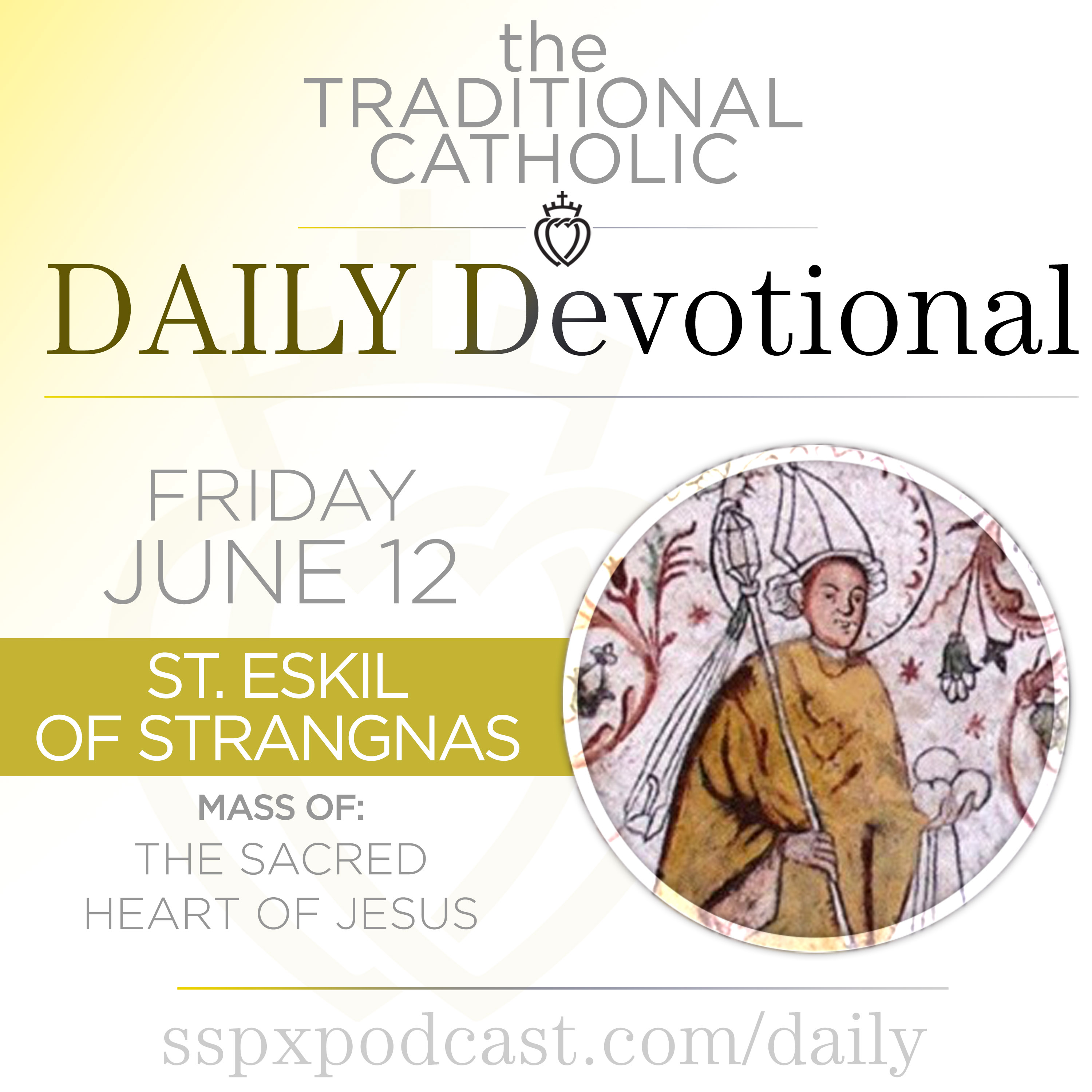
Jun 12 – Sacred Heart of Jesus / S Eskil of Strängnäs
Description
Sources Used Today:
- "Feast of the Sacred Heart" — From Trinity Sunday to the Assumption
- "The Mass of All Time: When an Archduke Agrees with Archbishop Lefebvre" (FSSPX.news)
- The SSPX Podcast: "The Future of the SSPX—and the Future of Tradition" (SSPX Podcast)
- View on YouTube
- Listen & Subscribe on SSPXpodcast.com
- The Spiritual Life — Archbishop Marcel Lefebvre (Angelus Press)
Please support our new project, the Archbishop Lefebvre Biography Audiobook!
- Learn more:https://www.youtube.com/watch?v=Y-Wp4MQdK2o
- Donate:https://sspx.gifts/audiobook
Saint Eskil of Strängnäs was a missionary bishop and martyr who helped bring the Christian faith to Sweden during its early centuries of evangelization. He lived during the eleventh century, a time when Christianity was gradually spreading throughout Scandinavia, often encountering resistance from those who remained attached to the old pagan religions. Like many missionary saints of northern Europe, Eskil left the security of his homeland to preach Christ in lands where the Gospel had not yet fully taken root.
Tradition holds that Eskil came from England, which had become a great source of missionaries to Scandinavia after its own conversion. He was sent to the Swedish province of Södermanland and eventually established himself in the region around Strängnäs. There he preached, baptized converts, built churches, and worked to strengthen the young Christian communities.
The Church remembers Eskil especially for his courage in confronting paganism. According to ancient tradition, a great pagan sacrifice was being held at Uppsala, one of the principal centers of the old Norse religion. Grieved by the persistence of idolatry, Eskil prayed that God would reveal the truth of the Christian faith. Some accounts tell of a miraculous storm that disrupted the pagan rites, leading many to question the power of the old gods.
Such actions, however, made him enemies. Tradition states that Eskil was seized by opponents of Christianity and driven away from the gathering. As he continued preaching, he was attacked and killed, becoming one of the early martyrs of Sweden. Though the exact historical details