Episode Details
Back to Episodes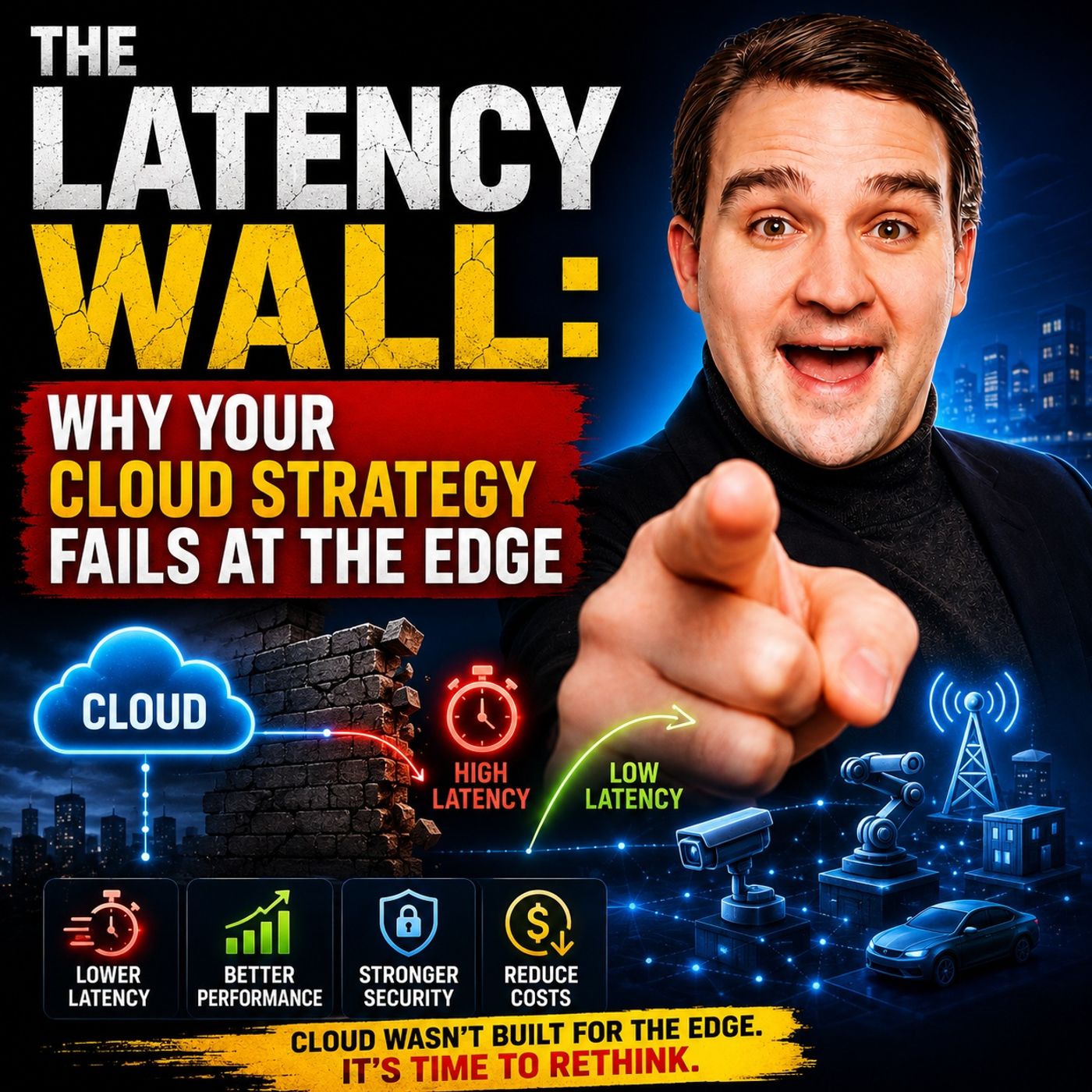
The Latency Wall: Why Your Cloud Strategy Fails at the Edge
Season 2
Published 1 month, 4 weeks ago
Description
For years, organizations have followed a simple rule: move everything to the cloud.The strategy worked brilliantly for collaboration, analytics, business intelligence, and productivity workloads. Microsoft 365, Azure, Power BI, Teams, and modern cloud platforms transformed how organizations operate.But a growing number of industries are discovering a hard reality.Physics doesn't care about your cloud strategy.When robots, autonomous vehicles, computer vision systems, industrial sensors, healthcare devices, and critical infrastructure require responses measured in milliseconds, traditional cloud architectures hit an unavoidable barrier: the Latency Wall.In this episode, we explore why centralized cloud architectures struggle at the edge, why bandwidth isn't the answer, and how organizations are redesigning their technology platforms around private 5G, Multi-Access Edge Computing (MEC), Azure Stack Edge, Azure Arc, and sovereign edge architectures.If your future includes AI, automation, robotics, manufacturing, logistics, healthcare, energy, or industrial IoT, this episode explains why the next phase of digital transformation is happening closer to the data than ever before.
WHY THE CLOUD BREAKS WHEN MILLISECONDS MATTER
Most enterprise systems were designed around humans.Humans tolerate delay.A dashboard that loads in a few seconds feels fast.A chatbot that responds in under a second feels instant.An analytics report that refreshes in a minute is perfectly acceptable.Machines don't think that way.A robotic arm operating on a production line may require updates every few milliseconds.A computer vision system inspecting defects has fractions of a second to react.An autonomous guided vehicle navigating a warehouse cannot wait hundreds of milliseconds for instructions from a distant cloud region.The challenge isn't cloud performance.The challenge is physics.This episode explores the science of latency, jitter, determinism, and why distance creates a hard limit that no cloud provider can eliminate.
THE PHYSICS OF LATENCY
Every cloud strategy ultimately runs into the same constraint.Data must travel.Even at the speed of light, distance creates delay.As organizations connect factories, warehouses, hospitals, ports, mines, energy grids, and autonomous systems to cloud platforms, latency becomes an architectural problem rather than a networking problem.We discuss:
INDUSTRIES HITTING THE LATENCY WALL
The edge is no longer a niche concept.Across every sector, organizations are discovering workloads that cannot depend on centralized cloud architectures.This episode examines real-world examples from:
THE OLD CLOUD MODEL VS THE NEW EDGE MODEL
For decades, enterprise architecture followed a hub-and-spoke model.Data flowed to the cloud.The cloud made decisions.The edge executed instructions.That model is changing.The modern edge architecture places intelligence closer to the source of the data.Instead of sending every sensor reading, image, and event to a distant cloud region, organizations process information locally and send only i
WHY THE CLOUD BREAKS WHEN MILLISECONDS MATTER
Most enterprise systems were designed around humans.Humans tolerate delay.A dashboard that loads in a few seconds feels fast.A chatbot that responds in under a second feels instant.An analytics report that refreshes in a minute is perfectly acceptable.Machines don't think that way.A robotic arm operating on a production line may require updates every few milliseconds.A computer vision system inspecting defects has fractions of a second to react.An autonomous guided vehicle navigating a warehouse cannot wait hundreds of milliseconds for instructions from a distant cloud region.The challenge isn't cloud performance.The challenge is physics.This episode explores the science of latency, jitter, determinism, and why distance creates a hard limit that no cloud provider can eliminate.
THE PHYSICS OF LATENCY
Every cloud strategy ultimately runs into the same constraint.Data must travel.Even at the speed of light, distance creates delay.As organizations connect factories, warehouses, hospitals, ports, mines, energy grids, and autonomous systems to cloud platforms, latency becomes an architectural problem rather than a networking problem.We discuss:
- Why latency and jitter matter more than bandwidth
- Deterministic versus best-effort networking
- Real-world control loop requirements
- The impact of packet loss and network variability
- Why cloud optimization cannot overcome physical distance
INDUSTRIES HITTING THE LATENCY WALL
The edge is no longer a niche concept.Across every sector, organizations are discovering workloads that cannot depend on centralized cloud architectures.This episode examines real-world examples from:
- Manufacturing and industrial automation
- Logistics and warehouse robotics
- Healthcare and patient telemetry
- Energy and utilities
- Mining operations
- Smart ports and maritime logistics
- Retail automation
- Autonomous transportation
THE OLD CLOUD MODEL VS THE NEW EDGE MODEL
For decades, enterprise architecture followed a hub-and-spoke model.Data flowed to the cloud.The cloud made decisions.The edge executed instructions.That model is changing.The modern edge architecture places intelligence closer to the source of the data.Instead of sending every sensor reading, image, and event to a distant cloud region, organizations process information locally and send only i