Episode Details
Back to Episodes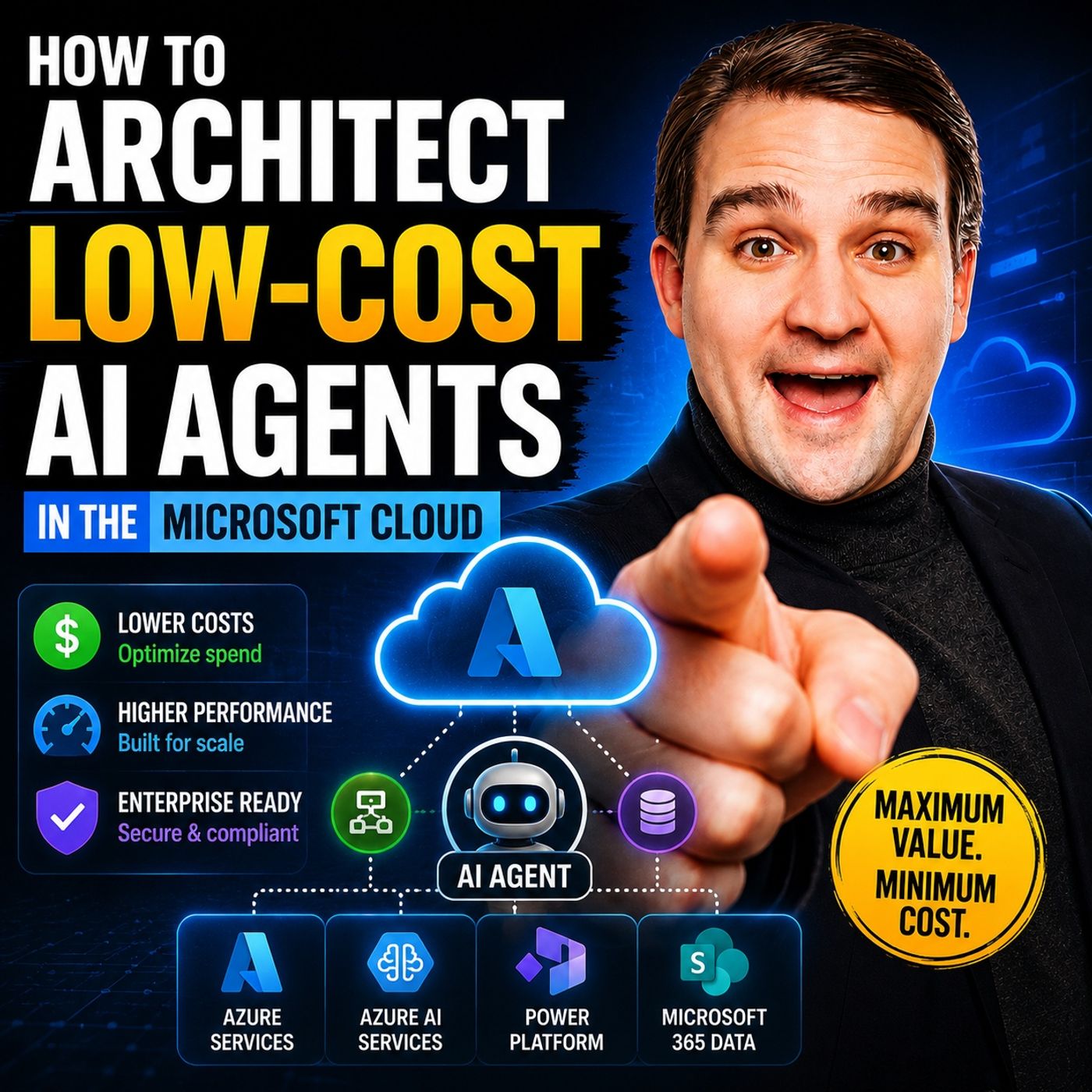
How to Architect Low-Cost AI Agents in the Microsoft Cloud
Season 2
Published 1 month, 4 weeks ago
Description
Most organizations think their AI costs are driven by model pricing.They're wrong.The biggest cost problems in Microsoft AI environments often have nothing to do with GPT-5, Azure OpenAI, or Copilot licensing. Instead, they come from hidden architectural decisions that quietly multiply costs behind the scenes.In this episode, we break down the real economics of building AI agents in Microsoft Azure, Microsoft 365, Copilot Studio, and Azure AI Foundry. You'll learn why some organizations spend thousands of dollars per month on AI while others deliver the same business outcomes for a fraction of the cost.We explore the three hidden taxes affecting nearly every enterprise AI deployment: the Context Tax, the Reasoning Tax, and the Autonomous Tax. Together, these invisible costs can turn a successful proof-of-concept into a budget crisis.More importantly, you'll learn how to eliminate them.
THE PROMISE VS THE INVOICE
Microsoft has made AI easier to deploy than ever before.Copilot appears inside Teams, Outlook, Word, PowerPoint, and Microsoft 365. Azure AI Foundry simplifies model deployment. Copilot Studio allows low-code agent development. Power Platform integrates AI into business processes.But simplicity often hides complexity.The moment you build a custom Copilot Studio agent, connect SharePoint knowledge sources, invoke Azure OpenAI models, or trigger autonomous workflows, you enter a world of consumption billing where every token, action, and retrieval operation has a cost.In this episode, we uncover how Microsoft's AI billing layers actually work and why understanding them is the foundation of any successful AI architecture.
THE THREE HIDDEN TAXES OF ENTERPRISE AI
Most organizations unknowingly pay three separate AI taxes.The Context TaxPoor retrieval design floods prompts with irrelevant content.Instead of retrieving only the information needed to answer a question, many RAG implementations pull dozens of documents into the prompt, dramatically increasing token consumption while often reducing answer quality.The Reasoning TaxMany organizations route every request to their most expensive model.Simple FAQ requests, classifications, and summarizations frequently run on frontier models when smaller and cheaper models could deliver identical outcomes.The Autonomous TaxAutonomous agents never sleep.Background workflows, Graph grounding, Power Automate actions, and event-driven agents continue consuming credits long after employees have logged off.When these three taxes combine, AI spending can spiral out of control.
UNDERSTANDING COPILOT STUDIO COSTS
Copilot Studio has become one of the most powerful tools in the Microsoft ecosystem.It also introduces new consumption models that many organizations underestimate.We discuss:
THE NOVEMBER 2026 AI BUILDER DEADLINE
One of the most important dates in Microsoft's AI roadmap arrives on November 1st, 2026.On that date, seeded AI Builder credits disappear.Organizations currently relying on included AI Builder capacity may discover that previously "free" AI workloads suddenly become billable.We explain:
THE COST ARCHITECTURE FRAMEWORK
Reducing AI costs isn't about buying cheaper models.It's about designing better architectures.The framework discussed in this episode focuses on four core engineering principles:Semantic Cachin
THE PROMISE VS THE INVOICE
Microsoft has made AI easier to deploy than ever before.Copilot appears inside Teams, Outlook, Word, PowerPoint, and Microsoft 365. Azure AI Foundry simplifies model deployment. Copilot Studio allows low-code agent development. Power Platform integrates AI into business processes.But simplicity often hides complexity.The moment you build a custom Copilot Studio agent, connect SharePoint knowledge sources, invoke Azure OpenAI models, or trigger autonomous workflows, you enter a world of consumption billing where every token, action, and retrieval operation has a cost.In this episode, we uncover how Microsoft's AI billing layers actually work and why understanding them is the foundation of any successful AI architecture.
THE THREE HIDDEN TAXES OF ENTERPRISE AI
Most organizations unknowingly pay three separate AI taxes.The Context TaxPoor retrieval design floods prompts with irrelevant content.Instead of retrieving only the information needed to answer a question, many RAG implementations pull dozens of documents into the prompt, dramatically increasing token consumption while often reducing answer quality.The Reasoning TaxMany organizations route every request to their most expensive model.Simple FAQ requests, classifications, and summarizations frequently run on frontier models when smaller and cheaper models could deliver identical outcomes.The Autonomous TaxAutonomous agents never sleep.Background workflows, Graph grounding, Power Automate actions, and event-driven agents continue consuming credits long after employees have logged off.When these three taxes combine, AI spending can spiral out of control.
UNDERSTANDING COPILOT STUDIO COSTS
Copilot Studio has become one of the most powerful tools in the Microsoft ecosystem.It also introduces new consumption models that many organizations underestimate.We discuss:
- Copilot Credits
- Capacity Packs
- Pay-As-You-Go billing
- Graph Grounding costs
- Agent actions
- Autonomous triggers
- AI Builder transitions
- The November 2026 licensing changes
THE NOVEMBER 2026 AI BUILDER DEADLINE
One of the most important dates in Microsoft's AI roadmap arrives on November 1st, 2026.On that date, seeded AI Builder credits disappear.Organizations currently relying on included AI Builder capacity may discover that previously "free" AI workloads suddenly become billable.We explain:
- What changes in November 2026
- Which workloads are affected
- How to prepare before the deadline
- Why many organizations could face unexpected costs
- How to build a transition strategy today
THE COST ARCHITECTURE FRAMEWORK
Reducing AI costs isn't about buying cheaper models.It's about designing better architectures.The framework discussed in this episode focuses on four core engineering principles:Semantic Cachin