Episode Details
Back to Episodes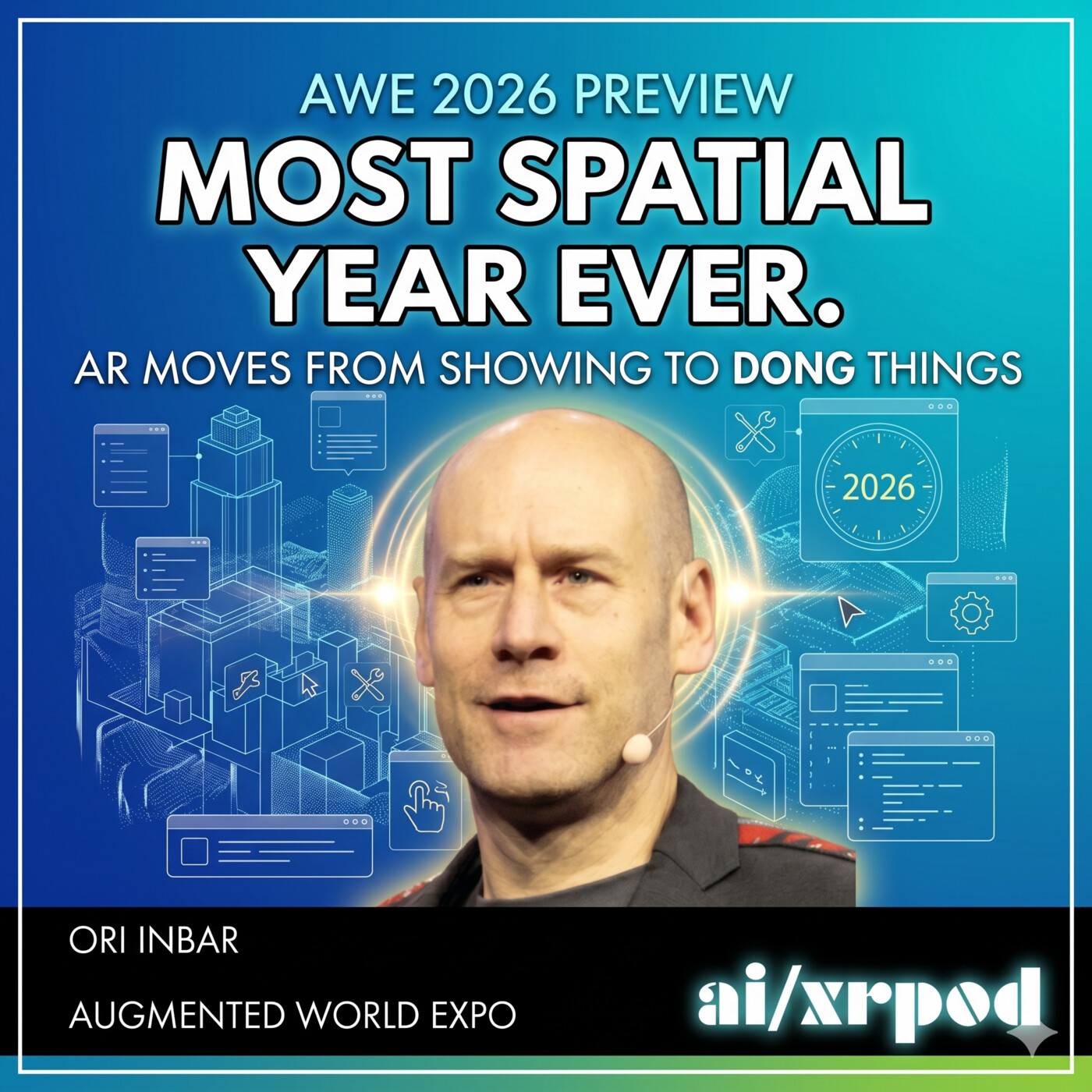
AWE 2026 Preview: The “Most Spatial Year Ever.” AR Moves From Showing to Doing Things — Ori Inbar
Description
Seventeen years into building the world's largest XR conference, Ori Inbar is not prone to hyperbole. He has watched hype cycles inflate and collapse, made predictions that turned out too optimistic, and learned to hold claims carefully. That is what makes his framing of AWE 2026 worth paying attention to: he calls it the most consequential year in the show's history. Not because everything is working — there have been heartbreaking layoffs in some corners of the industry — but because the convergence happening right now between AI and spatial computing is unlike anything the field has seen before.
Before Ori joins, the hosts wade through a week of signal and noise. Three big IPOs — Cerebras, Quantium, and others — are absorbing investor attention, with Quantium carrying a $15 billion market cap on what Charlie calls "de minimis revenue," raising questions about whether the quantum AI bandwagon has lapped actual quantum utility. Rony poses the challenge directly: what is the real use case for quantum computing besides breaking encryption?
Ted and Rony unpack qubits, superposition, and state-based computing in plain language, with Rony floating the multiverse analogy and the idea that neurons themselves might function as tiny quantum computers. Ted points to Cleveland Clinic's work with IBM as a concrete near-term example. Elsewhere: Anthropic has announced it is close to recursive self-improving AI — which, as Charlie notes, is the textbook definition of AGI. Apple's WWDC is around the corner, promising a Siri overhaul, a folding iPhone, and — per a Rony tease — a secret wearable project he can say almost nothing about.
Google's new Dream Beans app indexes all your files and reads your emails for $70 extra on top of YouTube Premium; Ted cuts through it simply: "It's an ad play." Suno is raising $400 million at a $5.4 billion valuation while still being sued for training on copyrighted music — Rony's investor thesis frames it as AI-generated sound engineered to trigger neurologic adrenaline hits, an addiction feedback loop he calls "musical crack." And Fox is reformatting "Farmer Wants a Wife" into 101 vertical two-minute episodes — Charlie's read is that this may be the moment when video content permanently shifts from advertising-supported to direct-to-consumer.
When Ori arrives, the conversation opens on Snap. Evan Spiegel is expected to make a major consumer announcement at AWE — Ori says Snap has put all their eggs in this basket, and the audience at the show will be the first to see it. Ted frames the stakes plainly: if the price shocks people, it's a consumer breakthrough; if it's expensive and exotic, it stays in the science column. Snap recently acquired Illumix, a spatial universe understanding startup, a move that signals the company is building seriously in this space.
More broadly, Meta's retreat from the metaverse has acted as a talent accelerant — hundreds of experienced XR engineers are now building independently, and the resulting Cambrian explosion of content for both AI glasses and AR glasses is just beginning. Ori points to Supernatural spinning off from Meta at a fraction of what the company paid for it as a symbol of a broader reset: the talent is free, the tools are ready, and the content is coming.
The tools argument extends to development itself. Ori built a working AR prototype — he describes it as a "chat with animals" experience — in two days using Gemini in the backend. Vibe coding for spatial computing is no longer theoretical. Unity has added it. Google is building game worlds by prompting them into existence. Ted's broader thesis: AI has learned from game engines well enough that it may not need them for 90% of use cases — a provocative observation for an industry built on Unity and Unreal.
AWE's show floor this year reflects how much is happening at once: 250 exhibitors, a ded