Episode Details
Back to Episodes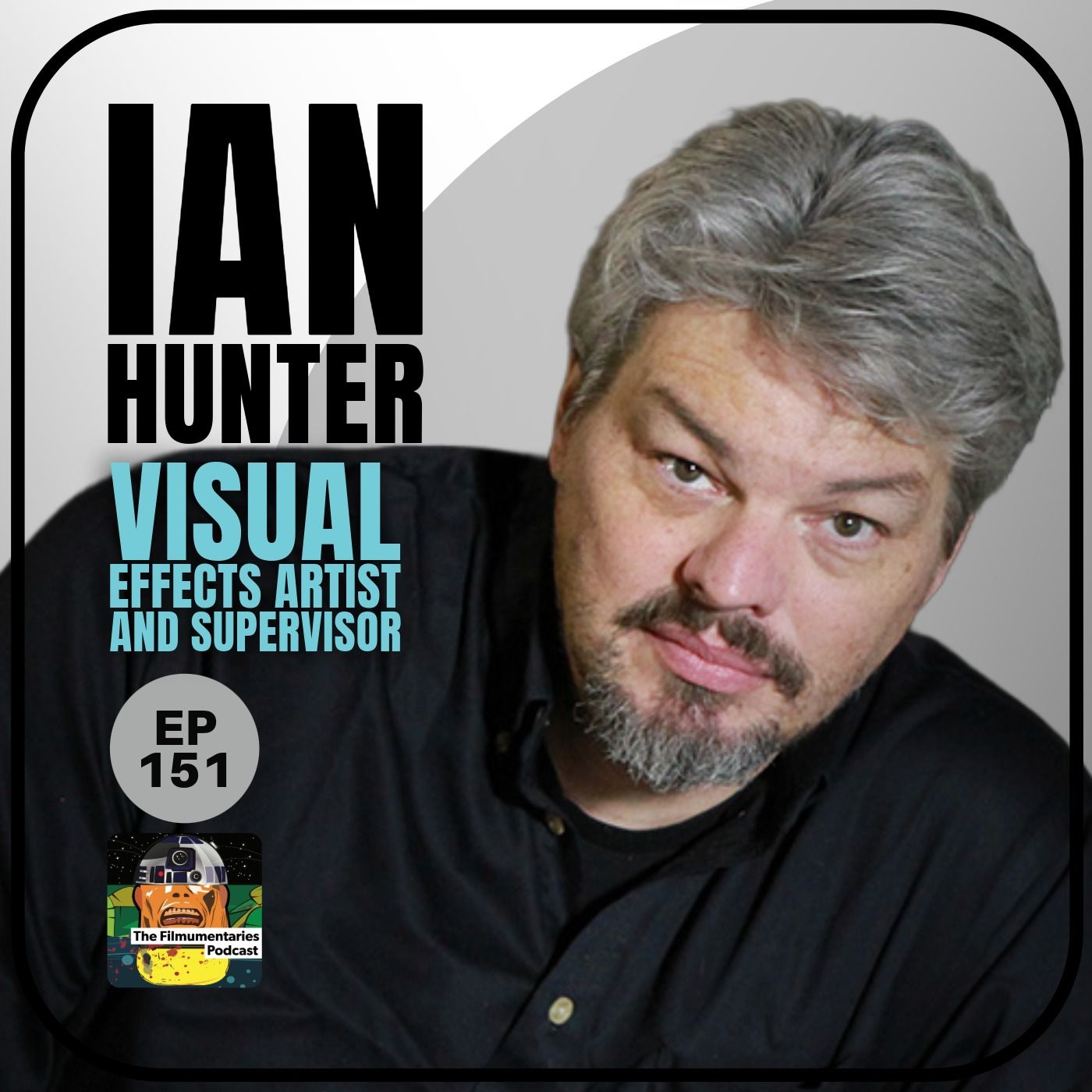
Ep 151 | Ian Hunter - VFX Supervisor on Cameron, Burton and more
Season 1
Episode 151
Published 3 months, 1 week ago
Description
Ian Hunter has spent four decades building miniatures, supervising visual effects and thinking like a filmmaker on some of the most demanding productions in Hollywood. In this episode, he traces a career that began in a garden shed with a punched-up piece of German black velvet and ended up — via James Cameron, Tim Burton, the Coen Brothers, and Christopher Nolan — on some of the most iconic screens in the world.
Ian grew up surrounded by art. His father painted oils and acrylics, played music and did pastel portraits, and encouraged his three sons to make things — even when those things destroyed the materials he'd given them. The moment that really clicked, Ian recalls, was being handed a model kit as a kid and taking to it immediately. That creative instinct only grew stronger. In high school, he and his brothers were making Super 8 films, scratching laser effects onto the film with a pin and blowing up overloaded resistors for explosions. One of those films required them to fake-rob a local bank — and the encounter that followed, with the surprisingly enthusiastic vice president of the Monrovia Wells Fargo, led to a meeting with the mother of Rick Baker, whose work Ian had recently encountered in a traveling special effects exhibition and been completely floored by.
After drifting away from an aerospace course at Cal Poly Pomona and working in an acid bath plastics factory, Ian answered a classified ad looking for model makers — and on the strength of a modest portfolio, was hired the same day. His first feature was The Abyss. He and fellow model maker Jim McGee built the flooded engine room of the Montana submarine with almost no direction beyond James Cameron's bare-bones description, and shipped it to South Carolina having never seen a frame of the live action. The production was not without its disasters — Ian found himself entangled in the notorious wax crane fiasco, and talks about the valuable early lesson of knowing when to call something out before it goes wrong.
From there, a friend pointed him toward Boss Film, Richard Edlund's company in Marina del Rey, where a chance encounter with departing model supervisor Mark Stetson changed everything. What was supposed to be a one-week favour on a music video turned into six years. Working with Stetson took Ian from being a junior model maker building things in isolation to visiting sets, talking directly with directors, and understanding that miniature work only succeeds when it becomes invisible — just more shots in a movie, telling the story rather than showing off the technique.
Among the projects from that period, Ian talks at length about Total Recall — including the behind-the-scenes chaos of a scale miscommunication on the final day of shooting, a scene involving a little person that nobody had accounted for, and the moment he glued a Coke can to a model building because they were running out of time. That Coke can, dressed up and shot from the front, made it into the finished film. So did one in Waterworld. And Inception. And Interstellar. And, after the story apparently got around, director Fede Álvarez greeted Ian on Alien: Romulus by asking exactly where he was planning to hide it.
Ian built the suburb for Edward Scissorhands — deliberately making it more bland and mundane than real life — and talks about one of his proudest in-camera shots: the final view through the bedroom window and out over the snow-dusted neighbourhood, achieved with a 1:24 scale model and real snow shakers on the night. On Batman Returns he built the Penguin's zoo, and describes receiving one of his all-time favourite compliments from Tim Burton — who, after watching a pyrotechnics test, asked simply: "Where did you shoot this?" Not realising he was looking at a miniature. The zoo also gave Ian one of his best examples of a happy accident: a polar bear sculpture that was supposed to explode but instead toppled slowly sideways with
Ian grew up surrounded by art. His father painted oils and acrylics, played music and did pastel portraits, and encouraged his three sons to make things — even when those things destroyed the materials he'd given them. The moment that really clicked, Ian recalls, was being handed a model kit as a kid and taking to it immediately. That creative instinct only grew stronger. In high school, he and his brothers were making Super 8 films, scratching laser effects onto the film with a pin and blowing up overloaded resistors for explosions. One of those films required them to fake-rob a local bank — and the encounter that followed, with the surprisingly enthusiastic vice president of the Monrovia Wells Fargo, led to a meeting with the mother of Rick Baker, whose work Ian had recently encountered in a traveling special effects exhibition and been completely floored by.
After drifting away from an aerospace course at Cal Poly Pomona and working in an acid bath plastics factory, Ian answered a classified ad looking for model makers — and on the strength of a modest portfolio, was hired the same day. His first feature was The Abyss. He and fellow model maker Jim McGee built the flooded engine room of the Montana submarine with almost no direction beyond James Cameron's bare-bones description, and shipped it to South Carolina having never seen a frame of the live action. The production was not without its disasters — Ian found himself entangled in the notorious wax crane fiasco, and talks about the valuable early lesson of knowing when to call something out before it goes wrong.
From there, a friend pointed him toward Boss Film, Richard Edlund's company in Marina del Rey, where a chance encounter with departing model supervisor Mark Stetson changed everything. What was supposed to be a one-week favour on a music video turned into six years. Working with Stetson took Ian from being a junior model maker building things in isolation to visiting sets, talking directly with directors, and understanding that miniature work only succeeds when it becomes invisible — just more shots in a movie, telling the story rather than showing off the technique.
Among the projects from that period, Ian talks at length about Total Recall — including the behind-the-scenes chaos of a scale miscommunication on the final day of shooting, a scene involving a little person that nobody had accounted for, and the moment he glued a Coke can to a model building because they were running out of time. That Coke can, dressed up and shot from the front, made it into the finished film. So did one in Waterworld. And Inception. And Interstellar. And, after the story apparently got around, director Fede Álvarez greeted Ian on Alien: Romulus by asking exactly where he was planning to hide it.
Ian built the suburb for Edward Scissorhands — deliberately making it more bland and mundane than real life — and talks about one of his proudest in-camera shots: the final view through the bedroom window and out over the snow-dusted neighbourhood, achieved with a 1:24 scale model and real snow shakers on the night. On Batman Returns he built the Penguin's zoo, and describes receiving one of his all-time favourite compliments from Tim Burton — who, after watching a pyrotechnics test, asked simply: "Where did you shoot this?" Not realising he was looking at a miniature. The zoo also gave Ian one of his best examples of a happy accident: a polar bear sculpture that was supposed to explode but instead toppled slowly sideways with