Episode Details
Back to Episodes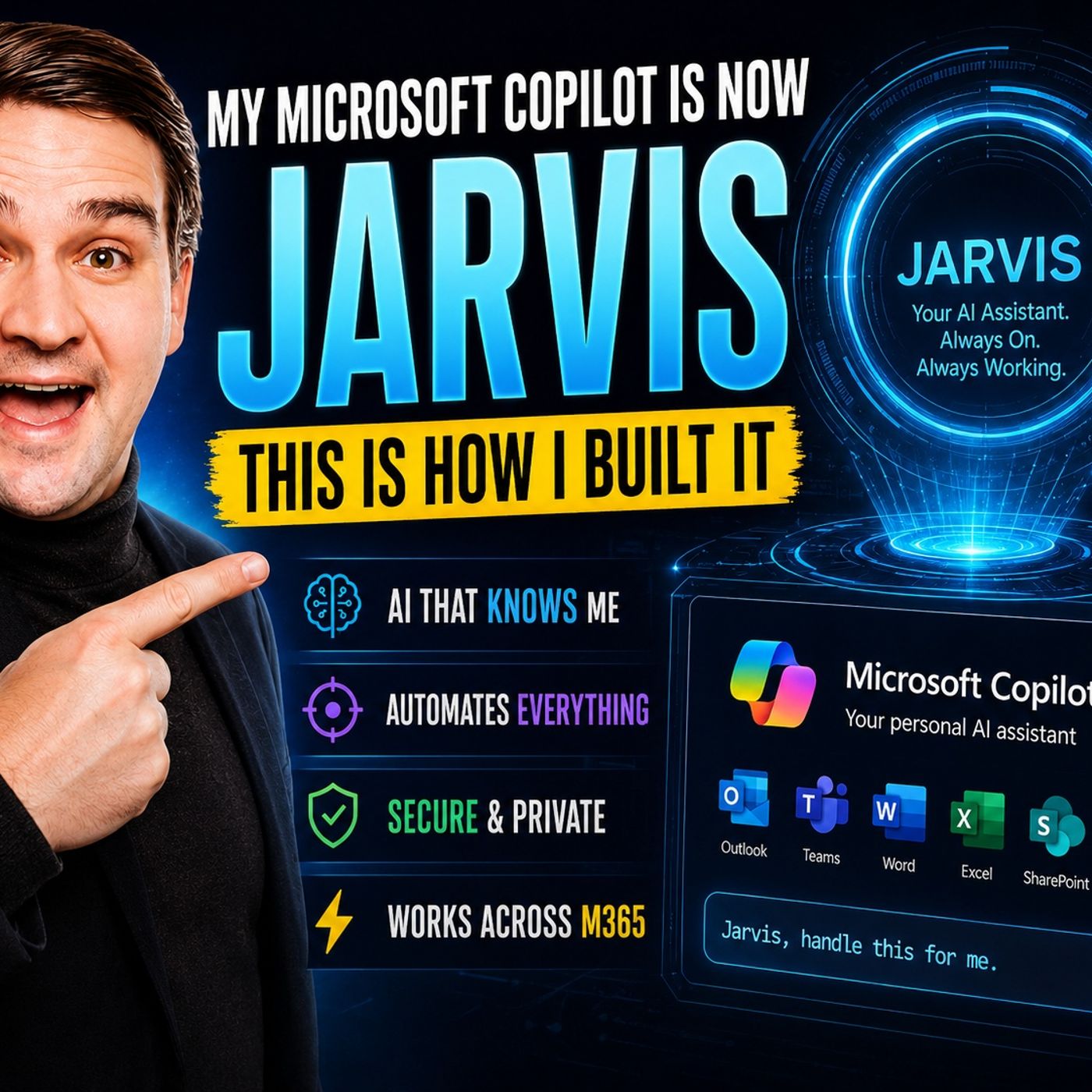
My Microsoft Copilot is now JARVIS: This is how I built it
Season 2
Published 2 months ago
Description
Most people are using Microsoft Copilot completely wrong.They treat it as a smarter search engine, a better chatbot, or a productivity feature tucked away inside Outlook, Teams, or Word. They ask a question, get an answer, and move on to the next task.But that's not JARVIS.In this episode of M365 FM, Mirko Peters explores how Microsoft Copilot can evolve from a reactive assistant into a true operating system for work. Instead of simply responding to prompts, JARVIS combines memory, reasoning, orchestration, governance, and automation to create an AI system that understands how you work, remembers what matters, and proactively helps you get things done.The future of AI isn't better prompts.The future is architecture.
WHY COPILOT FAILS AT AGENCY
The biggest limitation of most AI systems isn't intelligence. It's memory.Every new chat starts from zero. The system doesn't remember your decisions, your communication style, your business priorities, or the lessons learned from previous projects. This forces users to repeatedly provide context and creates AI experiences that remain generic and reactive.Mirko explains why context windows are not memory, why chat interfaces are not workflows, and why true agency requires persistence, structure, and orchestration.Key concepts include:
JARVIS is not a new AI model.It's an architectural pattern built on top of Microsoft Copilot that transforms AI from a tool into a system.The model consists of four foundational layers that work together to create agency, decision-making, and orchestration across Microsoft 365 and beyond.The four layers include:
COPILOT COWORK AND THE EXECUTION LAYER
Microsoft's new Copilot Cowork capabilities fundamentally change how work gets executed.Rather than drafting content and waiting for manual action, Cowork orchestrates multi-step processes across Microsoft 365 applications. It can summarize meetings, draft communications, create presentations, schedule follow-ups, update systems, and coordinate workflows from a single goal.This episode explores how orchestration differs from assistance and why execution is the missing ingredient in most AI deployments.Topics covered include:
Traditional workflows follow predefined paths.Agent Flows introduce reasoning.Built on Power Automate and powered by Large Language Models, Agent Flows enable systems to evaluate context, identify exceptions, apply business rules, and choose the best path forward dynamically.Mirko explains how organizations can move beyond rigid automation and build systems capable of handling ambiguity, escalation paths, stakeholder sensitivity, compliance requirements, and real-world complexity.This is where
WHY COPILOT FAILS AT AGENCY
The biggest limitation of most AI systems isn't intelligence. It's memory.Every new chat starts from zero. The system doesn't remember your decisions, your communication style, your business priorities, or the lessons learned from previous projects. This forces users to repeatedly provide context and creates AI experiences that remain generic and reactive.Mirko explains why context windows are not memory, why chat interfaces are not workflows, and why true agency requires persistence, structure, and orchestration.Key concepts include:
- Context vs Memory
- Reactive vs Proactive AI
- Copilot as a Feature vs Copilot as a Platform
- The Architecture Gap
JARVIS is not a new AI model.It's an architectural pattern built on top of Microsoft Copilot that transforms AI from a tool into a system.The model consists of four foundational layers that work together to create agency, decision-making, and orchestration across Microsoft 365 and beyond.The four layers include:
- Memory
- Action
- Reasoning
- Governance
COPILOT COWORK AND THE EXECUTION LAYER
Microsoft's new Copilot Cowork capabilities fundamentally change how work gets executed.Rather than drafting content and waiting for manual action, Cowork orchestrates multi-step processes across Microsoft 365 applications. It can summarize meetings, draft communications, create presentations, schedule follow-ups, update systems, and coordinate workflows from a single goal.This episode explores how orchestration differs from assistance and why execution is the missing ingredient in most AI deployments.Topics covered include:
- Copilot Cowork
- Multi-Step Orchestration
- Microsoft Graph
- Human Approval Gates
- Enterprise Automation
Traditional workflows follow predefined paths.Agent Flows introduce reasoning.Built on Power Automate and powered by Large Language Models, Agent Flows enable systems to evaluate context, identify exceptions, apply business rules, and choose the best path forward dynamically.Mirko explains how organizations can move beyond rigid automation and build systems capable of handling ambiguity, escalation paths, stakeholder sensitivity, compliance requirements, and real-world complexity.This is where