Episode Details
Back to Episodes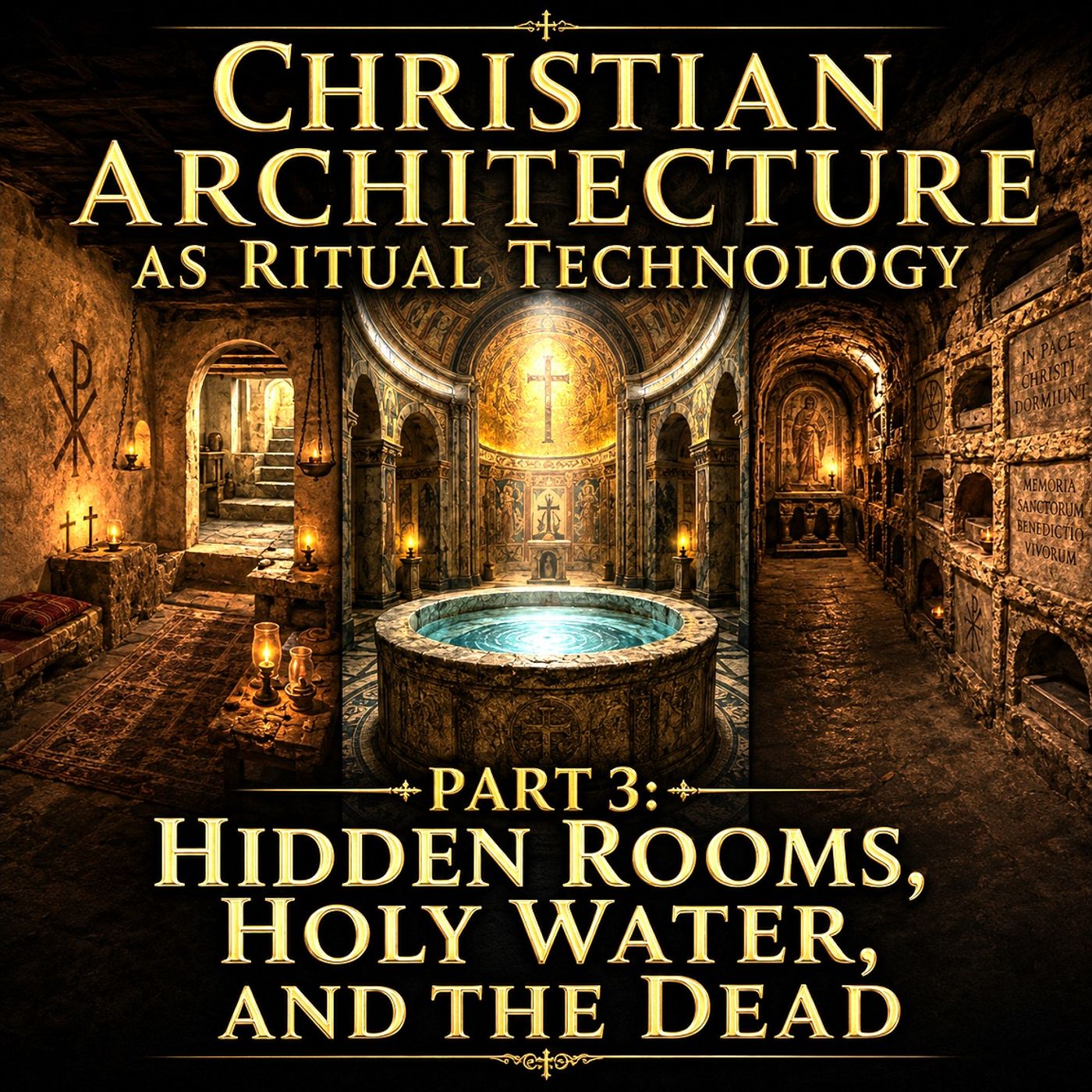
Christian Architecture As Ritual Technology Part 3- Hidden Rooms, Holy Water, & The Dead
Published 4 months, 3 weeks ago
Description
If you enjoy this episode, we’re sure you will enjoy more content like this on The Occult Rejects. In fact, we have curated playlists on occult topics like grimoires, esoteric concepts and phenomena, occult history, analyzing true crime and cults with an occult lens, Para politics, and occultism in music. Whether you enjoy consuming your content visually or via audio, we’ve got you covered - and it will always be provided free of charge. So, if you enjoy what we do and want to support our work of providing accessible, free content on various platforms, please consider making a donation to the links provided below.
Thank you and enjoy the episode!
Links For The Occult Rejects
https://linktr.ee/theoccultrejects
Occult Research Institute
https://www.occultresearchinstitute.org/
Substack
https://substack.com/@theoccultrejects?r=7auau0&utm_campaign=profile&utm_medium=profile-page
Cash App
https://cash.app/$theoccultrejects
Venmo
@TheOccultRejects
Buy Me A Coffee
buymeacoffee.com/TheOccultRejects
Patreon
https://www.patreon.com/TheOccultRejects
BIBLIOGRAPHY
Hidden Rooms, Holy Water, and the Dead
White, L. Michael. The Social Origins of Christian Architecture, Volume I: Building God’s House in the Roman World: Architectural Adaptation Among Pagans, Jews, and Christians. Trinity Press International, 1996.
Key use: Essential source for early Christian architectural adaptation, especially the shift from domestic and semi-domestic gathering spaces toward more specialized Christian buildings. White’s work is useful for showing that early Christian architecture develops inside a broader Roman social and architectural world, not in isolation.
White, L. Michael. The Social Origins of Christian Architecture, Volume II: Texts and Monuments for the Christian Domus Ecclesiae in Its Environment. Trinity Press International, 1997.
Key use: Companion volume for the textual and archaeological evidence behind the domus ecclesiae, early meeting spaces, and the built environment of pre-Constantinian Christianity.
Yale University Art Gallery. “Christian Building.” Dura-Europos: Excavating Antiquity.
Key use: Strong anchor for the Dura-Europos Christian building and its wall paintings. Yale notes that the Christian paintings were uncovered in 1932 and that Clark Hopkins described the murals as preserved from more than three-quarters of a century before Constantine recognized Christianity in 312.
Yale News. “House Call: A New Study Rethinks Early Christian Landmark.” 2024.
Key use: Useful cautionary source for not oversimplifying Dura-Europos as merely a domestic “house church.” The report highlights recent scholarship reexamining how domestic the Dura Christian building really was and why its architectural classification needs care.
Smarthistory. “Dura-Europos.”
Key use: Accessible overview of Dura-Europos as a multicultural Roman frontier site, including the adapted Christian building used as a meeting place and baptistery in the first half of the third century.
Peppard, Michael. The World’s Oldest Church: Bible, Art, and Ritual at Dura-Europos, Syria. Yale University Press, 2016.
Key use: Major source for the Dura-Europos Christian building, its baptistery, biblical imagery, ritual use, and the danger of reading the site too simply through later church categories.
Snyder, Graydon F. Ante Pacem: Archaeological Evidence of Church Life Before Constantine. Mercer University Press, revised edition, 2003.
Key use: Important archaeological source for Christian life before Constantine, especially material evidence for worship, burial, symbols, and everyday Christian practice before public imperial privilege. Mercer University Press identifies the book as focused on archaeological evidence of church life before Constantine.
Thank you and enjoy the episode!
Links For The Occult Rejects
https://linktr.ee/theoccultrejects
Occult Research Institute
https://www.occultresearchinstitute.org/
Substack
https://substack.com/@theoccultrejects?r=7auau0&utm_campaign=profile&utm_medium=profile-page
Cash App
https://cash.app/$theoccultrejects
Venmo
@TheOccultRejects
Buy Me A Coffee
buymeacoffee.com/TheOccultRejects
Patreon
https://www.patreon.com/TheOccultRejects
BIBLIOGRAPHY
Hidden Rooms, Holy Water, and the Dead
White, L. Michael. The Social Origins of Christian Architecture, Volume I: Building God’s House in the Roman World: Architectural Adaptation Among Pagans, Jews, and Christians. Trinity Press International, 1996.
Key use: Essential source for early Christian architectural adaptation, especially the shift from domestic and semi-domestic gathering spaces toward more specialized Christian buildings. White’s work is useful for showing that early Christian architecture develops inside a broader Roman social and architectural world, not in isolation.
White, L. Michael. The Social Origins of Christian Architecture, Volume II: Texts and Monuments for the Christian Domus Ecclesiae in Its Environment. Trinity Press International, 1997.
Key use: Companion volume for the textual and archaeological evidence behind the domus ecclesiae, early meeting spaces, and the built environment of pre-Constantinian Christianity.
Yale University Art Gallery. “Christian Building.” Dura-Europos: Excavating Antiquity.
Key use: Strong anchor for the Dura-Europos Christian building and its wall paintings. Yale notes that the Christian paintings were uncovered in 1932 and that Clark Hopkins described the murals as preserved from more than three-quarters of a century before Constantine recognized Christianity in 312.
Yale News. “House Call: A New Study Rethinks Early Christian Landmark.” 2024.
Key use: Useful cautionary source for not oversimplifying Dura-Europos as merely a domestic “house church.” The report highlights recent scholarship reexamining how domestic the Dura Christian building really was and why its architectural classification needs care.
Smarthistory. “Dura-Europos.”
Key use: Accessible overview of Dura-Europos as a multicultural Roman frontier site, including the adapted Christian building used as a meeting place and baptistery in the first half of the third century.
Peppard, Michael. The World’s Oldest Church: Bible, Art, and Ritual at Dura-Europos, Syria. Yale University Press, 2016.
Key use: Major source for the Dura-Europos Christian building, its baptistery, biblical imagery, ritual use, and the danger of reading the site too simply through later church categories.
Snyder, Graydon F. Ante Pacem: Archaeological Evidence of Church Life Before Constantine. Mercer University Press, revised edition, 2003.
Key use: Important archaeological source for Christian life before Constantine, especially material evidence for worship, burial, symbols, and everyday Christian practice before public imperial privilege. Mercer University Press identifies the book as focused on archaeological evidence of church life before Constantine.
Listen Now
Love PodBriefly?
If you like Podbriefly.com, please consider donating to support the ongoing development.
Support Us