Episode Details
Back to Episodes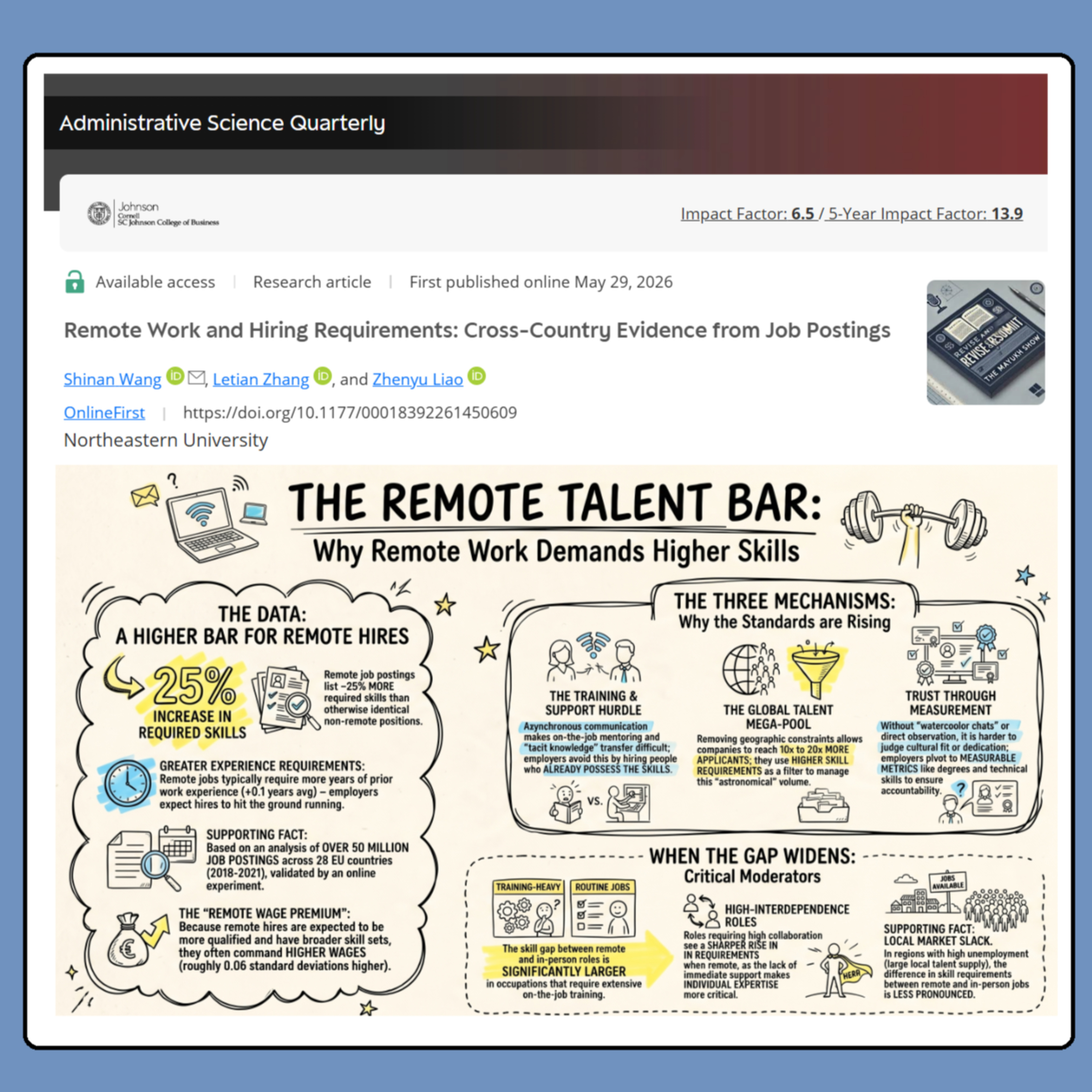
Remote Work and Hiring Requirements (Wang et al 2026) | FT50 ASQ
Description
English Podcast Starts at 00:00:00
Bengali Podcast Starts at 00:49:24
Hindi Podcast Starts at 01:08:26
Danish Podcast Starts at 01:21:52
Reference
Wang, S., Zhang, L., & Liao, Z. (2026). Remote Work and Hiring Requirements: Cross-Country Evidence from Job Postings. Administrative Science Quarterly. https://doi.org/10.1177/00018392261450609
Youtube Channel
https://www.youtube.com/@weekendresearcher
Podcast Website
https://mayukhmukhopadhyay.com/reviseandresubmit
Academy of Management PDW on Space Economy Registration Flyer
https://cto.aom.org/discussion/flagship-aom-2026-pdw-space-economy-consolidating-a-research-agenda-8
🎙️✨ Welcome to Revise and Resubmit.
There was a time when remote work sounded like liberation. 🌍💻
No traffic jams. No fluorescent office lights. No manager watching the clock from across the room. Just a laptop, an internet connection, and the quiet promise that work could finally fit around life instead of the other way around.
But every revolution leaves behind a different kind of pressure.
Today’s episode explores the fascinating new paper “Remote Work and Hiring Requirements: Cross-Country Evidence from Job Postings,” written by Shinan Wang, Letian Zhang, and Zhenyu Liao, published online on 29 May 2026 in Administrative Science Quarterly 📚🏛️, one of the world’s most prestigious FT50 journals.
The researchers analyzed more than 50 million job postings across 28 European countries. And hidden inside that mountain of data was a troubling shift in the modern labor market.
Remote jobs increasingly ask for more.
More skills. More qualifications. More experience.
According to the study, remote positions often require nearly 25% more skills than comparable in-person jobs. Why? Because remote work changes how organizations trust people.
When employees are physically distant, training becomes harder. Informal learning disappears. Managers cannot simply walk across the office to solve confusion in real time. At the same time, companies suddenly receive applications from an enormous global talent pool, allowing them to become more selective than ever before. 📈
And so hiring changes.
Employers begin relying heavily on measurable signals like certifications, technical expertise, and years of experience. Cultural fit and human chemistry slowly lose ground to metrics and keywords.
The résumé becomes a filter.
The worker becomes a checklist.
What makes this paper powerful is that it reveals something larger than remote work itself. It reveals how digital life quietly transforms human expectations. Flexibility sounds humane. But flexibility also creates competition on a scale previous generations never imagined.
The office may disappear.
But the pressure follows us home.
And maybe that leaves us with a difficult question tonight:
If remote work gives us freedom from physical offices, why does it also make workers feel they must become endlessly optimized just to belong? 🌌
🙏 Special thanks to Shinan Wang, Letian Zhang, Zhenyu Liao, and SAGE Publications for this outstanding contribution to scholarship in the prestigious FT50 journal Administrative Science Quarterly.
🎧 Subscribe to Revise and Resubmit on Spotify and follow the YouTube channel Weekend Researcher 🚀
Also available on Amazon Prime Music and Apple Podcast 🍎🎙️