Episode Details
Back to Episodes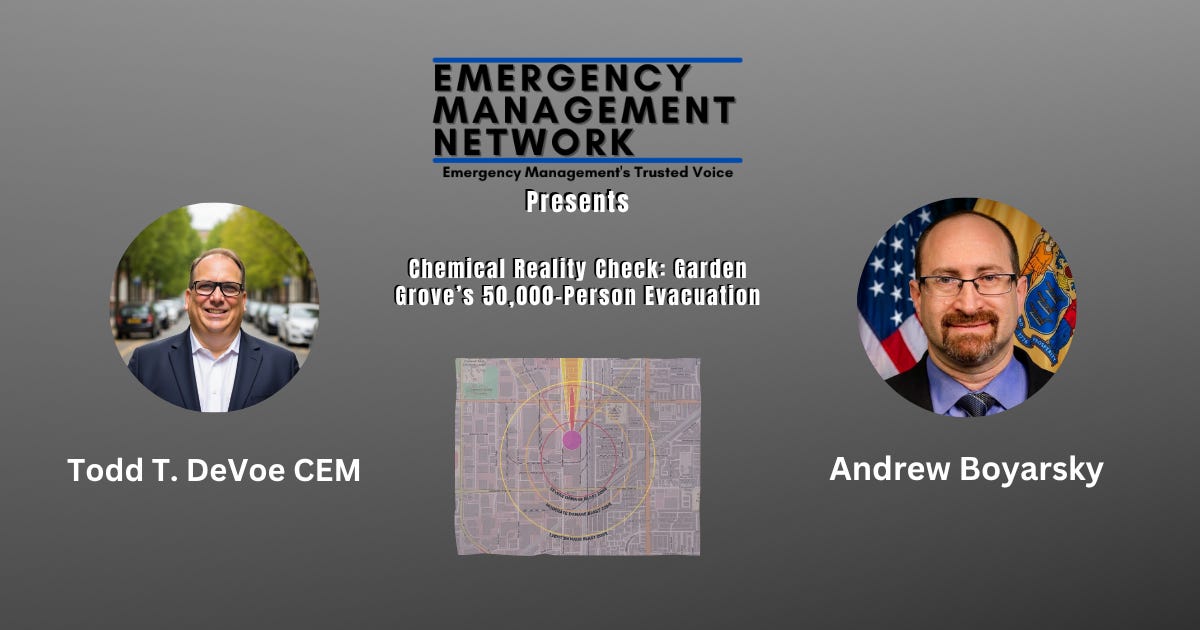
Chemical Reality Check: Garden Grove’s 50,000-Person Evacuation
Description
Episode Description
What happens when a single industrial chemical tank threatens an entire community?
In this episode of the Emergency Management Network Podcast, Todd DeVoe and Andrew Boyarsky examine the Garden Grove hazardous materials incident that led to the evacuation of approximately 50,000 residents and businesses. What began as a concern over an overheating tank containing methyl methacrylate (MMA) quickly escalated into one of Southern California’s most significant precautionary evacuations in recent memory.
Todd and Andrew break down the incident from an emergency management perspective, discussing the decision-making process behind large-scale evacuations, the challenges of public messaging during uncertain situations, and the realities of managing low-probability, high-consequence events. They also explore what this event reveals about industrial hazards in urban environments and how emergency managers can better prepare their communities for complex technological disasters.
This conversation is not about assigning blame. It is about understanding risk, learning from real-world events, and strengthening preparedness before the next incident occurs.
In This Episode
Understanding the Incident
* What happened in Garden Grove?
* The role of methyl methacrylate (MMA) and why it created concern.
* How emergency officials assessed the threat.
* Why was a precautionary evacuation ordered?
The Emergency Management Perspective
* Decision-making under uncertainty.
* Balancing public safety against disruption.
* The importance of situational awareness and intelligence gathering.
* Working with fire, law enforcement, public health, and industry partners.
Evacuating 50,000 People
* Challenges of moving large populations quickly.
* Traffic management and public compliance.
* Protecting vulnerable populations and special needs residents.
* Shelter and mass care considerations.
Public Information and Risk Communication
* Communicating complex hazards to the public.
* Managing rumors and misinformation.
* Building trust during rapidly evolving incidents.
* The role of social media and traditional media.
Lessons for Emergency Managers
* Planning for industrial and hazardous materials incidents.
* Reviewing evacuation zones and protective action strategies.
* Strengthening public-private partnerships.
* Incorporating technological hazards into emergency operations plans.
* Training for events that are unlikely but potentially catastrophic.
Looking Ahead
* What communities can learn from Garden Grove.
* Emerging risks associated with industrial facilities in urban areas.
* Building resilience through planning, exercises, and partnerships.
* Why preparedness remains a community-wide responsibility.
Key Takeaways
* Rare events still require planning.
* Protective actions must be based on available information, not perfect information.
* Effective risk communication can be as important as operational response.
* Strong relationships between emergency managers, fire agencies, law enforcement, and private industry are essential.
* The Garden Grove incident serves as a reminder that technological disasters can have community-wide consequences.
About the Hosts
Todd DeVoe, CEM, is the Editor-in-Chief of The Emergency Management Network, Emergency Management Coordinator for the City of Inglewood, educator, author, and IAEM-USA leader.
Andrew Boyarsky is a veteran emergency management professional and co-host of the EMN Podcast, bringing practical insight and operational experience to discussions on disaster preparedness, response, recovery, and resilience.
Tags
#EmergencyManagement #HazMat #GardenGrove #PublicSafety #Emerg