Episode Details
Back to Episodes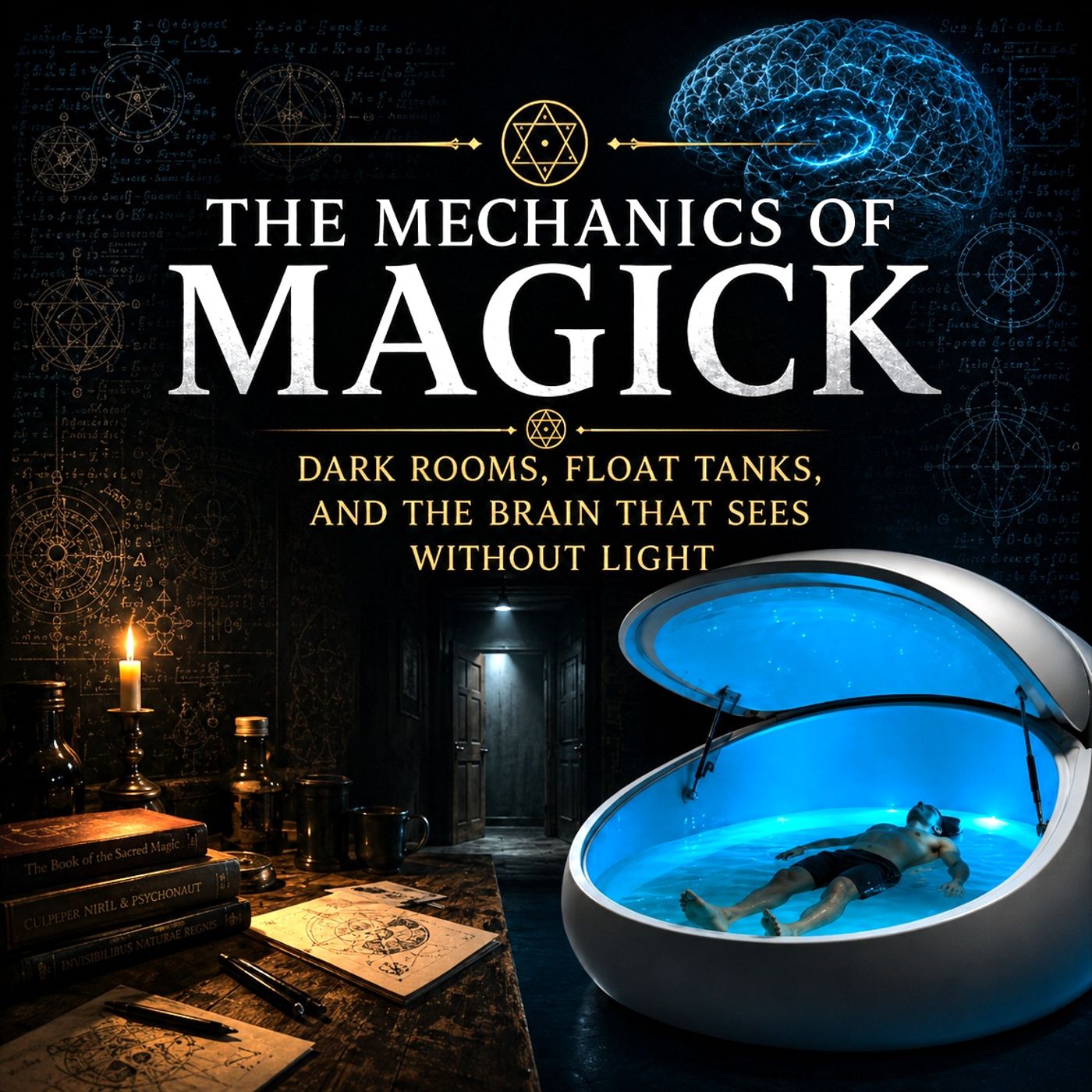
The Mechanics of Magick: Dark Rooms, Float Tanks, Initiation, and the Brain That Sees Without Light Part 1
Published 4 months, 3 weeks ago
Description
Links For The Occult Rejects
https://linktr.ee/theoccultrejects
Occult Research Institute
https://www.occultresearchinstitute.org/
Substack
https://substack.com/@theoccultrejects?r=7auau0&utm_campaign=profile&utm_medium=profile-page
Cash App
https://cash.app/$theoccultrejects
Venmo
@TheOccultRejects
Buy Me A Coffee
buymeacoffee.com/TheOccultRejects
Patreon
https://www.patreon.com/TheOccultRejects
Part 1: The Road of Rhythm
Part 1 focuses on the drum as an ancient technology of altered consciousness. The argument is not that every beat causes trance, or that neuroscience has proven spirits. The stronger argument is that rhythm enters the human organism through hearing, motor prediction, breath, movement, attention, emotion, expectation, culture, and social synchrony. The drum becomes powerful when sound, body, group, ritual frame, and meaning converge. These sources support the archaeology, neuroscience, EEG research, shamanic studies, possession studies, Indigenous and culturally specific drum traditions, ritual theory, placebo and meaning-response research, ceremonial magic, and modern witchcraft material used in the episode.
Core Academic and Scientific Sources
Huels, Emma R., Hyoungkyu Kim, UnCheol Lee, Tirsa Bel-Bahar, Ana V. Colmenero, Alexandra Nelson, Stefanie Blain-Moraes, George A. Mashour, and Richard E. Harris. “Neural Correlates of the Shamanic State of Consciousness.” Frontiers in Human Neuroscience 15 (2021): 610466.
Use for the strongest modern EEG anchor. This study used high-density EEG with shamanic practitioners and controls during rest, shamanic drumming, and classical music listening. It assessed altered-state reports alongside brain measures such as power, connectivity, signal diversity, and criticality. Use carefully: the study does not prove spirits or show that drumming mechanically causes trance in everyone. It supports the more careful claim that trained practitioners entering shamanic states with drumming show measurable brain-state differences.
Gordon, Yoel, Golan Karvat, Noa Dagan, and Ayelet N. Landau. “Neural Tracking at Theta Predicts Drumming-Induced Altered States of Consciousness.” Scientific Reports 16, no. 1 (2026): Article 10204.
Use for the strongest updated drumming/theta/neural-tracking source. This study tested drumming at theta, delta, and alpha-rate rhythms while recording EEG, and found that stronger rhythmic neural tracking at theta was linked to stronger altered-experience reports. Use carefully: this does not mean theta equals the spirit world or that one frequency opens a portal. The serious point is that altered experience may depend partly on how strongly the nervous system tracks rhythmic stimulation.
Aparicio-Terrés, R., et al. “The Neurobiology of Altered States of Consciousness Induced by Drumming and Other Rhythmic Sound Patterns.” Annals of the New York Academy of Sciences, 2025.
Use for the newer review literature showing that rhythmic sound is now a serious altered-consciousness research topic. This supports the opening claim that modern academia is examining drumming, rhythmic sound, absorption, relaxation, cognition, and neural activity without reducing the subject to one simple “trance frequency.” The review is especially useful for framing the field as promising but still complex.
Neher, Andrew. “Auditory Driving Observed with Scalp Electrodes in Normal Subjects.” Electroencephalography and Clinical Neurophysiology 13 (1961): 449–451.
Use for the historical bridge between repetitive sound, EEG, auditory driving, and early scientific interest in rhythmic stimulation.
Neher, Andrew. “A Physiological Explanation of Unusual Behavior in Ceremonies Involving Drums.” Human Biology 34, no. 2 (1962): 151–160.
Use carefully. This is useful as an early attempt to connect ceremonial drummin
https://linktr.ee/theoccultrejects
Occult Research Institute
https://www.occultresearchinstitute.org/
Substack
https://substack.com/@theoccultrejects?r=7auau0&utm_campaign=profile&utm_medium=profile-page
Cash App
https://cash.app/$theoccultrejects
Venmo
@TheOccultRejects
Buy Me A Coffee
buymeacoffee.com/TheOccultRejects
Patreon
https://www.patreon.com/TheOccultRejects
Part 1: The Road of Rhythm
Part 1 focuses on the drum as an ancient technology of altered consciousness. The argument is not that every beat causes trance, or that neuroscience has proven spirits. The stronger argument is that rhythm enters the human organism through hearing, motor prediction, breath, movement, attention, emotion, expectation, culture, and social synchrony. The drum becomes powerful when sound, body, group, ritual frame, and meaning converge. These sources support the archaeology, neuroscience, EEG research, shamanic studies, possession studies, Indigenous and culturally specific drum traditions, ritual theory, placebo and meaning-response research, ceremonial magic, and modern witchcraft material used in the episode.
Core Academic and Scientific Sources
Huels, Emma R., Hyoungkyu Kim, UnCheol Lee, Tirsa Bel-Bahar, Ana V. Colmenero, Alexandra Nelson, Stefanie Blain-Moraes, George A. Mashour, and Richard E. Harris. “Neural Correlates of the Shamanic State of Consciousness.” Frontiers in Human Neuroscience 15 (2021): 610466.
Use for the strongest modern EEG anchor. This study used high-density EEG with shamanic practitioners and controls during rest, shamanic drumming, and classical music listening. It assessed altered-state reports alongside brain measures such as power, connectivity, signal diversity, and criticality. Use carefully: the study does not prove spirits or show that drumming mechanically causes trance in everyone. It supports the more careful claim that trained practitioners entering shamanic states with drumming show measurable brain-state differences.
Gordon, Yoel, Golan Karvat, Noa Dagan, and Ayelet N. Landau. “Neural Tracking at Theta Predicts Drumming-Induced Altered States of Consciousness.” Scientific Reports 16, no. 1 (2026): Article 10204.
Use for the strongest updated drumming/theta/neural-tracking source. This study tested drumming at theta, delta, and alpha-rate rhythms while recording EEG, and found that stronger rhythmic neural tracking at theta was linked to stronger altered-experience reports. Use carefully: this does not mean theta equals the spirit world or that one frequency opens a portal. The serious point is that altered experience may depend partly on how strongly the nervous system tracks rhythmic stimulation.
Aparicio-Terrés, R., et al. “The Neurobiology of Altered States of Consciousness Induced by Drumming and Other Rhythmic Sound Patterns.” Annals of the New York Academy of Sciences, 2025.
Use for the newer review literature showing that rhythmic sound is now a serious altered-consciousness research topic. This supports the opening claim that modern academia is examining drumming, rhythmic sound, absorption, relaxation, cognition, and neural activity without reducing the subject to one simple “trance frequency.” The review is especially useful for framing the field as promising but still complex.
Neher, Andrew. “Auditory Driving Observed with Scalp Electrodes in Normal Subjects.” Electroencephalography and Clinical Neurophysiology 13 (1961): 449–451.
Use for the historical bridge between repetitive sound, EEG, auditory driving, and early scientific interest in rhythmic stimulation.
Neher, Andrew. “A Physiological Explanation of Unusual Behavior in Ceremonies Involving Drums.” Human Biology 34, no. 2 (1962): 151–160.
Use carefully. This is useful as an early attempt to connect ceremonial drummin